Alternate Futures: Five Modernist Landmarks Reimagined for the 21st Century
Modernism in architecture was perhaps the first truly global building design philosophy. Established at the beginning of the twentieth century, its early proponents were heavyweights from Europe, such as Le Corbusier, Walter Gropius, and Mies van der Rohe. In 1923, Le Corbusier published his seminal written work, usually translated into English as Towards a New Architecture. Newness, and a rejection of history, was one of the central tenets of modernism. This manifested itself in the use of new materials such as steel and concrete, which gave rise to an unprecedented freedom of formal expression.
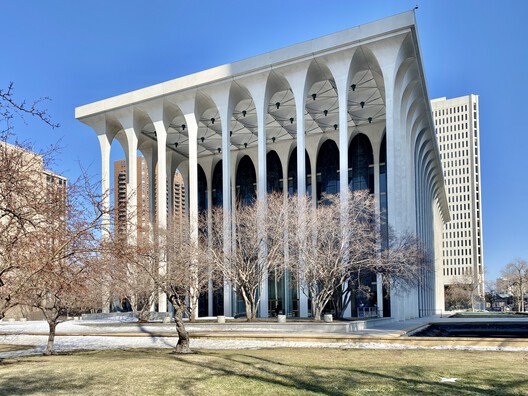
 Northwestern National Life Building / Minoru Yamasaki. Image © w_lemay via Wikimedia Commons Creative Commons Attribution-Share Alike 2.0
Modernism in architecture was perhaps the first truly global building design philosophy. Established at the beginning of the twentieth century, its early proponents were heavyweights from Europe, such as Le Corbusier, Walter Gropius, and Mies van der Rohe. In 1923, Le Corbusier published his seminal written work, usually translated into English as Towards a New Architecture. Newness, and a rejection of history, was one of the central tenets of modernism. This manifested itself in the use of new materials such as steel and concrete, which gave rise to an unprecedented freedom of formal expression.
By the middle of the twentieth century, Modernism was adopted across the world by countries recovering from the Second World War and overcoming the legacy of colonialism. It became the language of reconstruction and of nation-building, reinforced by its rejection of the past. Its emphasis on technology suited this brave new world of industry, large-scale development, and new building types. Fast-forwarding to a century after its birth, Modernism itself has become the legacy. As buildings progressively become obsolete or reach the end of their design lives, there is an appreciation of the heritage value of these structures, both as designed items and as symbols of the spirit of the age in which they were built. Here, we look at five Modernist buildings from five regions going through adaptive reuse proposals. Where form once followed function, here, the function must follow the form.