From the Archive: Designing This Washington State Home Was an Exercise in Scaling Down
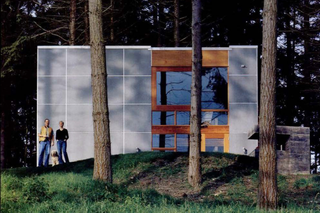
Homeowners Margo and Greg Plaunt originally had a 3,000-square-foot home in mind, but when their budget shifted, they pivoted to an 850-square-foot plan.
Homeowners Margo and Greg Plaunt originally had a 3,000-square-foot home in mind, but when their budget shifted, they pivoted to an 850-square-foot plan.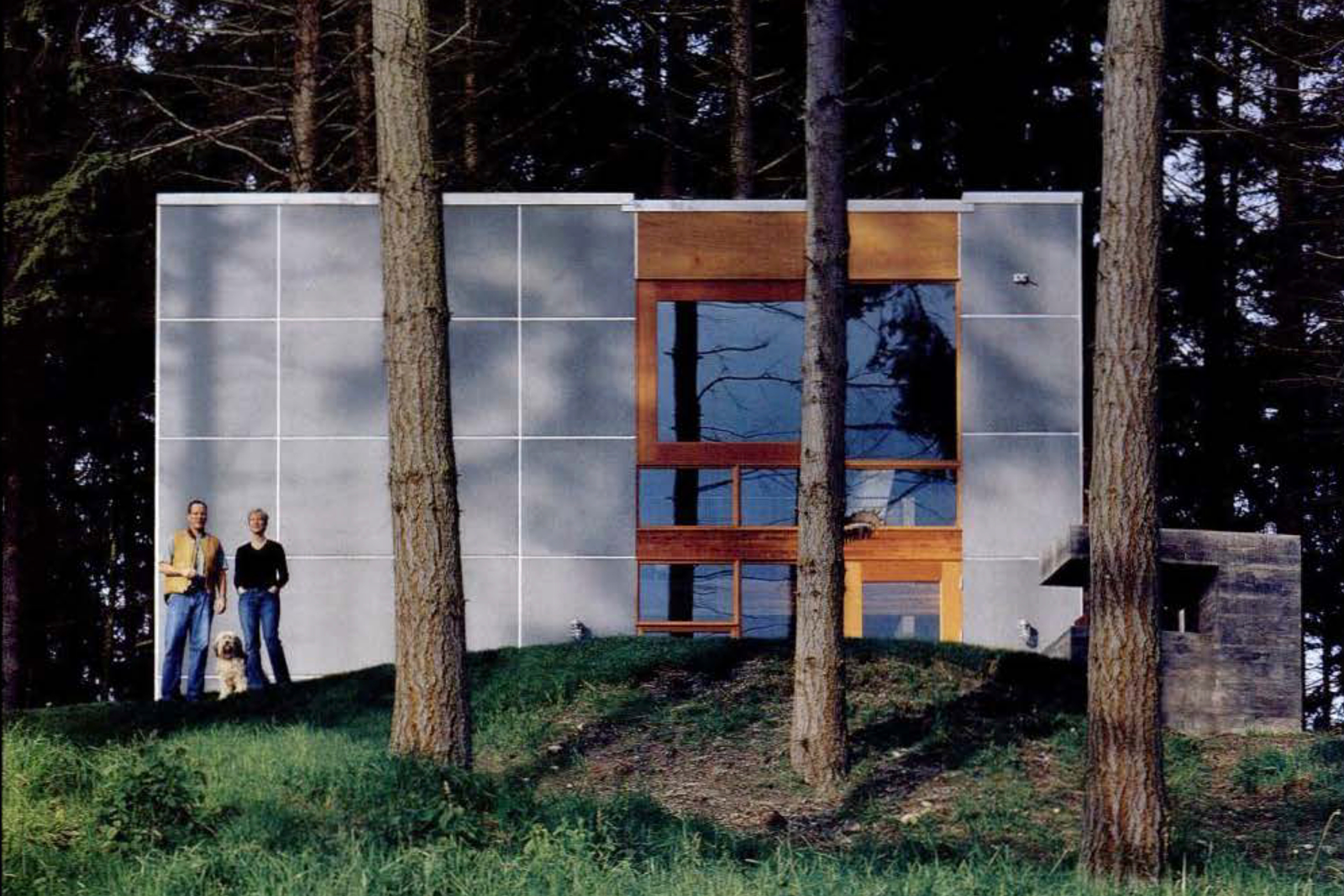
Welcome to From the Archive, a look back at stories from Dwell’s past. This story previously appeared in the July/August 2003 issue.
Five minutes after landing at the airport, I’m in a Seattle cliché: polar fleece, coffee, and a late-model Volkswagen. Chris Patano introduces me to the crowd in the car—his friend (and partner at the firm) Laura Hafermann, their friend Kevin Eckert, and Kevin’s friendly Labrador retriever, Daisy. We’re off to Whidbey Island, to tour the vacation house that Chris and Laura (as Patano Architects) designed, and Kevin (with partner Andrew van Leeuwen, as BuildLLC) built, for their mutual friends Greg and Margo Plaunt.
While Bainbridge Island is one of the most populous of Seattle’s commuter islands, Whidbey Island, about two hours by car and ferry northwest of the city, is the longest, with 148 miles of shoreline. From the interior, Whidbey feels like a Vermont lake town; a sparsely traveled highway wends through wooded marshlands dotted with farms and fraternal lodges. The Plaunts live near the middle of the island, not far from the eastern shore of south Whidbey, home to "artists, liberals, and wealthy retirees," according to Kevin.
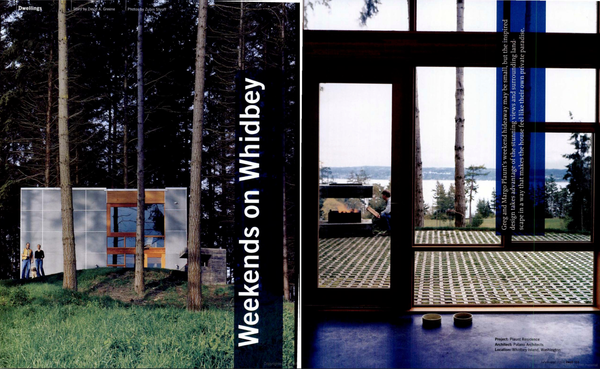
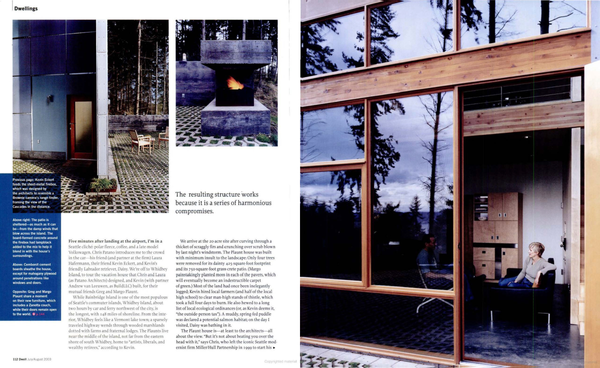
We arrive at the 20-acre site after curving through a thicket of scraggly firs and crunching over scrub blown by last night’s windstorm. The Plaunt house was built with minimum insult to the landscape: Only four trees were removed for its dainty 425-square foot footprint and its 750-square-foot grass-crete patio. (Margo painstakingly planted moss in each of the pavers, which will eventually become an indestructible carpet of green.) Most of the land had once been inelegantly logged; Kevin hired local farmers (and half of the local high school) to clear man-high stands of thistle, which took a full four days to burn. He also hewed to a long list of local ecological ordinances (or, as Kevin deems it, "the outside-person tax"). A muddy, spring-fed puddle was declared a potential salmon habitat; on the day I visited, Daisy was bathing in it.
The Plaunt house is—at least to the architects—all about the view. "But it’s not about beating you over the head with it," says Chris, who left the iconic Seattle modernist firm Miller/Hull Partnership in 1999 to start his own firm (Laura left Miller/Hull soon after to join him). They explain the view as a series of layers: the swale leading away from the house, now planted with native grasses; Camano Island just across Puget Sound’s narrow Saratoga Passage; and the snowcapped Cascade Range in the distance.
From inside, the view is framed by a 20-foot-tall wall of windows edged in vertical-grain fir. Downstairs, a small stand of firs fits perfectly in the tall lower panes; upstairs, a door-sized unit, installed sideways, frames the misty peak of Mt. Baker. To understand why the Plaunts didn’t insist on an imposing, single sheet of floor-to-ceiling glass, you have to understand Seattle, where views are the coin of the real estate realm. You also have to understand the Plaunts.
Fourteen years ago, Greg was an art-school graduate from Detroit who found himself parking cars for a living. He wrote a rudimentary computer program for his bosses, and realized that it beat standing outside in the Seattle wet. His company now provides software to the insurance industry. "And this," Greg says, gesturing to his million-dollar view, "is one of the things I got in return."
When discussing the Whidbey site, the Plaunts speak of "the house" as one would a dear, departed relative. They refer not to this house but to the 3,000-square-foot structure originally planned for the land, a vertically oriented showplace with an even more commanding easterly view. But when the dot-com economy foundered—leaving Seattle feeling like a playground after recess—the Plaunts were forced to scale back.
With their grand plans on hold, the Plaunts wanted to "get to know the land." Soon after, however, they just wanted to get the hell out of the 119-square-foot shed Greg had built that served as the property’s only shelter. "I was tired of having to go to the state park to use the bathroom," recalls Margo.
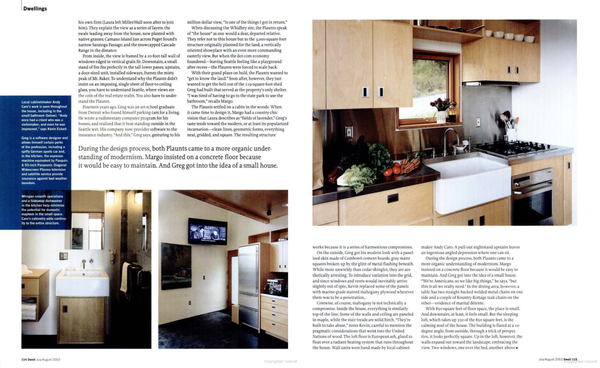
The Plaunts settled on a cabin in the woods. When it came time to design it, Margo had a country-chic vision that Laura describes as "fields of lavender." Greg’s taste tends toward the modern, or at least its popularized incarnation—clean lines, geometric forms, everything neat, gridded, and square. The resulting structure works because it is a series of harmonious compromises.
See the full story on Dwell.com: From the Archive: Designing This Washington State Home Was an Exercise in Scaling Down
Related stories: