From the Archive: Landscape Architect James Rose’s New Jersey Home Was Both Beautiful and Rebellious
Disturbed by the separation between the average American house and its lawn, Rose crafted an unconventional space that dissolved the boundary between interior and exterior.
Disturbed by the separation between the average American house and its lawn, Rose crafted an unconventional space that dissolved the boundary between interior and exterior.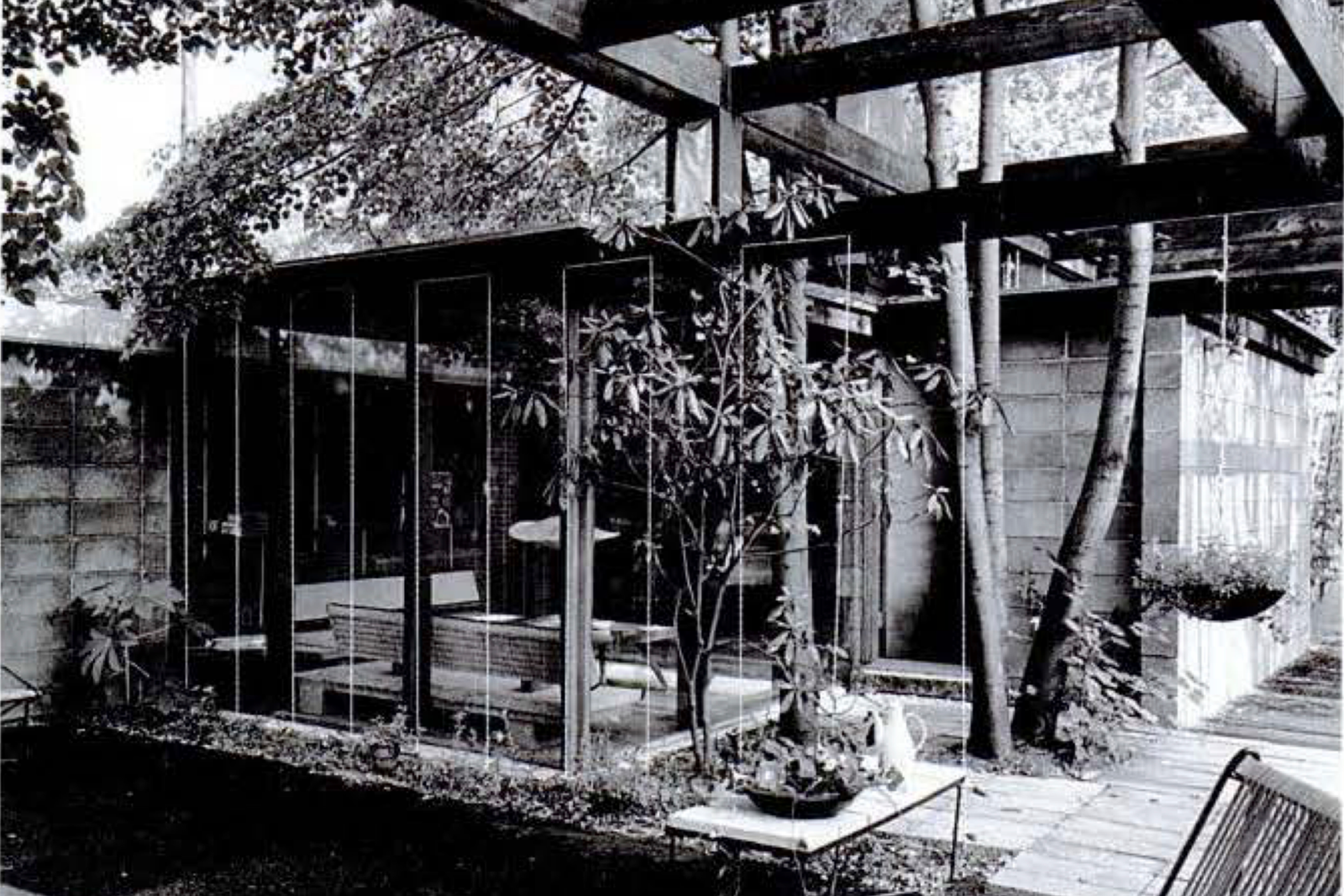
Welcome to From the Archive, a look back at stories from Dwell’s past. This story previously appeared in the October 2006 issue.
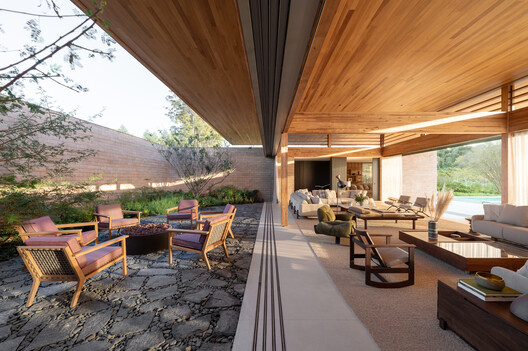
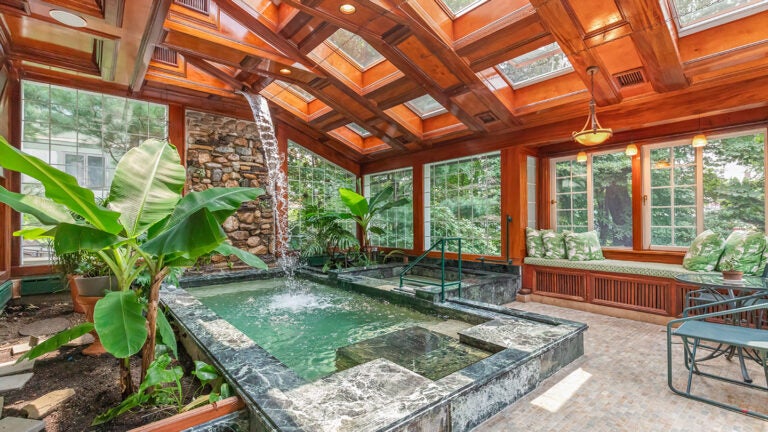
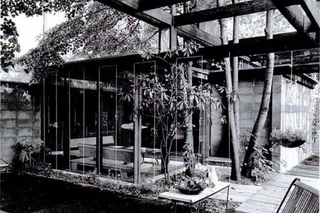
Approaching the door of the James Rose house on a corner lot in Ridgewood, New Jersey, you are not greeted by the typical velvety emerald lawn or picture windows politely set back from the street. After locating the entrance of the cinder block, wood, thatch, and fiberglass structure embedded in foliage, you ascend a few steps to enter a room dappled with light, hear the splashing of a fountain, and wonder, Why can’t I live here?
Once dubbed the James Dean of landscape architecture, Rose (1913-1991) was a rebel with a cause, expelled from Harvard’s Graduate School of Design in 1937 for producing modernistic landscape designs rather than pastoral watercolor renderings in the formal Beaux Arts style. In 1938 and ’39, Rose and former classmates Garrett Eckbo and Dan Kiley put forth their design philosophies in a series of influential articles in Pencil Points magazine (now Progressive Architecture), and helped propel landscape architecture into the modern world.
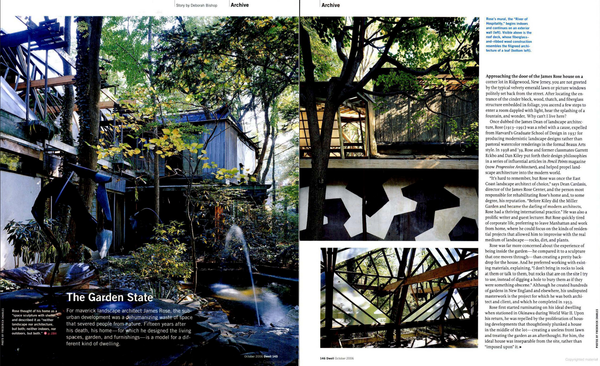
Photos by Frederick Charles
"It’s hard to remember, but Rose was once the East Coast landscape architect of choice," says Dean Cardasis, director of the James Rose Center, and the person most responsible for rehabilitating Rose’s home and, to some degree, his reputation. "Before Kiley did the Miller Garden and became the darling of modern architects, Rose had a thriving international practice." He was also a prolific writer and guest lecturer. But Rose quickly tired of corporate life, preferring to leave Manhattan and work from home, where he could focus on the kinds of residential projects that allowed him to improvise with the real medium of landscape—rocks, dirt, and plants.
Rose was far more concerned about the experience of being inside the garden—he compared it to a sculpture that one moves through—than creating a pretty backdrop for the house. And he preferred working with existing materials, explaining, "I don’t bring in rocks to look at them or talk to them, but rocks that are on the site I try to use, instead of digging a hole to bury them as if they were something obscene." Although he created hundreds of gardens in New England and elsewhere, his undisputed masterwork is the project for which he was both architect and client, and which he completed in 1953.
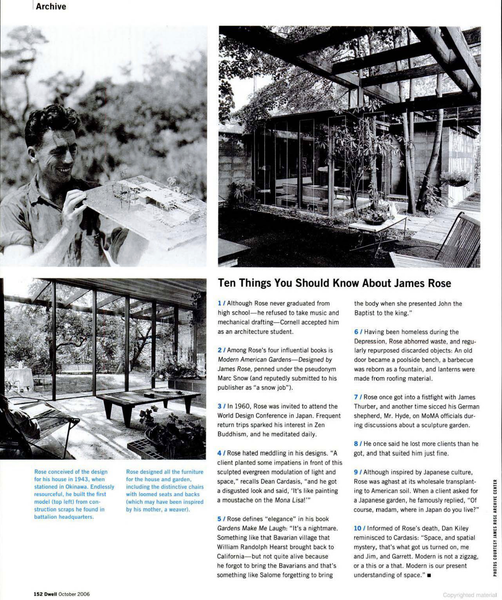
Rose first started ruminating on his ideal dwelling when stationed in Okinawa during World War II. Upon his return, he was repelled by the proliferation of housing developments that thoughtlessly plunked a house in the middle of the lot—creating a useless front lawn and treating the garden as an afterthought. For him, the ideal house was inseparable from the site, rather than "imposed upon" it.
Working on a modest lot (described by Rose as "half a tennis court"), he placed three pavilions—a main house with a kitchen for his mother, a guesthouse for his sister, and a live/work studio for himself—joined by a tightly choreographed connective tissue of courtyards, pools, and gardens. Affording three adults both privacy and communion with nature, the property at Ridgewood embodies the midcentury ideal, so rarely realized, of blurring the borders between indoors and out. Wrote Rose: "The walls become garden walls instead of barriers. The landscape is of the house instead of attached to it, and the space is one."
"It’s hard to tell if it’s a landscape connected by shelter, or shelters connected by a common landscape," says Cardasis. "Rose essentially took the architecture and pulled it apart, with the solid parts and the voids exploded. I think of it as architectural origami."
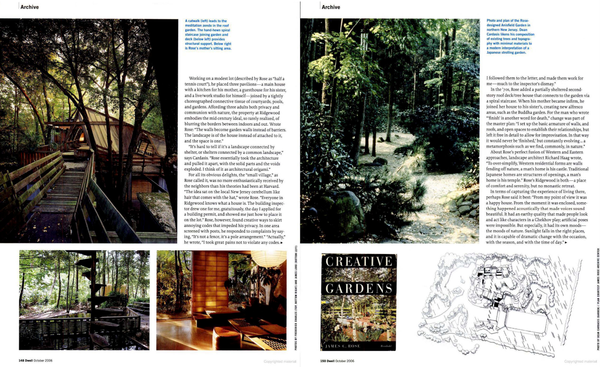
Images courtesy Frederick Charles / James Lord / Dean Cardasis / James Rose Archive Center
For all its obvious delights, the "small village," as Rose called it, was no more enthusiastically received by the neighbors than his theories had been at Harvard. "The idea sat on the local New Jersey cerebellum like hair that comes with the hat," wrote Rose. "Everyone in Ridgewood knows what a house is. The building inspector drew one for me, gratuitously, the day I applied for a building permit, and showed me just how to place it on the lot." Rose, however, found creative ways to skirt annoying codes that impeded his privacy. In one area screened with posts, he responded to complaints by saying, "It’s not a fence, it’s a pole arrangement." "Actually," he wrote, "I took great pains not to violate any codes. I followed them to the letter, and made them work for me—much to the inspector’s dismay."
In the ’7os, Rose added a partially sheltered second-story roof deck/tree house that connects to the garden via a spiral staircase. When his mother became infirm, he joined her house to his sister’s, creating new alfresco areas, such as the Buddha garden. For the man who wrote "‘finish’ is another word for death," change was part of the master plan: "I set up the basic armature of walls, and roofs, and open spaces to establish their relationships, but left it free in detail to allow for improvisation. In that way it would never be ‘finished,’ but constantly evolving...a metamorphosis such as we find, commonly, in nature."
About Rose’s perfect fusion of Western and Eastern approaches, landscape architect Richard Haag wrote, "To oversimplify, Western residential forms are walls fending off nature, a man’s home is his castle. Traditional Japanese homes are structures of openings, a man’s home is his temple." Rose’s Ridgewood is both—a place of comfort and serenity, but no monastic retreat.
In terms of capturing the experience of living there, perhaps Rose said it best: "From my point of view it was a happy house. From the moment it was enclosed, something happened acoustically that made voices sound beautiful. It had an earthy quality that made people look and act like characters in a Chekhov play; artificial poses were impossible. But especially, it had its own moods—the moods of nature. Sunlight falls in the right places, and it is capable of dramatic change with the occasion, with the season, and with the time of day."
Photos courtesy James Rose Archive Center
See the full story on Dwell.com: From the Archive: Landscape Architect James Rose’s New Jersey Home Was Both Beautiful and Rebellious