From the Archive: Low and Long, This Rural Home Was Designed to Feel Like Moving Through the Forest
Built for Bill Moggridge, the designer of the first laptop, and his wife Karin, the property provided a reprieve from the couple’s intercontinental life.
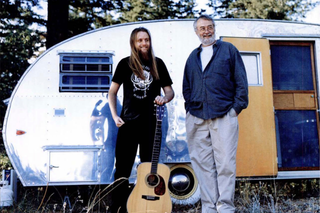
Built for Bill Moggridge, the designer of the first laptop, and his wife Karin, the property provided a reprieve from the couple’s intercontinental life.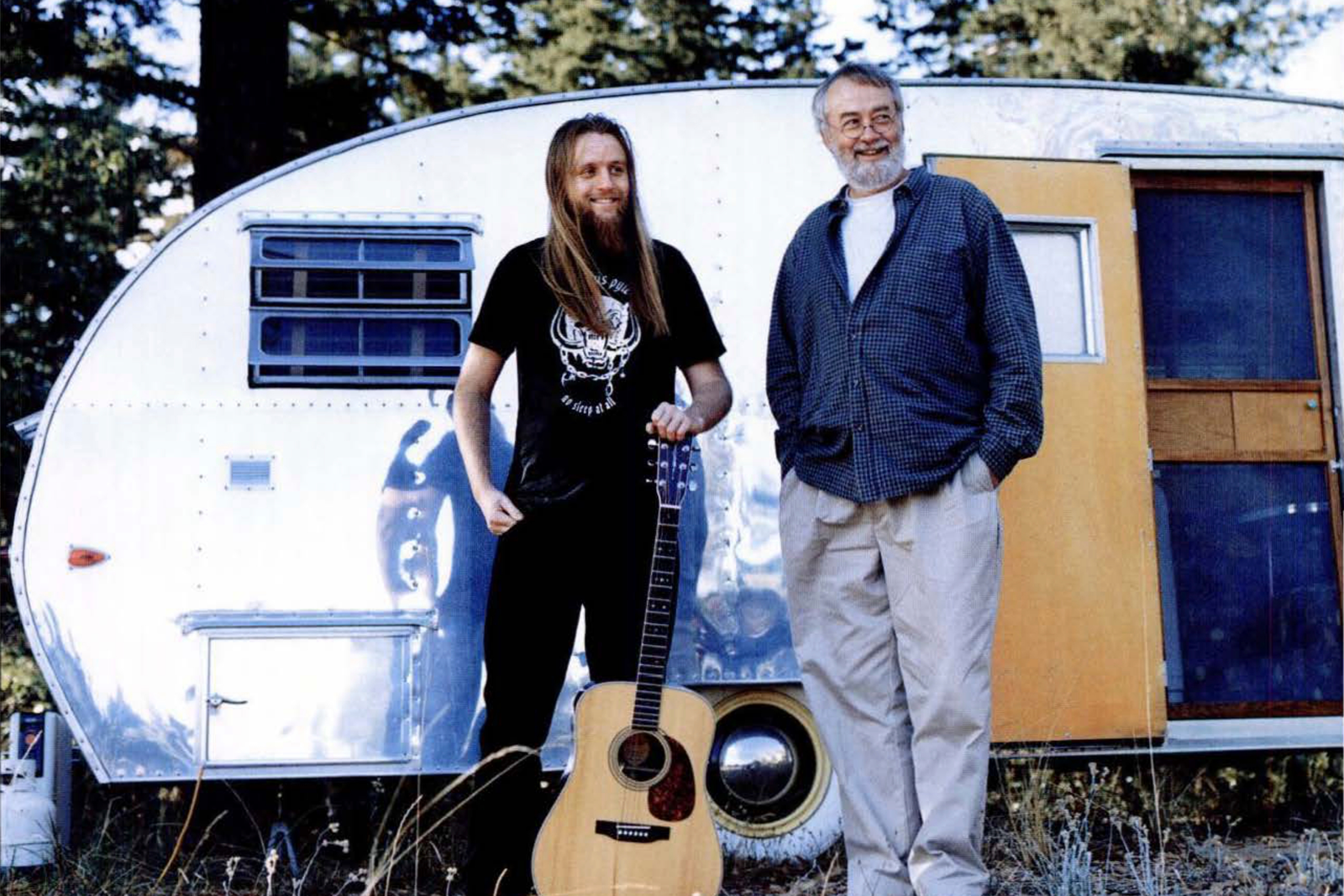
Welcome to From the Archive, a look back at stories from Dwell’s past. This story previously appeared in the January/February 2003 issue.
Heading south from San Francisco on Interstate 280, the "little boxes made of ticky-tacky" (made famous by singer/songwriter Malvina Reynolds in the ’6os) that line the hillsides of Daly City and South San Francisco rapidly give way to rolling green hills that turn a smoldering gold in the summer. Twenty minutes down the road, you can take any number of exits and creep farther away from civilization. As you turn onto Skyline Boulevard and drive through towering redwoods, the city and surrounding suburbs become a memory.
Here, deep in the woods, about an hour from downtown San Francisco, Bill and Karin Moggridge found the land that would become their home. "When Karin found this place, she did a little dance," says Bill, a cofounder of Ideo, the international design consulting firm. "From that moment, I knew it was all over." "It was just so incredible to see it," continues Karin, a fiber artist and clothing designer from Copenhagen. "I’m not a religious or spiritual person in any way, but it was as if something had said, ‘This is it. This is where you should put down your roots.’"
High above the Silicon Valley smog and sloping toward the distant Pacific, the land captivated the Moggridges from day one. Eccentric neighbors (including a helicopter-flying, horseback-riding, earth-moving-equipment-obsessed emergency-room doctor and a Cadillac-driving Neil Young), attracted by the area’s seclusion and beauty, are hidden at a safe distance among the manzanitas.
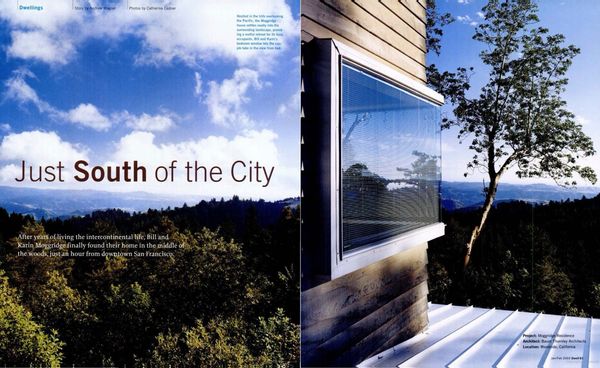
After Ideo took off in the ’8os, the Moggridges found themselves living the intercontinental life, splitting their time between London, where they owned a flat, and Palo Alto, where they owned a small house. "But everything had to be sacrificed for this," Bill says of their new house.
The Moggridges had long thought about building their own house but hadn’t seriously considered the possibility until 1994. "Basically, our freedom started with the kids leaving home and Ozzy passing on," Bill says, referring to their two grown sons and now-deceased dog, named after the infamous Black Sabbath singer Ozzy Osbourne.
With their freedom granted, the couple quickly staked their claim. Just 7o days after Karin first saw the land, the Moggridges were the proud owners of 17 acres of trees, dirt, wildflowers, and their fair share of poison oak, spiders, and mice. The two creative forces quickly got to work on their dreams, setting up a tent in a clearing and spending as much time as possible imagining what could be. "The first thing we did was to try and understand the land," Bill says. "So we got maps and an aerial photograph from the USGS. Then we started exploring the land, surveying the edges to find out where the periphery was, putting little flags every hundred feet."
"We were hoping to design the house," Karin says. "We made this little book in order to find out what we liked. The book got some of the desire to actually design it ourselves out of the way." "It also allowed us to work out our differences and discover what we each wanted," says Bill.
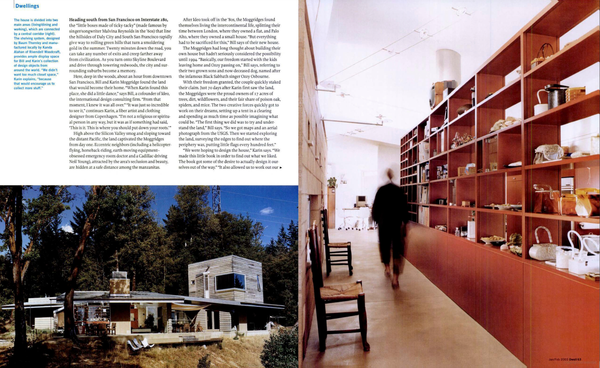
Photo: Catherine Ledner
With the idea of designing the house on the back burner, the Moggridges made a short list of five architects whom they were interested in working with, including the small San Francisco firm of Baum Thornley. "We knew Doug [Thornley]," Bill explains, "from having worked with him on Ideo’s San Francisco office."
The Moggridges sent their 62-page book—containing chapters titled "The Land," "What We Want," "First Ideas," "Where We’ve Lived," and "Planning"—to the five firms and waited to see how each responded. "Most of the well-known ones sent us a copy of the book that they had published. They didn’t try particularly hard, but Doug and Bob [Baum] came to us with a portfolio and then finally presented us with the biggest proof of their interest in doing the job," Bill explains.
Thornley and Baum had been so moved by the site at their initial meeting that they snuck back to it without the Moggridges’ knowledge. They scoured the land, collecting dirt, tree bark, flowers, shedded snakeskin, and leaves, putting them in test tubes and constructing a wooden box to safely hold them all—a crafty presentation of the hues and textures that the architects saw playing a crucial role in Bill and Karin’s home.
"It was the first ground-up residential project for the firm," Thornley says, "so we really wanted to do it. Having worked with Ideo, we knew this house had the potential to be special. We looked at their book and thought, Wow, they’re ready to go. They really thought it through, and it wasn’t just a matter of how many square feet they wanted in the bathroom. It was a whole other level of how they lived, and how they wanted to be."
At the final meeting, the architects placed their creation in the center of the table and told the Moggridges they couldn’t open it till the end of the presentation. When they finally did, the deal was done. "It proved that they understood what we liked about the place—because we really felt that the house needed to have everything to do with the natural qualities of the place, the foliage, the earth, the trees," Bill explains.
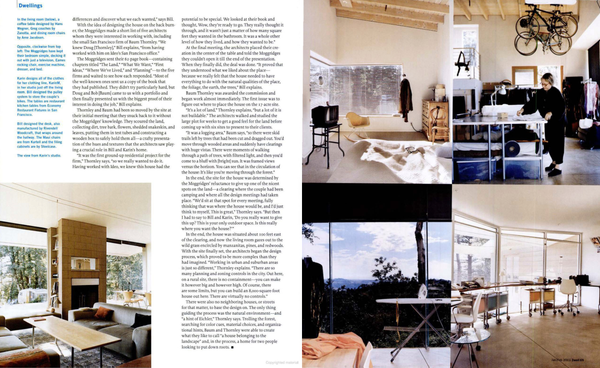
Photo: Catherine Ledner
See the full story on Dwell.com: From the Archive: Low and Long, This Rural Home Was Designed to Feel Like Moving Through the Forest
Related stories:



.jpg?1590446941#)