It’s a Great Time to Be the Giant Maker of Route 66
As The Mother Road revs up for its centennial, demand for sculptor Mark Cline’s Muffler Man statues is soaring, transforming a fading folk art into a pop-culture revival.
As The Mother Road revs up for its centennial, demand for sculptor Mark Cline’s Muffler Man statues is soaring, transforming a fading folk art into a pop-culture revival.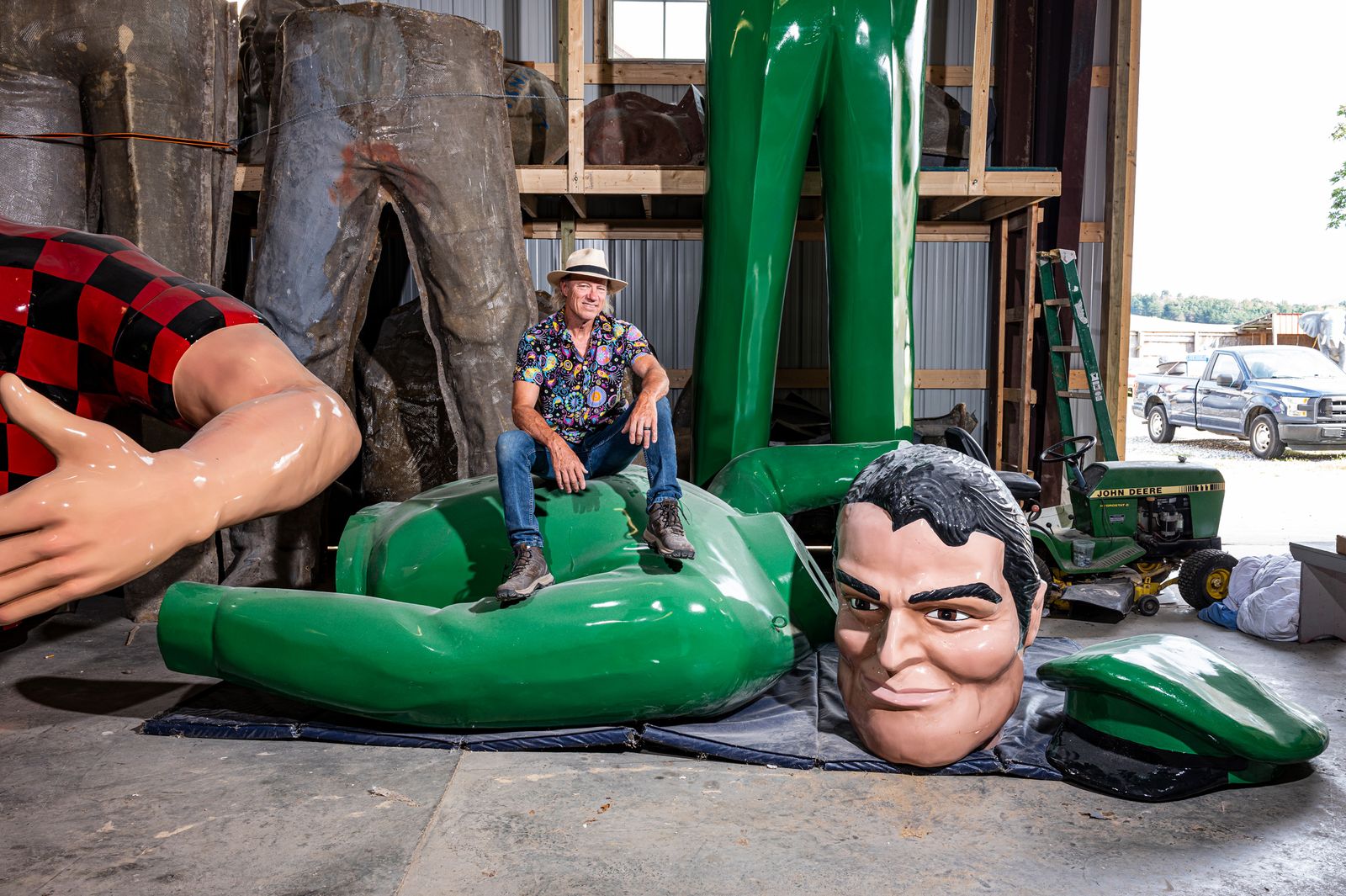
Everything in artist Mark Cline’s orbit feels a little larger than life. Even his setbacks carry a certain Herculean weight. In the early days of his creative career, before he became known for sculpting the massive fiberglass figures that now define his work and an American landscape, when he was still trying to carve out a niche for himself, Cline was so broke that he sometimes slept on park benches. Years later, his studio burned to the ground—not once but twice—reducing decades of work to billowing piles of ash.
Self-taught artist Mark Cline (pictured in top image), whose background is in sculpture and resin work, started making fiberglass "giants" several decades back. Now his business, Enchanted Castle Studios, which he runs with his wife, Sherry, builds and refurbishes traditional advertising figures, huge dinosaurs, and more, such as Muffler Men (called such because they historically held car mufflers to advertise auto shops) owned by an Ohio collector.
Photo by Scott Suchman
And yet, eventually Cline found his way into a monumental niche: making the oversize fiberglass figures, the iconic "giants," that dot Route 66. When I arrived at his Enchanted Castle Studios in the fall of last year, set amid rolling farmland 40 miles northeast of Roanoke, Virginia, business was booming and on a triumphant scale. Cline and his two-person team have enough giants looming on the docket to keep them hopping for a while. Both the self-taught sculptor and his towering creations appear to be in the midst of a glorious renaissance. That’s fueled in part by the 2026 centennial of Route 66, known as the Mother Road or the Main Street of America, famous for its role in funneling travelers of many generations cross-country.
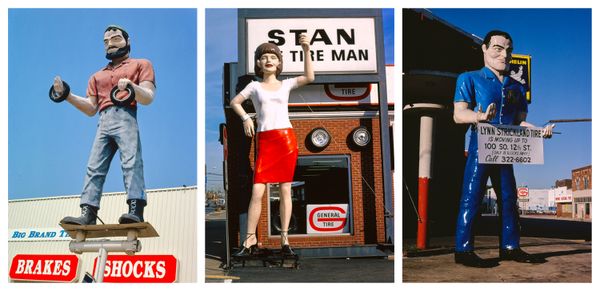
Route 66 celebrates its 100th anniversary this year, sparking a new wave of attention to its iconic kitsch and giant figures, most ranging from 14 to 23 feet tall. From left to right: Tire Man Big Brand tire statue in Van Nuys, California, 1991; Stan the Tire Man statue in Mount Vernon, Illinois, 1988; Tire Man statue in Birmingham, Alabama, 1980.
John Margolies Roadside America Photograph Archive. Library of Congress Prints & Photographs Division.
Highway guardians like this had their heyday in the 1960s, when cross-country road trips ruled and a chorus line of colossal statues sprang up along the nation’s roads, beckoning drivers to stop at local chains, franchises, and mom-and-pop businesses. Among the most popular archetypes of the era was the Muffler Man, with outstretched hands poised to grip an enormous car part; his female counterpart, the Uniroyal Gal, often clad in a bikini and said to have been modeled on First Lady Jackie Kennedy; and a popular variation called Paul Bunyan, a beefy lumberjack whose axe was sometimes swapped for a monstrously large hotdog.
"I’m working on giants seven days a week at the moment," Cline tells me as we stroll through the property, his phone buzzing often with requests from small-business owners seeking massive pink doughnuts or chicken-drumstick-wielding cowboys.
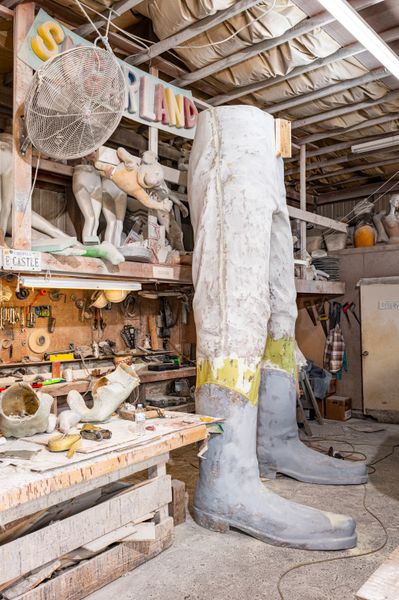
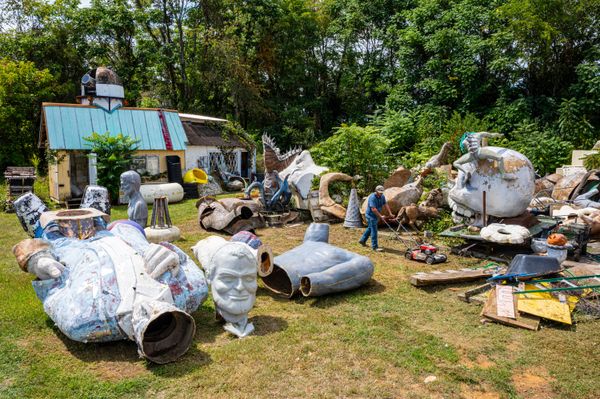
The interior of Enchanted Castle Studios is shared by a workshop and a warehouse, where completed projects like dinosaurs and miniature trains stand alongside molds for unique sculptures Cline has restored over the years.
Photo by Scott Suchman
See the full story on Dwell.com: It’s a Great Time to Be the Giant Maker of Route 66
Related stories: