Light from Above: Measuring and Designing Daylight Under Sloped Roofs
If we ask a child to draw a house, a triangular silhouette will almost certainly appear, with two sloped planes meeting at a ridge. Few architectural forms are as universally recognizable as the pitched-roof house. From a semiotic perspective, this elemental image functions as a condensed sign of shelter that, in just a few traces, synthesizes protection, interiority, and belonging. What we now read as a universal symbol, however, emerged from a concrete necessity. From Alpine chalets shedding snow to Mediterranean roof tiles mitigating summer heat, the slope responded to climate and construction challenges long before it became an aesthetic code.
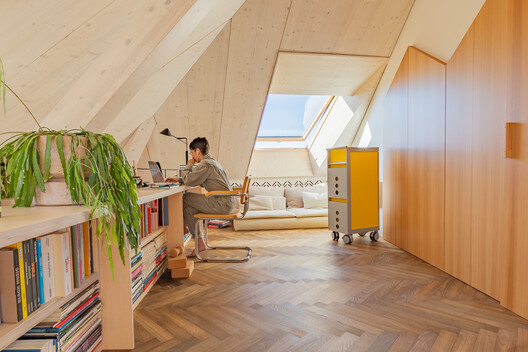
 Courtesy of VELUX
If we ask a child to draw a house, a triangular silhouette will almost certainly appear, with two sloped planes meeting at a ridge. Few architectural forms are as universally recognizable as the pitched-roof house. From a semiotic perspective, this elemental image functions as a condensed sign of shelter that, in just a few traces, synthesizes protection, interiority, and belonging. What we now read as a universal symbol, however, emerged from a concrete necessity. From Alpine chalets shedding snow to Mediterranean roof tiles mitigating summer heat, the slope responded to climate and construction challenges long before it became an aesthetic code.
Although modern architecture has favored horizontal planes and orthogonal plans, the pitched roof requires a project to be conceived in section. Its angle allows for efficient use of the volume beneath the roof and introduces variations in height, spatial compression, and expansion. When openings are incorporated into this plane, the condition intensifies. Unlike vertical windows, which capture lateral light, roof apertures receive a larger portion of the visible sky and significantly higher luminance than the horizon, offering up to three times more light than vertical glazing on overcast days.