
Patchwork Textile Is the Digital Palette Cleanser We Need Right Now
Designers and makers share why they’re turning to the age-old craft at a time when we're all looking for an antidote to life online.

Designers and makers share why they’re turning to the age-old craft at a time when we're all looking for an antidote to life online.
From major media headlines to conversations in bars, at the beginning of 2026 we all agreed that this year would be the year of analog. We had had it with prioritizing our screens. We would put ’em away and bring out our knitting needles, or gardening gloves, or meditation pillows. Seven months later, whether or not we’ve all successfully ditched our phones, the desire to live a little less intimately with our devices has remained. Part of what we’re running from when we turn our phones on airplane mode, or lock them away in a nightstand drawer, is the homogenous—and frankly boring—quality of content online nowadays. This broader trend is showing up in our interiors in obvious ways, like the return of the landline, and in less obvious ways, too. Some are finding their escape by turning to something the algo could never produce: the craft of patchwork which, with its randomness and sense of texture, is very much a product of human creativity.
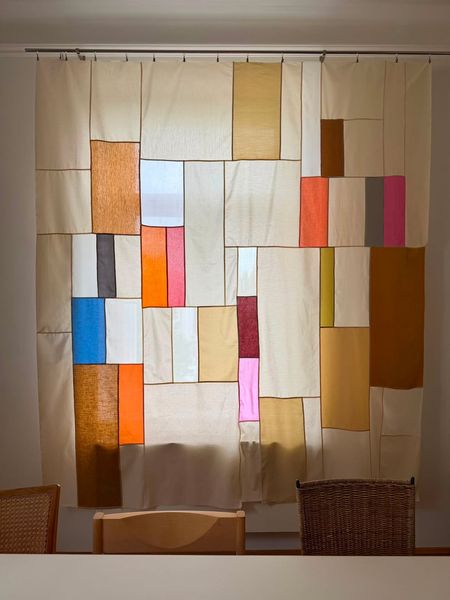
"A patchwork curtain can become a strong statement in a room, but it can also feel very soft and natural," says Munich designer and artist Lea Sigg. "For me, it is less about a specific interior style and more about the atmosphere you want to create."
Courtesy of Lea Sigg
Many of the patchwork textiles I see on Instagram are curtains specifically, in photos where light filters through each uniquely colored square. They’re mostly by independent makers selling one-of-one creations directly to followers. Munich designer and artist Lea Sigg became hooked on patchwork after first making a set of curtains for her friend upon request. "It almost felt like the curtain had two lives: one as a textile object and one as a kind of painting made of light," she says. "There is something very magical about that and I still cannot fully explain it. Maybe that’s why I like it." As a broader cultural trend, Sigg thinks the desire for something that you can visibly tell was made by hand draws people to patchwork. "There is a certain care in it. We are surrounded by so many things that are Al-generated, mass-produced, perfect and replaceable," Sigg explains.
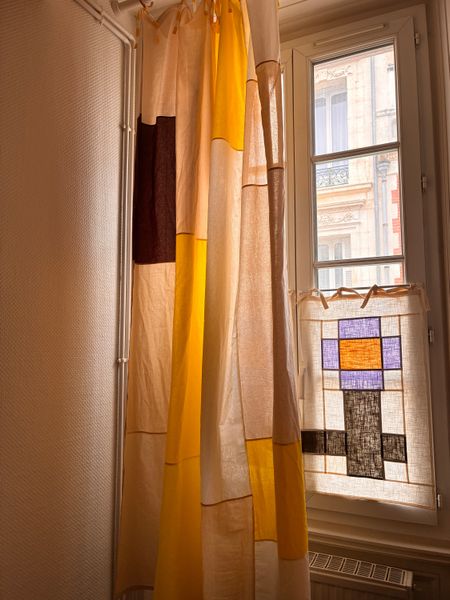
"Even without knowing where each fabric comes from, people instinctively sense that it has been assembled by hand, piece by piece," French designer Coralie Halbout says. "In a world of mass production, there’s something comforting about objects that celebrate craftsmanship and imperfection."
Courtesy of Polka Atelier
Coralie Halbout of Polka Atelier, in La Rochelle, France, similarly fell into making patchwork curtains after making a backdrop for a photoshoot from her fabric scraps, then realizing how the method can be both practical and aesthetically distinct. "Patchwork is naturally a resourceful technique. It allows me to work with remnants, vintage fabrics, or small quantities of exceptional textiles that would otherwise be impossible to use for full-length curtains," Halbout says. "But sustainability isn’t only about reducing waste. It’s also about creating objects that people want to keep for a very long time."

The new Alex Mill x Quiet Town collaboration includes two different colorways of the Work Jacket and Saturday Shorts, in addition to an overnight bag.
Courtesy of Alex Mill and Quiet Town
See the full story on Dwell.com: Patchwork Textile Is the Digital Palette Cleanser We Need Right Now
Related stories: