Ramand is, before being a project, a decision—a decision about how a cube can stand on a dual-cornered site without compromising its own geometry and without disregarding the city. The wooden volume is a controlled rotation, neither a formal gesture nor an exaggeration; merely the minimal deviation required for the form to settle into the site. Its geometry does not impose itself on the city, but aligns with it. The wooden skin is not an emotional choice, but a means to soften the hard cube. In a site surrounded by schools, the wood transforms potential seriousness into a conversational tone, aware of the daily gaze of children building their spatial memory.
This website uses cookies to distinguish you from other users of our website. The use of cookies helps us to provide you with a specific service, to facilitate website use and to understand our visitors. By continuing to browse the site you are agreeing to our use of cookies.

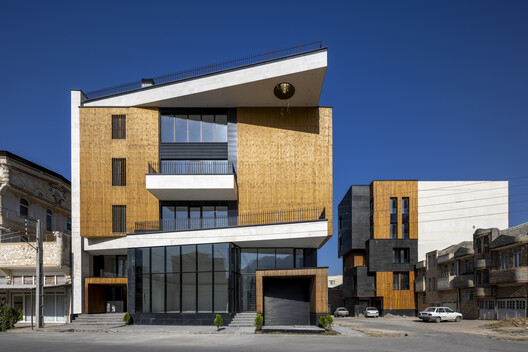
 © Parham Taghioff