The Remote Mountain Lodge’s Greatest Allure Is Also Its Biggest Liability
The Lodge at Bow Lake in the Canadian Rockies has survived for more than a century. But a visit during an extreme storm was a reminder that a faraway luxury experience cannot be promised amidst climate chaos.
The Lodge at Bow Lake in the Canadian Rockies has survived for more than a century. But a visit during an extreme storm was a reminder that a faraway luxury experience cannot be promised amidst climate chaos.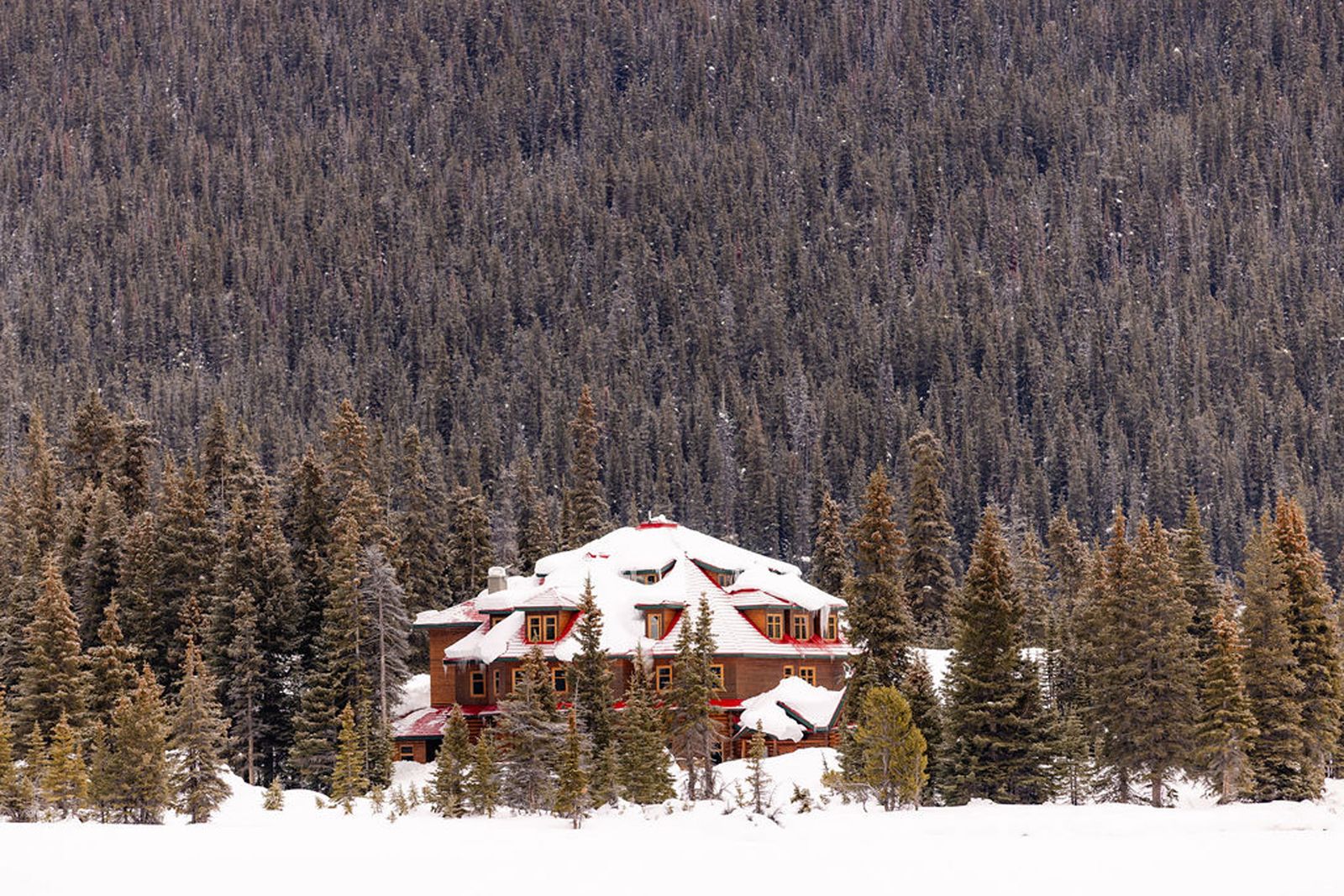
In Canada’s Rocky Mountains, the Icefields Parkway road climbs up a narrow valley, stacked ridgelines and tangled ice piled too high to see fully from the frame of a car window. The 144-mile road traverses Banff and Jasper National Parks, and for a winter visitor seeking to rest their head between the respective towns, only one full-service hotel stays open through much of the lonely, cold half of the year.
The Lodge at Bow Lake first opened as a hunting lodge in 1922. Other than a three-year pandemic closure, during which time new owners purchased and renovated the Lodge, it’s been operating more or less continuously ever since. For more than a century, its iconic red roof has interrupted the endless frozen landscape around it like a siren song, the landmark persisting as the landscape changed around it—as buffalo were eradicated, then wolves, and then, over the last 20 years, as both species were reintroduced. Today, the Lodge can accommodate 34 people in rooms that run $740 to $1,750 CAD a night. (This fall, when they open a second building, designed by Calgary-based Shugarman Architecture + Design, the total number of guests will roughly double.) The nightly costs include an all-inclusive stay, enjoyed to the soundtrack of diesel generators humming under the sound of the wind in the trees. But the biggest change the Lodge faces in its second century may be the ever-quickening pace of landscape-level changes—in the last two years alone, the immediate surroundings have faced an almost unrelenting barrage of rockfall, wildfire and extreme weather events.
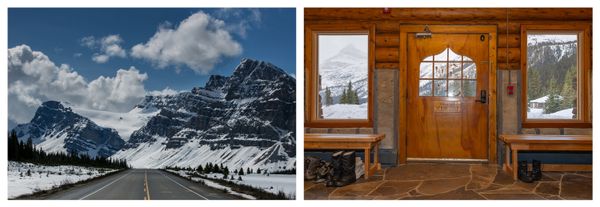
From left: A view of Icefields Parkway between Lake Louise and Jasper, and the entrance to the Lodge at Bow Lake.
From left: Photo by George Rose/Getty Images; photo by Nick Fitzhardinge, courtesy The Lodge at Bow Lake
In late March, I boarded a mountain-bound bus in Calgary, on an assignment to cover how remote mountain lodges like the Lodge at Bow Lake are designing for the future amid escalating climate events in the landscapes where they operate. I’d visited the Canadian Rockies annually for the last seven years—on a Pan-American bicycle ride, while conducting field research for my environmental science master’s thesis, as well as during several stints at the Banff Centre for Arts and Creativity. I was glad that a press stay at the Lodge gave me a reason to be back, and relieved that I’d even made it after a wily morning of close connections and flight delays. My skis were now safely tucked in the airport bus’s luggage rack, and I watched as the familiar mountains whirred outside my window. It was time to put my feet up, I thought. I texted the Lodge’s owner, Bruce Millar, that I’d arrive at our planned meeting place in Canmore soon. My phone buzzed in my hand immediately: "Just checking to see if the road is closed," Millar wrote.
The Lodge at Bow Lake’s allure—that it’s far from other places, on the front door of Canada’s wildest mountain range—is also its greatest liability. The sole road in and out is flanked with steep cliffs that were, the Wednesday I arrived, draped in layer after layer of rotten winter snow. And now a storm of generational proportions was blowing in from the Pacific, warm and weird—the perfect combination to make these idyllic mountain slopes into a massive avalanche problem. The roadway was at risk. Parks Canada would close it until their team could clear the route by dropping bombs from helicopters onto particularly slide-prone slopes.
After 20 minutes, my phone pinged again: the road would stay open until seven that evening. We’d make it through in the nick of time.
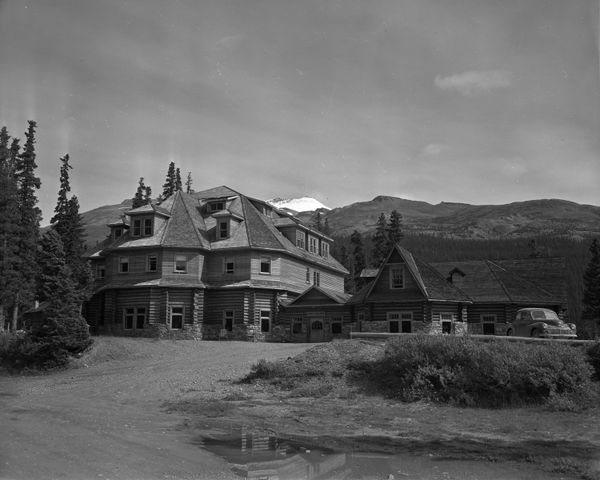
The exterior of the Lodge at Bow Lake circa 1955.
Photo from Whyte Museum of the Canadian Rockies (v469_i_na_1002)
The Lodge’s general manager, John, met me at the welcome desk, apologizing for his informal flannel—he’d just been out shoveling snow. The foyer seemed cavernous in the unlit lodge, its gray stone tiles turned blue from the dim glow of the snow beyond the two windows at the end of the long, rectangular room. I’d shown up on a Wednesday, at Bruce’s invitation, a day before guests would typically arrive. (When it operates during winter from the end of January to early April, the Lodge is only open Thursdays through Mondays.) Now that the roads were closed, it would just be me for the weekend. John led me past a room full of chairs made out of antlers, up a massive stairwell made from old-growth lumber, and through several shadowy halls to my third-floor room.
Even in the dark, the light wood on the walls was stunning—a warm nod to Scandinavia amidst what was otherwise a cowboy-colonial aesthetic. Natural world-inspired design was a priority for Millar who, with a team of investors, bought the property after it closed during the pandemic and set about restoring it. Millar, who’d spent the last several decades operating the nearby Kananaskis Lodge, and his group became the third owners of the Lodge in its long history. The original structure, made from local fir trees that were too short to make into any shape other than a hexagon, remains intact, along with the dining room’s massive, hand-cobbled fireplace with fist-sized quartz crystals jutting from its firebox. If there had been any other guests there with me, they would have sat at tables hewn from old growth lumber under the taxidermied heads of animals the Lodge’s original proprietor, Jimmy Simpson, hunted a hundred years ago. Even after the renovations, Simpson still looms large at the Lodge. There are wide-format Simpson family photos in every hall. Giant placards, like a museum’s wall text, line the walls of the foyer, which paint Simpson as a regular Buffalo Bill.
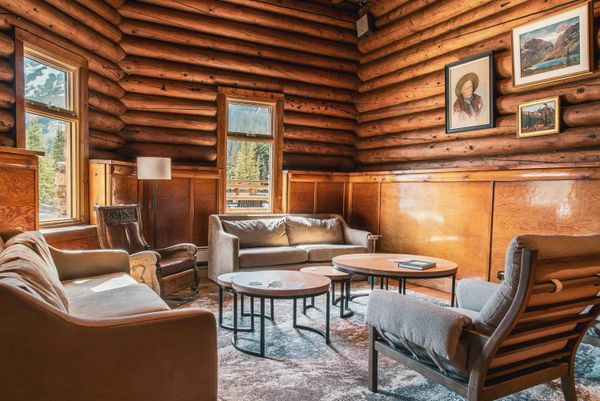
One of the sitting nooks at The Lodge at Bow Lake.
Courtesy The Lodge at Bow Lake
See the full story on Dwell.com: The Remote Mountain Lodge’s Greatest Allure Is Also Its Biggest Liability
Related stories: