The Technical Reality of Mass Timber Housing: Five European Case Studies
Recent years have seen a shifting paradigm in multi-family residential architecture, as more and more new projects are being built with engineered wood, specifically Cross-Laminated Timber (CLT) and glued-laminated timber (glulam). Because timber is lightweight, these systems can reduce dead load and ease foundation demands, which is especially useful on sites with limited bearing capacity or over existing infrastructure. From a sustainability standpoint, timber can store carbon over the life of the building and often reduces embodied carbon compared with conventional concrete-and-steel systems. In fire design, large timber members can be engineered to char at a predictable rate, allowing the structural core to remain protected for a defined period when detailed appropriately.
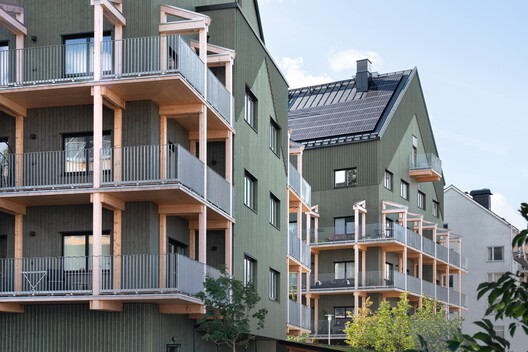
 Notuddsparken Apartments close-up. Image © Anna Kristinsdóttir
Recent years have seen a shifting paradigm in multi-family residential architecture, as more and more new projects are being built with engineered wood, specifically Cross-Laminated Timber (CLT) and glued-laminated timber (glulam). Because timber is lightweight, these systems can reduce dead load and ease foundation demands, which is especially useful on sites with limited bearing capacity or over existing infrastructure. From a sustainability standpoint, timber can store carbon over the life of the building and often reduces embodied carbon compared with conventional concrete-and-steel systems. In fire design, large timber members can be engineered to char at a predictable rate, allowing the structural core to remain protected for a defined period when detailed appropriately.