We’re All Just Visitors at the Whale House
Santa Barbara’s famous novelty home is a seductive, unwieldy world of possibility. Its newest owners want to see how deep it goes.
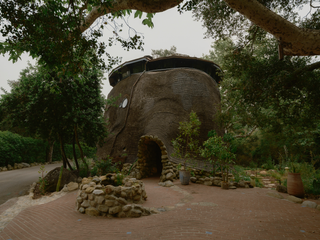
Santa Barbara’s famous novelty home is a seductive, unwieldy world of possibility. Its newest owners want to see how deep it goes.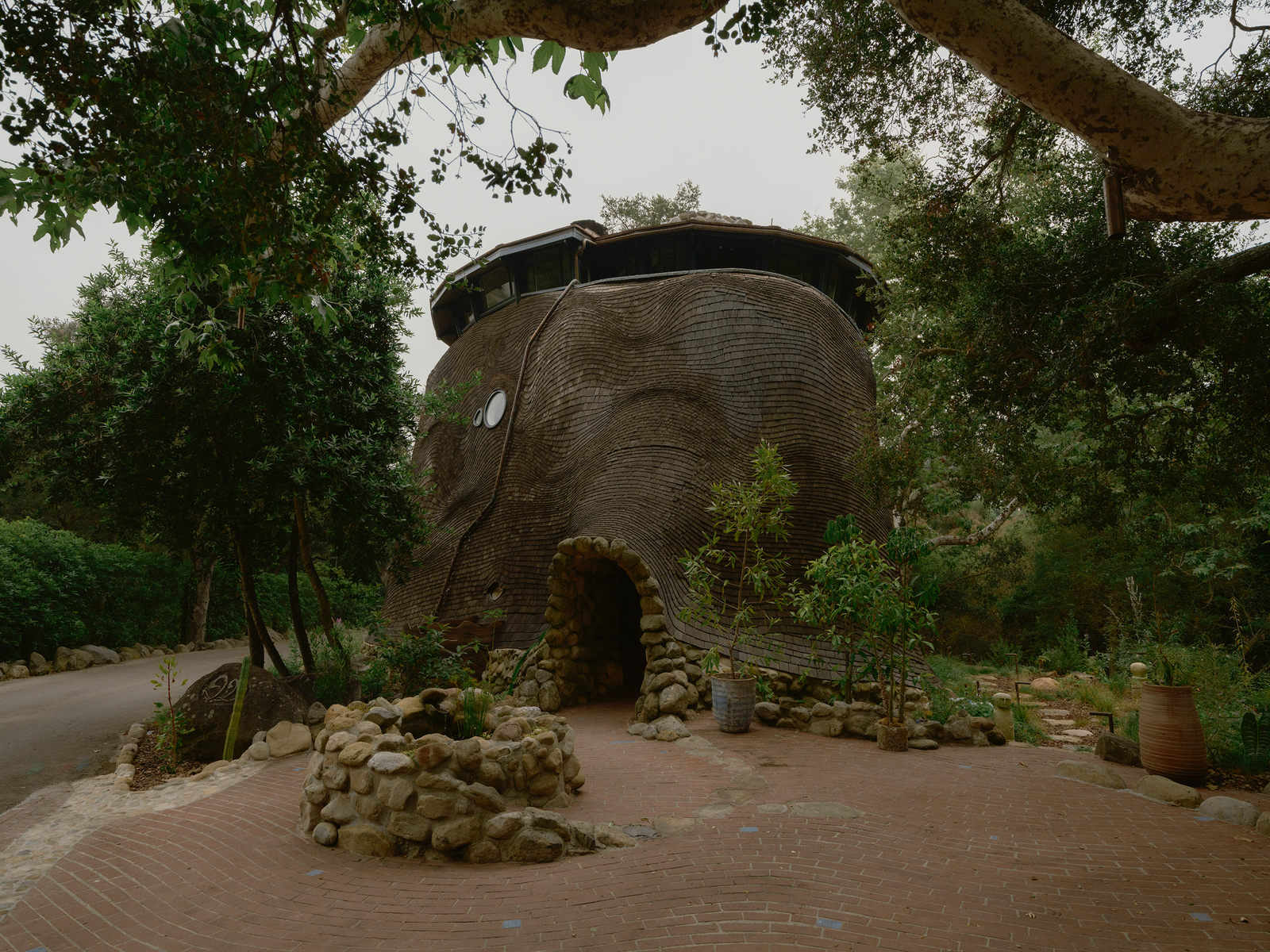
After Jeff "Jade" Spangler’s rental burned down in the 2009 Jesusita Fire in Santa Barbara, he moved into his motor home on the property, keeping an eye on Craigslist rental listings between runs to Northern California to trade at art festivals. His trips served a dual purpose: Many of the vendors were fronts for grow operations, so he’d sell his jade artwork and pick up pounds of marijuana to haul back to Los Angeles to sell to dispensaries. He kept a low profile by transporting goods in a Mini Cooper. "I never got greedy," he says, pointing out that marijuana had yet to be legalized beyond medical use in California. Business was humming—he’d socked away nearly a million dollars by then, he says—when he saw an ad for the Whale House, a residence in Mission Canyon famed for being built in the likeness of, yes, a whale. He went to look at it immediately, wrote a check for the requested rent, and used it as home base for his operations for the next five years.
Spangler quite liked living at 999 Andante Road. Completed in 1978 by Michael Carmichael, an architect and builder with an engineering degree from UC Berkeley, the Whale House is cloistered and surreptitious in its plan, presenting as an Epic Bachelor Pad. Carmichael called it a high-tech hobbit house: The living area has a river rock hearth facing a very sexy lounge that, when it was built, had an entire wall of cascading plush purple and pink seating and a state-of-the-art sound system. On the second floor is a "bed-womb," a hollow inside the second story wall with a door etched with moonbeams shooting from clouds. "Near a crackling river rock fireplace, [Carmichael] can slide from the hot tub and Jacuzzi straight into his waterbed cave," wrote Anette Burden for the fall 1980 issue of Santa Barbara Magazine, her description seeming to parody the trimmings of double-oh agent-style philandering. "Inside, fabric panels hide a telephone, stereo system, color TV, and refrigerator stocked with champagne. It’s a safe, intimate space…" Not mentioned by Burden: a red-tiled primary bath with a urinal that lit up when approached, and a shower with several sprayers large enough for a group.
Spangler made a few enhancements over the years. Notably, in the backyard pool, he installed a 40-foot stripper pole with a redwood deck where his live-in personal assistant practiced her dancing. On occasion, she and two other women would don Hollywood-grade mermaid tails to perform at events in the garden, ensconced by old-growth oaks and cedar-clad walls topped with massive Gaudí-esque fiberglass tiles that resemble vertebrae. (Antoni Gaudí and Frank Lloyd Wright greatly influenced Carmichael.) Spangler dreamt of buying the home—he loved it. But he and the then-owners couldn’t agree on a price. So in 2014 it went on the market. "An architectural masterpiece on a creekside lot in Mission Canyon," started a Prudential Realty ad taken out by Spangler’s landlords. "The ‘Whale House’ offers an escape from the ordinary! Offered at $1,795,000."
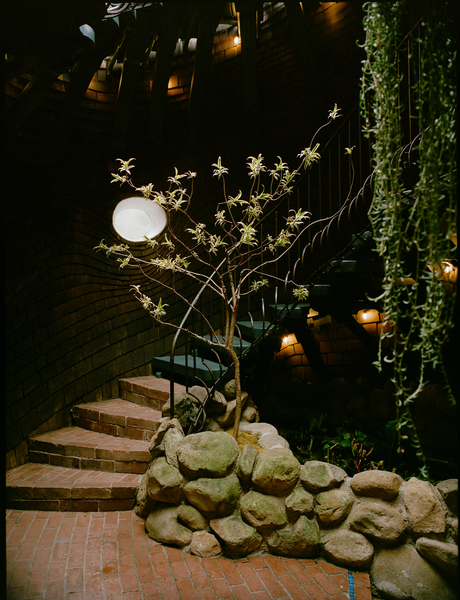
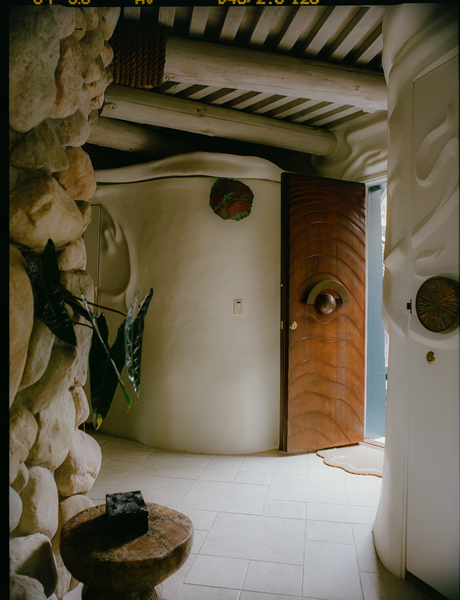
The open-air foyer of the Whale House leads in three directions: to the left, the sauna and pool; straight ahead, inside the home; and to the right, a stair that hugs that spirals upward.
Photo by Jared Chambers
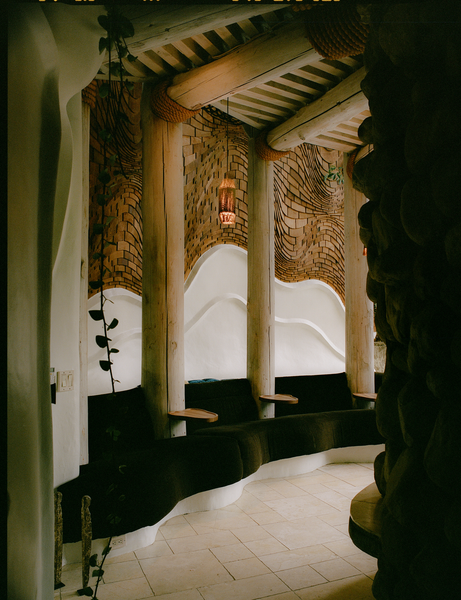
Through the front door and off to the left is the lounge, which has a hearth nested within the home’s river-rock core. The wavy white wall was originally covered in cascading, plush seating, and the floor was shag carpet.
Photo by Jared Chambers
—
For more than 30 years, Fran Galt has had a distinct vantage of the Whale House and its rotating cast of admirers from her home across the street. Massive boulders that tumbled down the canyon in a mudslide around a thousand years ago frame a path to her driveway, and through a tangle of old oaks to the left she can see the home’s flowing rows of cedar shingles. "I guess it wasn’t for everybody, because very traditional people don’t want to live next to it," she says. "But I’m an artist, so to me, it’s a work of art." Galt vaguely remembers Spangler’s name, but definitely his parties. Signs reading "bathing suits optional" were posted around the property. "We got a kick out of that," she says. One nice and unassuming couple who rented the home were, she says, arrested for making a business of selling pharmaceuticals under the table. Eddie Vedder apparently stayed in the house in the ’90s. "My neighbor said he told her that he played the guitar." Did she ever hear him play? "No, I never did. I guess he liked to keep a low profile."
In 2023, about a decade after the house sold and Spangler moved out, it listed again, and word spread fast. Shelter publications, including Dwell, circulated the news of the psychedelic home, and Sam Arneson, a California realtor who specializes in cedar-clad, shag-carpeted West Coast listings, even chimed in on socials that the Final Boss of ’70s organic architecture was once again up for sale. Word eventually made its way to Marley and Josh Raab, a millennial couple from Santa Barbara with two kids who had decamped to Portland, Oregon, during the pandemic. Ever since Marley was young, the myth of the Whale House has loomed large. She would leave her "grid reality" of a condo by the beach and drive into leafy Mission Canyon for summer camp, eager to catch a glimpse. "Counselors told us elves and gnomes lived there, and we were five, so we were like, it could be true," says Marley. "It just looked like something out of Snow White to me. I remember my brain being like, Oh. My. God." Marley grew up in a spiritual community, and later, becoming a yoga teacher led to psychedelic exploration, which came to include a curiosity for fringe real estate. "I am always looking for weird shit that’s kind of forgotten," she says. Before she and Josh moved to Portland, they had agreed, while still living at the top of the mountain behind the Whale House, that if it ever became available, they would put in an offer. Now here it was. Soon, they were officially Galt’s newest neighbors.
—
Since buying the home in 2023, Marley and Josh have been untangling its murky past and fantastical lore. Yes, it probably did its time as a Temple to Hedonism. Steven Handelman, who designed the home’s impossibly flowy stained glass and runs a lighting design business in town, describes Carmichael as a wild man who burned the candle at both ends. (Nobody I spoke to for this story was in touch with him or knew where he was. A message to his purported family was not returned by press time.) He built the home with a large crew of young men, many of them just out of high school, paying them in experience, the satisfaction of contributing to a once-in-a-generation build, perhaps, but also, a good hang. "Every Friday, they had a party, and all their friends would come around and everybody would get stoned and drink, with loud music," says Handelman, who occasionally joined in. But maybe Carmichael’s uncompromising vision is much more than just a really great place to get high. Marley thinks he might have been unknowingly partying on hallowed ground of his own making: "To use New Age speak, a lot of people come here and they’re like, ‘It feels like it’s like a portal.’ And we’re like, ‘It could be.’"
She and Josh weren’t going to make the Whale their primary address, and not many have in the residence’s nearly 50-year existence. But what makes it unhinged as a place to live full-time also makes it great for a few weird nights. It has been used often as a short-term rental, and under the couple’s stewardship, psychonaut Meta executives have already done a lap, searching the contours of its slippery Möbius strip interiors. The couple have also extended an open-ended invitation to the local Indigenous community, since the home sits within an old Chumash Indian village. But what else? "I was like, I’m open to God on this one," Josh says. Wedding inquiries have been pouring in, but endorsing couples’ commitments felt like, well, too much of a commitment. Concerts would be cool. Photo shoots, sure. Brand partnerships seem plausible.
Architect Michael Carmichael designed a "bed-womb" on the second floor.
Photo by Jared Chambers
See the full story on Dwell.com: We’re All Just Visitors at the Whale House