
Biohacking Has Come for Our Homes
AI-powered toilets. Diagnostic mirrors. In the age of "looksmaxxing" and even "poopmaxxing," the craze for self-optimization is closing in on where we live.
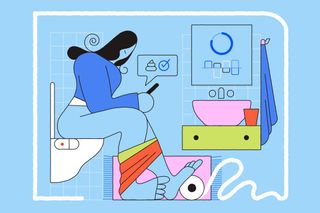
AI-powered toilets. Diagnostic mirrors. In the age of "looksmaxxing" and even "poopmaxxing," the craze for self-optimization is closing in on where we live.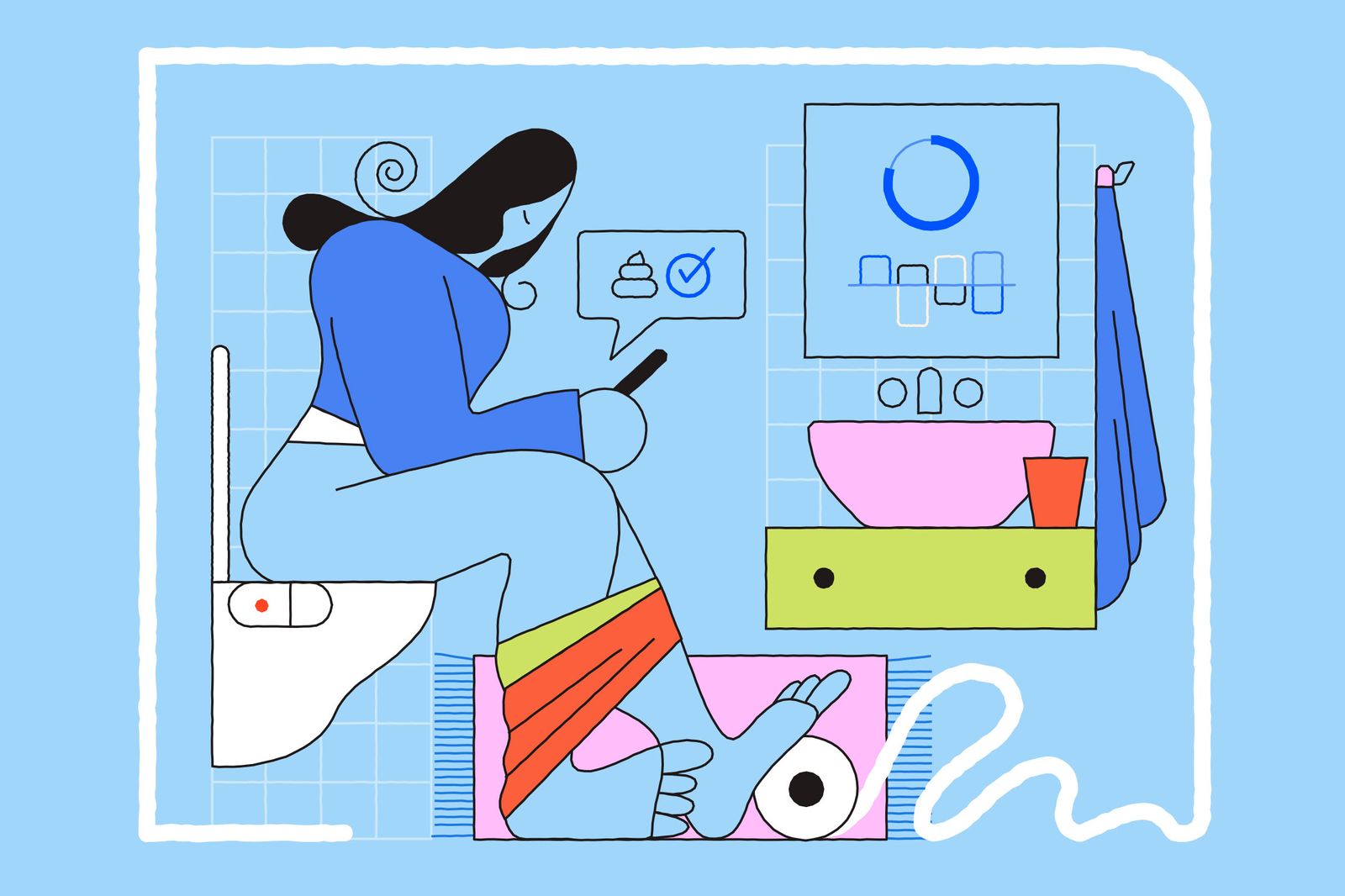
In October 1999, an Onion article titled "New E-Toilet To Revolutionize Online Shitting" proclaimed the arrival of a "cutting-edge cyberdump technology" deemed "Number 2.0" by the Silicon Valley set. The computer-slash-toilet had "the potential to forever alter the way humans defecate," the satirical piece read, through features like "real-time urine-streaming" and "point, click, and shit capability."
Last October, in the real world, Kohler Health, a new subsidiary of the kitchen and bath company, released its first product, the Dekoda. The $449 device attaches to the side of a toilet bowl and uses (downward-facing) optical sensors to analyze users’ urine and stool for gut health and hydration insights that are quickly transmitted to its app, where you can track things like "session" frequency and the time of day you tend to go. Using spectroscopy (the measure of light across wavelengths to detect a substance’s chemical properties) its sensors can assess things like stool consistency, which the app categorizes as either "Regular," "Hard," or "Loose," and users can add tags to their toilet session "reports" for added context. The sensors are also designed to detect traces of blood in the toilet bowl, which, as a gastroenterologist/influencer said in a #KohlerHealthPartner Instagram post about the product, "could be a sign of something more serious." That same month, health tech company Withings debuted two $380 shell-shaped urine trackers that suction onto the toilet bowl: U-Scan Nutrio and U-Scan Calci. The former checks users’ pee for ketone levels and other markers tied to metabolic health; the latter for parameters like calcium content that could signal the formation of kidney stones. In January, at-home urine test company Vivoo unveiled its hydration-analyzing toilet clip-on, and consumer health start-up Throne launched its AI-powered toilet sensor, which, according to its website, helps "passively" turn "every flush into insights."
That Onion story was satirical, but the idea that digital technology would become so embedded in our daily existence that it would infiltrate the infrastructure of one of our most intimate spaces was, as it turns out, pretty spot on. An entire market has emerged around a vision of the toilet tied to our current fixation with "wellness" and the notion, which some of the world’s wealthiest and most powerful people are selling, that our bodies can be optimized—if we’re willing to spend.
It’s not just about toilets: Video-based health and wellness–monitoring company NuraLogix teased a $1,199 Longevity Mirror that it says can estimate physiological age and even disease risk from a 30-second selfie scan, and Withings has its own (undeveloped) diagnostic smart mirror concept, plus a forthcoming $600 "body scan" device that looks like a digital scale but is called "the first science-backed longevity station." Eight Sleep—a smart-mattress company backed by neuroscientists/wellness influencers Andrew Huberman and Matthew Walker (and, until he was pulled from the brand’s "scientific advisory board" after appearing in the Epstein files, prominent longevity expert Peter Attia)—raised $100 million to advance the biometric-data-interpreting capabilities of its $3,000-plus mattress covers, which already track, for example, the amount of time you spent in REM sleep the night prior.
And these smart home devices join a market already flush with self-trackers disguised as everyday accessories—watches, rings, even earrings designed to help us count our steps, score our sleep, and surveil our own physiological data 24/7, in real time. An estimated 22 to 26 percent of people worldwide wear a smartwatch or fitness tracker—fitness tracker purchases in the U.S. alone reportedly grew 88 percent from 2024 to 2025—and the global wearables market is projected to reach $177 billion by 2030, more than doubling over five years. The proliferation of health-centric, self-monitoring consumer tech traces back decades. "This obsession with using numbers to track health and fitness started to emerge in the 1970s when the pedometer emerged as a commercial technology and you got these new workout and fitness regimes," says Mikki Kressbach, the author of Sensing Health and an associate professor at Loyola Marymount University whose research focuses on digital health technologies. "That laid the foundation for this much more quantified metric understanding of health and fitness, and that’s only expanded, starting in the mid-2000s with the emergence of Fitbit." Kressbach adds that the Fitbit put forth "a cooler, more tech-forward version of the pedometer that was aligned with the ethos of Silicon Valley at that moment."
In our increasingly optimization-obsessed culture, self-improvement isn’t just a personal endeavor; it’s something to be performed through consumption to signal virtue and status.
When the first Fitbit Tracker came out in 2009, the practice of biohacking—a blanket term for experimental approaches to self-improvement aimed at upgrading human performance—was just starting to penetrate popular culture, originating from fringe movements of 1980s DIY biologists. At the time, biohackers were mostly Silicon Valley tech bros with lots of disposable income to shell out on (often unregulated) products and procedures in the pursuit of their own enhancement. In the early 2010s, self-tracking practices started to shift, as sociologist Deborah Lupton writes in her book The Quantified Self, from the niche undertakings of numbers-obsessed subcultures to more of the general public. The year 2015 alone gave us the Apple Watch and Oura Ring, not to mention Gwyneth Paltrow’s vaginal-steaming endorsement on her lifestyle/wellness brand Goop’s website, signaling that putting the pursuit of health at the core of one’s personal identity and public perception was amassing cachet beyond the biohacking manosphere. But while wealthy wellness seekers like Paltrow and Dave Asprey, who popularized one of the biohacking movement’s first mainstream practices (adding butter to your coffee), might have already put infrared saunas and cryotherapy chambers in their homes, most of us were just starting to switch out our cookware for new nonstick options marketed as "nontoxic."
The cult of wellness continues to be driven by the purchase of particular goods and services, and the rich lead the way. Health and wealth have always been imbricated, but in our increasingly optimization-obsessed culture, self-improvement isn’t just a personal endeavor; it’s something to be performed through consumption to signal virtue and status. Spend 10 minutes on social media and odds are you’ll swipe by at least one clip of a big-name longevity podcaster or wellness TikToker (even a gastroenterology influencer) touting a commercialized path to your best self, with uncertain credentials to do so, whether through injectable peptides or a mattress that self-adjusts its temperature to keep you in deep sleep. The message is largely: Your biological destiny is yours to conquer…if you just buy this…and this…and this. Most of these products, of course, aren’t cheap, and many have additional subscription fees for the corresponding app components. Included in the price, though, is the badge value.
The latest health measure circulating social media is "poopmaxxing"—these fiber-infused sodas and gummies should help you. Just don’t forget to use the Kohler Health app to log your score. The logic that you need to be intimately attuned to the tides of your biological markers to live your healthiest, longest, and thereby best life has crept closer and closer to becoming dogma.
Tech broligarchs are no longer the only residents of the Biohacking Extended Universe, but they still sit at the center of it: Amazon founder Jeff Bezos, Palantir cofounder Peter Thiel, and OpenAI CEO Sam Altman have all invested millions in biotech research initiatives and start-ups aimed at extending human lifespans, and many have talked publicly about their own longevity regimens. Then there’s Bryan Johnson, the ultrawealthy, quadragenarian tech mogul who reportedly spends $2 million a year trying to reduce his "biological age" to that of a teenager and appeared on a 2025 episode of The Kardashians with fellow longevity figurehead Huberman discussing antiaging tricks over dinner with Kris, Kim, and Khloé. In the U.S. alone, the wellness economy is valued at $2.1 trillion, and it’s expected to reach nearly $10 trillion globally by 2029. Meanwhile, the global longevity market—an umbrella for consumer spending on products and services aimed at extending life, specifically—is predicted to reach $740 billion this year. Upscale longevity clinics and med spas where people pay steep fees for access to medical tests and treatments (many of which aren’t covered by insurance or confirmed to prolong lifespan) are on the rise, and in the U.S., there are reportedly nearly as many med spas as McDonald’s restaurants.
The logic that you need to be intimately attuned to the tides of your biological markers to live your healthiest, longest, and thereby best life has crept closer and closer to becoming dogma.
You could write this off as mass solipsism fueled by social media and the acts of one-percenters, but the desire for technologies that make the act of "staying healthy" slightly more passive makes sense when you factor in the failing U.S. healthcare system and rising medical costs, plus declining trust in doctors and public health authorities amid unscientific medical theories and nutritional agendas promoted by federal health leadership. A recent study showed that around 4 in 10 U.S. adults now get health and wellness guidance from social media. "We have a system that makes it incredibly difficult to access care to really understand our health, and these technologies supposedly offer us incredibly personalized insight into what’s going on in our bodies," says Kressbach. (Never mind that the majority of these nonmedical technologies are not protected under current health and privacy laws.)
A toilet that could help you piece together a potential food sensitivity before seeking expensive allergy testing could help close some gaps in care. That was the thinking for the Dekoda, says Kohler Health’s head of design, Rafael Rexach: "There’s that time frame in between your doctor visit that it’s like, ‘Hey, am I doing okay?’" He explains that users can add tags showing that they ate gluten or dairy before a bathroom session, for example, and start making their own correlations about cause and effect. Rexach makes sure to state that the device is not a diagnostic one—should a user see a result that’s "unexpected," they "can choose to follow up with their primary care physician."
Kressbach says she’s also noticed a rise in smart home technology related to aging. The global population over 60 years old is set to double to 2.1 billion by 2050, and in the U.S., older adults are increasingly opting to "age in place" (aka stay in their homes), with some living solo. San Francisco start-up Toi Labs, for example, leases its TrueLoo toilet seats that scan waste for potential signs of illness to assisted-living and senior care facilities across the country, and late last year home appliance company Vovo announced a $4,990 urine-analyzing smart toilet intended for seniors, among others. It’s easy to pooh-pooh the new frontier of AI-powered smart toiletdom as a strange, even slightly worrisome, development of the ever-growing wellness-industrial complex. But some of these devices could also provide necessary scaffolding for how we take care of ourselves in an unpredictable world. The Onion’s barbed vision of the future of smart toilets and "cyberdefecation" now feels right at home.
Top illustration by Justyna Stasik
—