Cast Concrete Steps Form a Flowing Staircase That Centers This Belgian Home
The treads match the kitchen island and bathroom, which echo the residence’s curving, plaster-finished facade.
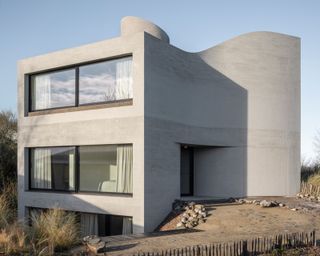
The treads match the kitchen island and bathroom, which echo the residence’s curving, plaster-finished facade.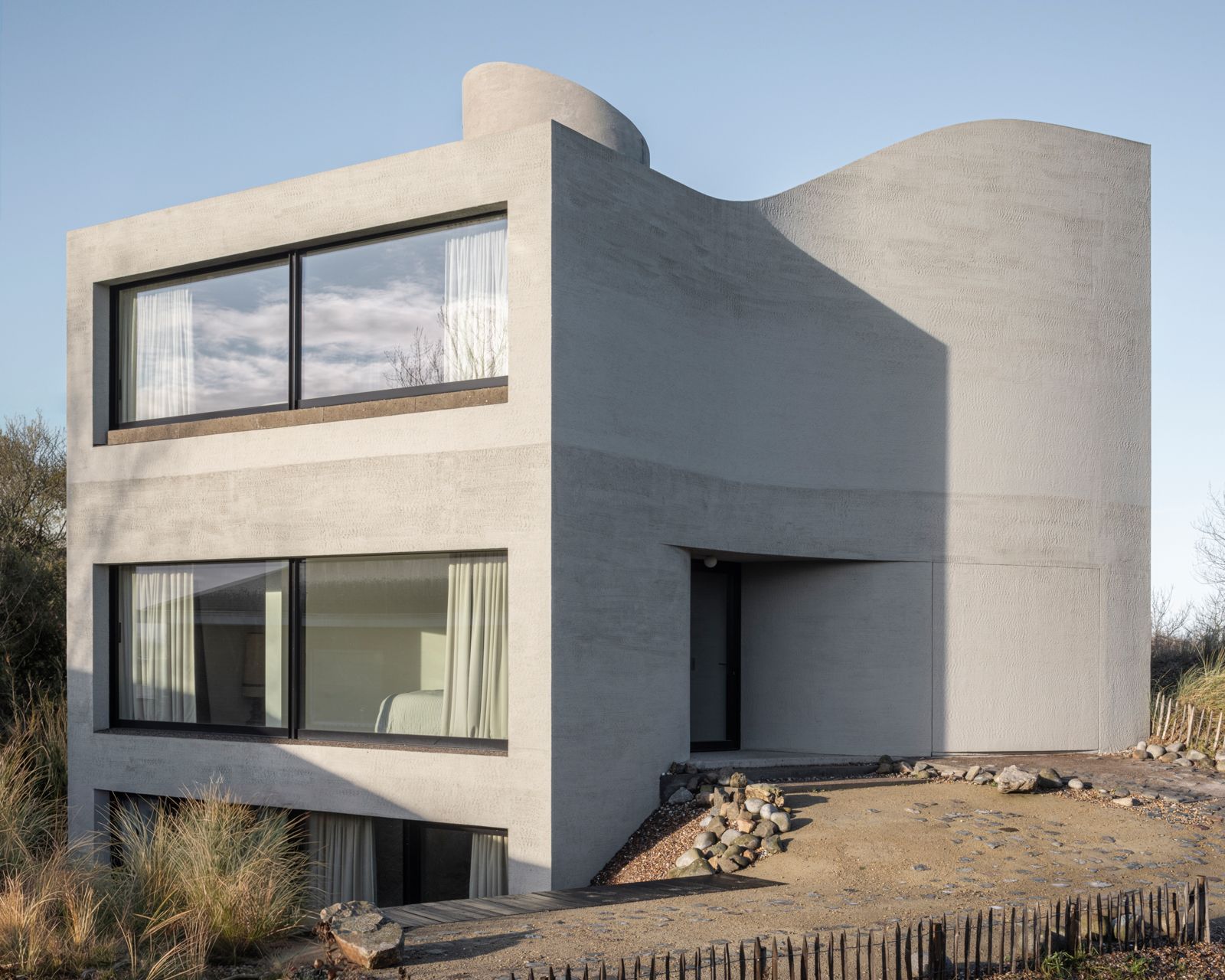
Houses We Love: Every day we feature a remarkable space submitted by our community of architects, designers, builders, and homeowners. Have one to share? Post it here.
Project Details:
Location: Oostduinkerke, Belgium
Architect: Magalie Munters™ Architecture / @magaliemuntersarchitecture
Footprint: 3,100 square feet
Builder: OSA bv with Details/Systems
Structural Engineer: X-act
Photographer: Tim Van de Velde / @tvdvphotography
From the Architect: "Villa Nouvelle Vague explores how sculptural architecture can be realized with precision, translating the fluid logic of a coastal landscape into built form. Located in Oostduinkerke, on the Belgian coast, the house is embedded within a dune environment shaped by wind, sand, and shifting light. Rather than mimicking its surroundings, the project engages with the landscape through abstraction—interpreting its softness and continuous movement into a coherent architectural language. From the street, the curved volume reads as a protective shell, and quietly references the shape of the Normandie, the modernist 1937 boat-shaped restaurant nearby.
"The project is driven by a search for continuity. Instead of composing the house as a series of elements, it is conceived as a single, flowing volume in which architecture, structure, and construction are intrinsically connected. This underlying logic allows complex geometries to emerge with clarity and control. A deliberate tension defines the relationship between the house’s outer and inner expression. The exterior appears soft and almost eroded, with a custom-developed plastered surface—its color and texture calibrated to the coastal landscape—that recalls the shifting patterns of sand shaped by wind and tide. In contrast, the interior reveals a more direct and tactile materiality. Cast concrete elements—the staircase, the kitchen island, the bathroom fixtures—remain present and raw, grounding the space in a physical, almost archaic atmosphere.
"A sculptural concrete staircase anchors the house and links its three levels, set within a vertical shaft that cuts through the building toward the rooftop. The stair feels almost cast in place—part structural element, part standing object—and gives the interior the spatial logic of a vessel. The bedrooms are anchored low in the dunes; higher up, the living spaces rise toward the horizon, lifted by curving walls and a softly undulating roof.
"The house unfolds as a sequence of interconnected spaces without strict boundaries. Curved facades expand the interior, while large openings establish a direct relationship with the surrounding dunes. Inside, the spatial experience is defined by light, proportion, and surface continuity. The curved walls and ceilings create a sense of enclosure and expansion at once, evoking the feeling of being within a shell. Light moves gradually across the plastered surfaces, enhancing the tactile quality of the space and reinforcing its calm, immersive atmosphere. The interior remains deliberately restrained, allowing spatial coherence and material presence to define its character."
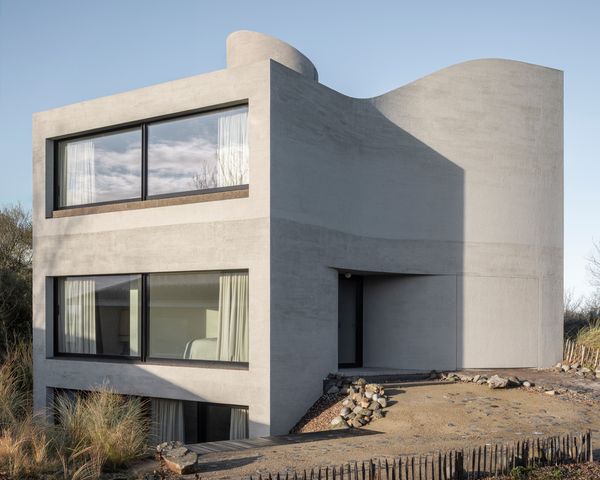
Photo: Tim Van de Velde
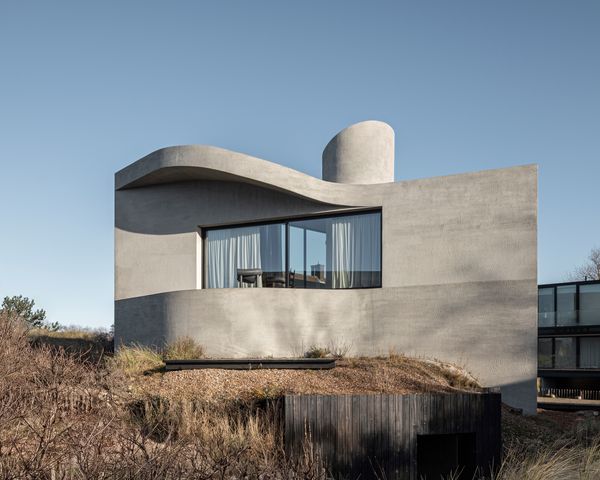
Photo: Tim Van de Velde
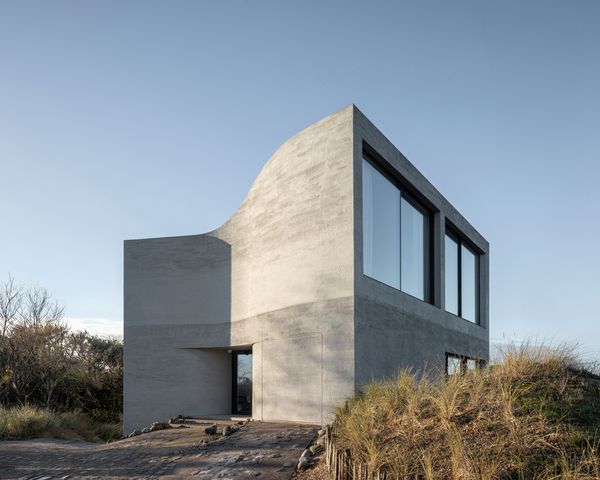
Photo: Tim Van de Velde
See the full story on Dwell.com: Cast Concrete Steps Form a Flowing Staircase That Centers This Belgian Home
Related stories: