From the Archive: How Edith Heath Upended Modern Ceramics
After her death more than two decades ago, we revisited how the trailblazing potter’s beloved tableware became synonymous with California style and the midcentury-modern aesthetic.
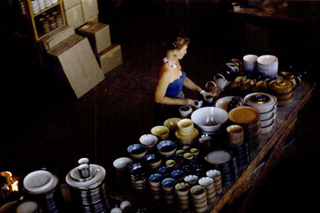
After her death more than two decades ago, we revisited how the trailblazing potter’s beloved tableware became synonymous with California style and the midcentury-modern aesthetic.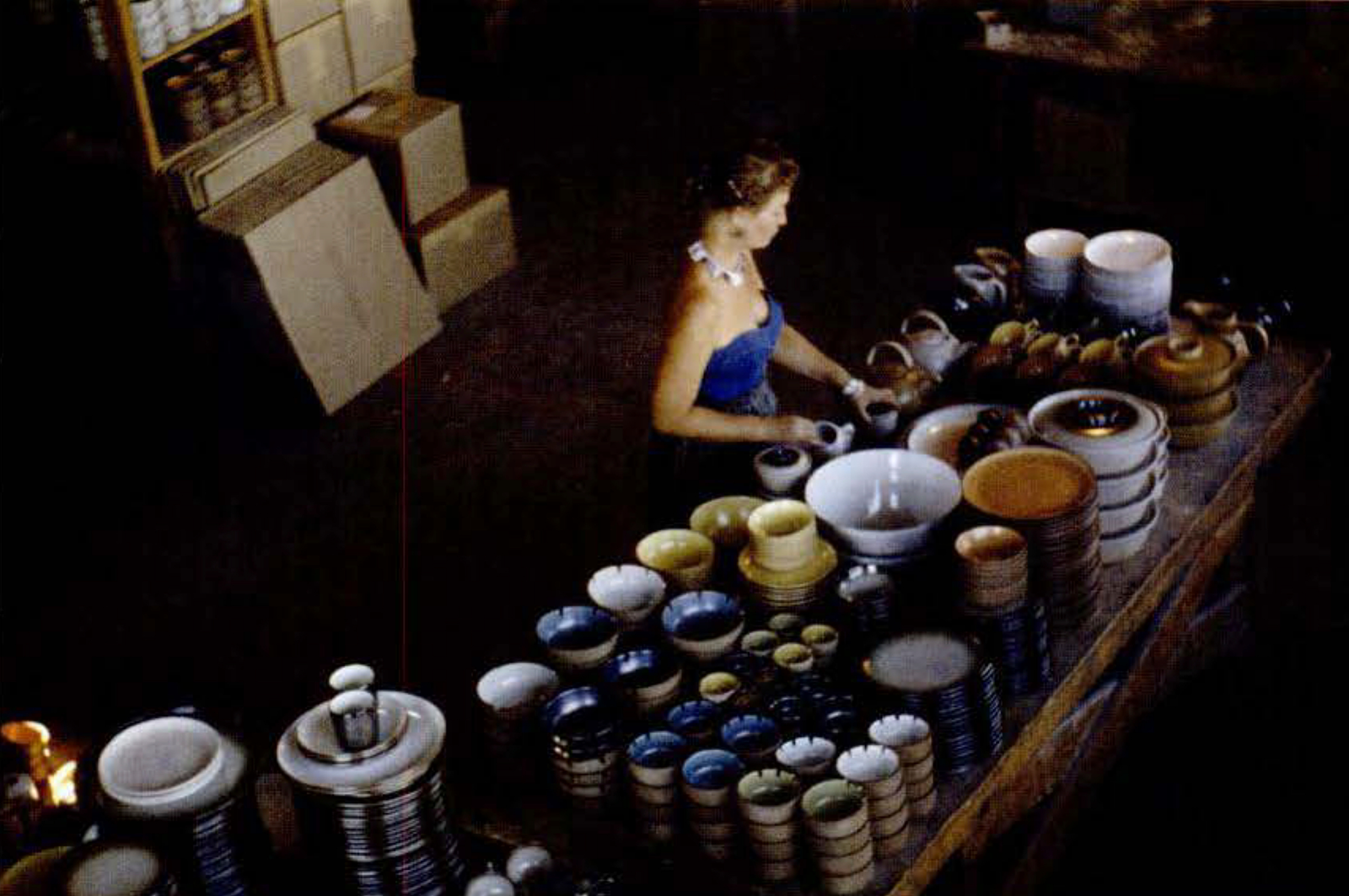
Welcome to From the Archive, a look back at stories from Dwell’s past. This story previously appeared in the June 2006 issue.
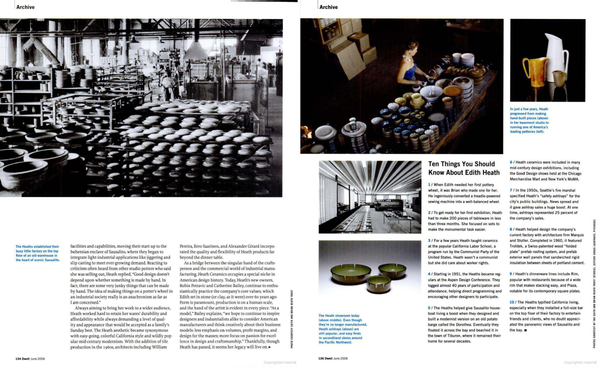
When Edith Heath died this past December, at the age of 94, she left behind a treasured legacy as a dedicated studio potter, a gifted industrial designer, and the owner of one of the few remaining American potteries, Heath Ceramics. Step inside the energetic little factory in Sausalito, California, just over the Golden Gate Bridge from San Francisco, and you can see, through a slight haze of clay dust, Heath’s influence up and down the production floor. From the 90 different dinnerware shapes she designed—most of which are still in production—to the lively and organic tile experiments that hang from every wall, Heath’s presence and persistence is a dense tapestry of clay and color.
Photos courtesy of The Edith and Brian Heath Trust / Jeffery Cross
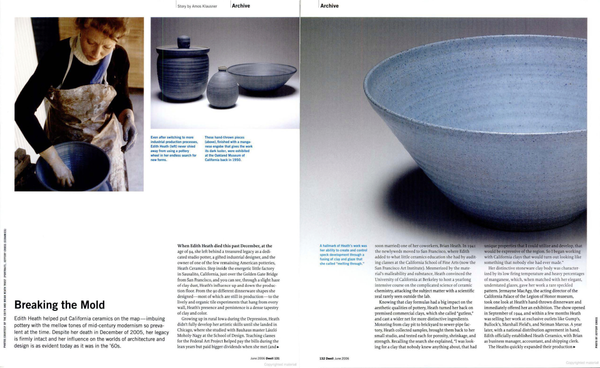
Growing up in rural Iowa during the Depression, Heath didn’t fully develop her artistic skills until she landed in Chicago, where she studied with Bauhaus master László Moholy-Nagy at the School of Design. Teaching classes for the Federal Art Project helped pay the bills during the lean years but paid bigger dividends when she met (and soon married) one of her coworkers, Brian Heath. In 1941 the newlyweds moved to San Francisco, where Edith added to what little ceramics education she had by auditing classes at the California School of Fine Arts (now the San Francisco Art Institute). Mesmerized by the material’s malleability and substance, Heath convinced the University of California at Berkeley to host a yearlong intensive course on the complicated science of ceramic chemistry, attacking the subject matter with a scientific zeal rarely seen outside the lab.
Knowing that clay formulas had a big impact on the aesthetic qualities of pottery, Heath turned her back on premixed commercial clays, which she called "gutless," and cast a wider net for more distinctive ingredients. Motoring from clay pit to brickyard to sewer-pipe factory, Heath collected samples, brought them back to her small studio, and tested each for porosity, shrinkage, and strength. Recalling the search she explained, "I was looking for a clay that nobody knew anything about, that had unique properties that I could utilize and develop, that would be expressive of the region. So I began working with California clays that would turn out looking like something that nobody else had ever made."
Her distinctive stoneware clay body was characterized by its low firing temperature and heavy percentages of manganese, which, when matched with her elegant, understated glazes, gave her work a rare speckled pattern. Jermayne MacAgy, the acting director of the California Palace of the Legion of Honor museum, took one look at Heath’s hand-thrown dinnerware and immediately offered her an exhibition. The show opened in September of 1944, and within a few months Heath was selling her work at exclusive outlets like Gump’s, Bullock’s, Marshall Field’s, and Neiman Marcus. A year later, with a national distribution agreement in hand, Edith officially established Heath Ceramics, with Brian as business manager, accountant, and shipping clerk.
The Heaths quickly expanded their production facilities and capabilities, moving their start-up to the bohemian enclave of Sausalito, where they began to integrate light-industrial applications like jiggering and slip casting to meet ever-growing demand. Reacting to criticism often heard from other studio potters who said she was selling out, Heath replied, "Good design doesn’t depend upon whether something is made by hand. In fact, there are some very junky things that can be made by hand. The idea of making things on a potter’s wheel in an industrial society really is an anachronism as far as I am concerned."
Always aiming to bring her work to a wider audience, Heath worked hard to retain her wares’ durability and affordability while always demanding a level of quality and appearance that would be accepted as a family’s Sunday best. The Heath aesthetic became synonymous with easy-going, colorful California style and wildly popular midcentury modernism. With the addition of tile production in the 196os, architects including William Pereira, Eero Saarinen, and Alexander Girard incorporated the quality and flexibility of Heath products far beyond the dinner table.
As a bridge between the singular hand of the craftsperson and the commercial world of industrial manufacturing, Heath Ceramics occupies a special niche in American design history. Today, Heath’s new owners, Robin Petravic and Catherine Bailey, continue to enthusiastically practice the company’s core values, which Edith set in stone (or clay, as it were) over 6o years ago: Form is paramount, production is on a human scale, and the hand of the artist is evident in every piece. "As a model," Bailey explains, "we hope to continue to inspire designers and industrialists alike to consider American manufacturers and think creatively about their business models: less emphasis on volumes, profit margins, and design for the masses; more focus on passion for excellence in design and craftsmanship." Thankfully, though Heath has passed, it seems her legacy will live on.
Photos courtesy of the Edith and Brian Heath Trust / Jeffery Cross
See more from the Dwell archive on US Modernist.
Related Reading:
From the Archive: Forget the Machine for Living—Designer Eva Zeisel Aimed for Objects With Soul
From the Archive: Remembering Alexander Girard, the American Master of Colorful Modernism