From the Archive: In the Suburbs of L.A., a Modern Loft Addition Made a Tract Home Ideal for Artists
Hardly visible from the street, the Central Office of Architecture’s new structure provided a rebuttal to the site's existing predictable bungalow—without disrupting the flow of the neighborhood.
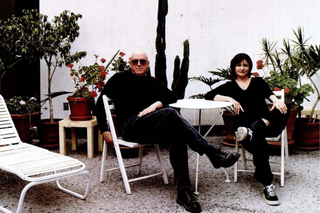
Hardly visible from the street, the Central Office of Architecture’s new structure provided a rebuttal to the site's existing predictable bungalow—without disrupting the flow of the neighborhood.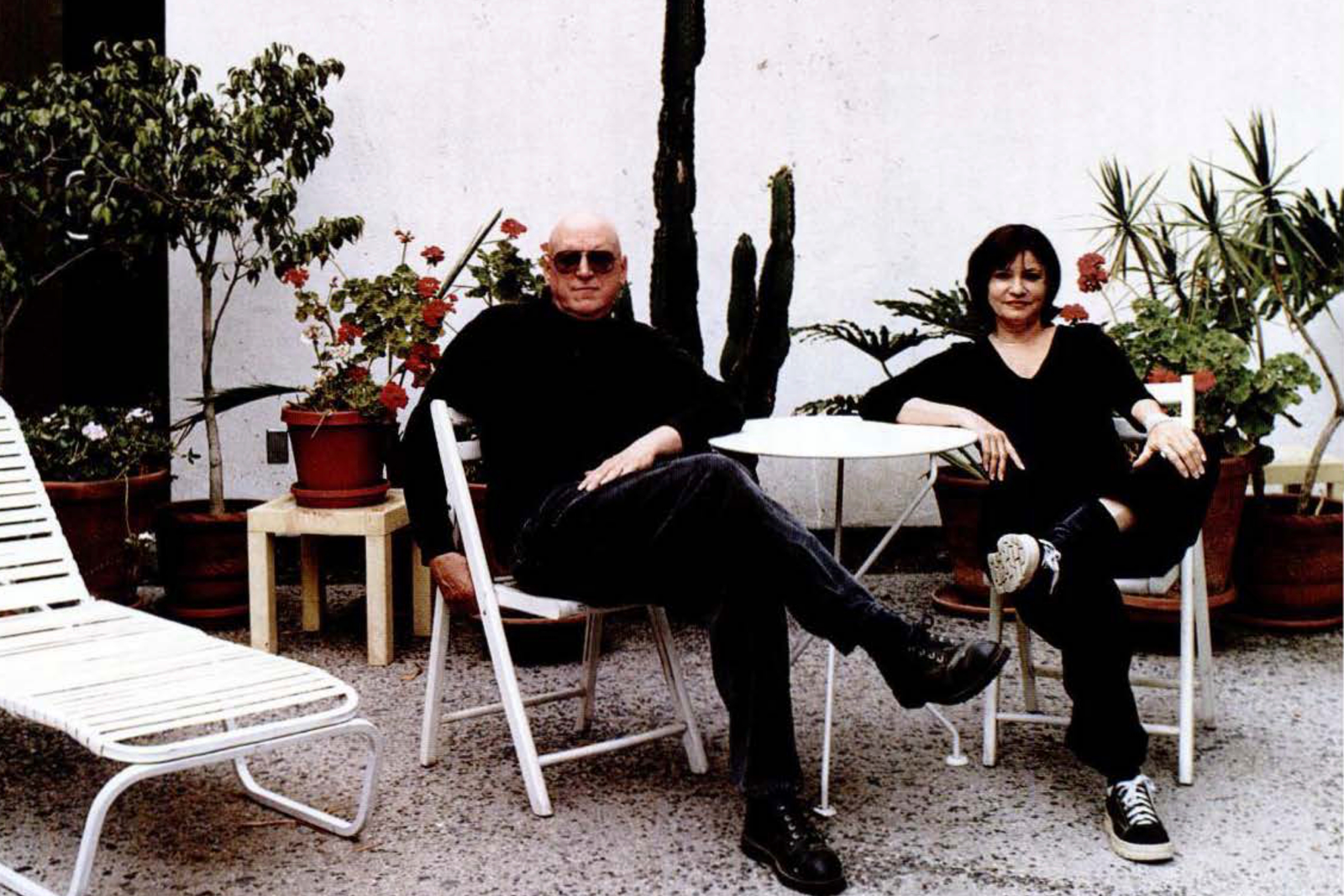
Welcome to From the Archive, a look back at stories from Dwell’s past. This story previously appeared in the October 2001 issue.
Propped up on the wood-plank fence that divides this property from the neighbor’s, contractor Roman Janczak surveys an amply weedy backyard. For him, this is all potential, a found space on which to build. Before moving, Janczak transformed his own lot (which once looked much like the one next door) from lawnmower nightmare to modernist dream. Perched on the fence between lots with Janczak, I feel like a cross between a peeping Tom and Kilroy as we peer over the boundary and crane to get glimpses of other properties. Orange, lemon, and flowering pomegranate trees flourish in this post-war subdivision. A couple of beasts, which I am told are "nice dogs," bark and scratch at the fence.
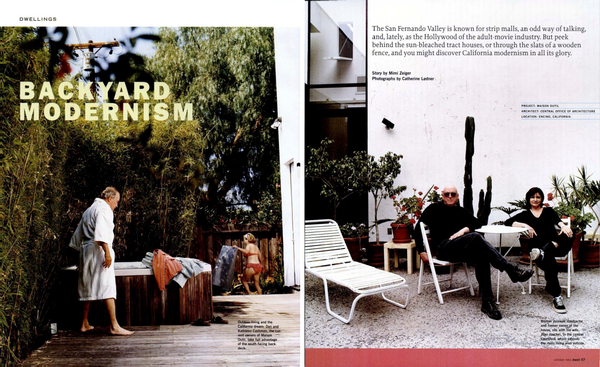
This is Encino. The San Fernando Valley. Southern California. Although it is years past the height of midcentury "keeping up with the Joneses," and the development has aged without the facelifts of other, richer suburbs, there is a sense of Arcadia in the valley on a day clear and relatively free from smog.
Our side of the fence is a different type of Eden: a utopia inspired by such modern masters as Richard Neutra and Rudolph Schindler. Maison Outil (Tool House), which was designed by the Los Angeles firm Central Office of Architecture (COA) and constructed in the backyard, fills up most of the lot, but the openness of the design gives the sense of being outdoors. COA partners Russell Thomsen, Ron Golan, and Eric Kahn picked up on Le Corbusier’s doctrine "a house is a machine for living in," and integrated it with the openness afforded by California living to produce architecture that follows their philosophy of the house as functioning not only as a machine but as a tool.
The space is decadent in its airiness, but restrained in its materiality. The floor is made of polished concrete and the walls are white plaster. Crucial to the early design session was a quote by Janczak: "I want to live in an aircraft hangar." His seemingly simple request carries through into the built form.
But how do you build an aircraft hangar in a postwar subdivision filled with two-bedroom houses crowned with TV antennae? COA’s solution is more discreet than one might expect. The 1,400-square-foot addition is stealthily tucked away behind the existing 860-square-foot bungalow. The result is an industrial, loftlike space hidden in suburbia.
Roman Janczak and Joan Jaeckel lived in the existing house for more than 10 years before commissioning COA to design the addition, which Janczak, a contractor and an unofficial fourth partner of the architecture firm, built.
"Any job we get, we all work on it," says Kahn about the structure of the firm. "Roman negotiates with the clients. He sees the purpose in doing something well for the sake of architecture and for the clients. It’s hard to get [a contractor] to really care, and Roman really does." Of course, when the contractor is the client, things run pretty smoothly. "The house was absolutely for ourselves—very personal. We looked upon it as a piece of art," offers Janczak. In fact, it is hard to get him to put a price on the cost of the addition, since he donated his time and skill, as well as pulling in a few favors amassed in his trade. The result is a home where the details are modest but refined, and well thought-out. He gestures to the specialized lighting in the art studio and the Korean-inspired main bath.
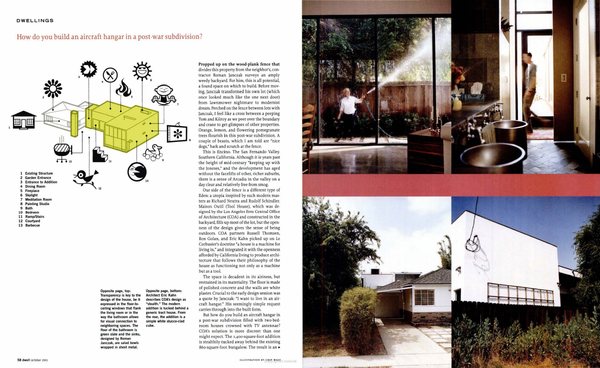
The house transitions from old to new, from the mass production of cookie-cutter tract homes to contemporary customization. A narrow skylight cuts into the existing structure, using light to join the remodeled kitchen to the double-height living area.
Jaeckel, an education advocate for the Whole Education Project, wanted to use the house to host fundraising events. In response to her requests, the main living area embodies both the industrialism of a live/work space and the characteristics of a garden pavilion. In short, it’s a great space for parties.
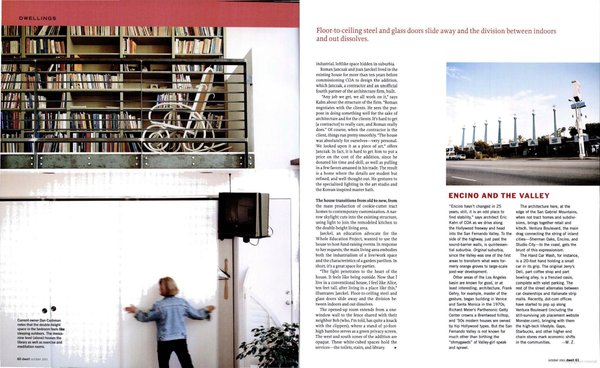
"The light penetrates to the heart of the house. It feels like being outside. Now that I live in a conventional house, I feel like Alice, ten feet tall, after living in a place like this," illustrates Jaeckel. Floor-to-ceiling steel and glass doors slide away and the division between indoors and out dissolves.
The opened-up room extends from a one-window wall to the fence shared with their neighbor Bob (who, I’m told, has quite a knack with the clippers), where a stand of 3o-foot-high bamboo serves as a green privacy screen. The west and south zones of the addition are opaque. These white-cubed spaces hold the services—the toilets, stairs, and library.
See the full story on Dwell.com: From the Archive: In the Suburbs of L.A., a Modern Loft Addition Made a Tract Home Ideal for Artists
Related stories:



.jpg?1616711915#)