The Urban Swimming Revolution Is Here
Across a growing number of European and American cities, people are taking back their waterways.
Across a growing number of European and American cities, people are taking back their waterways.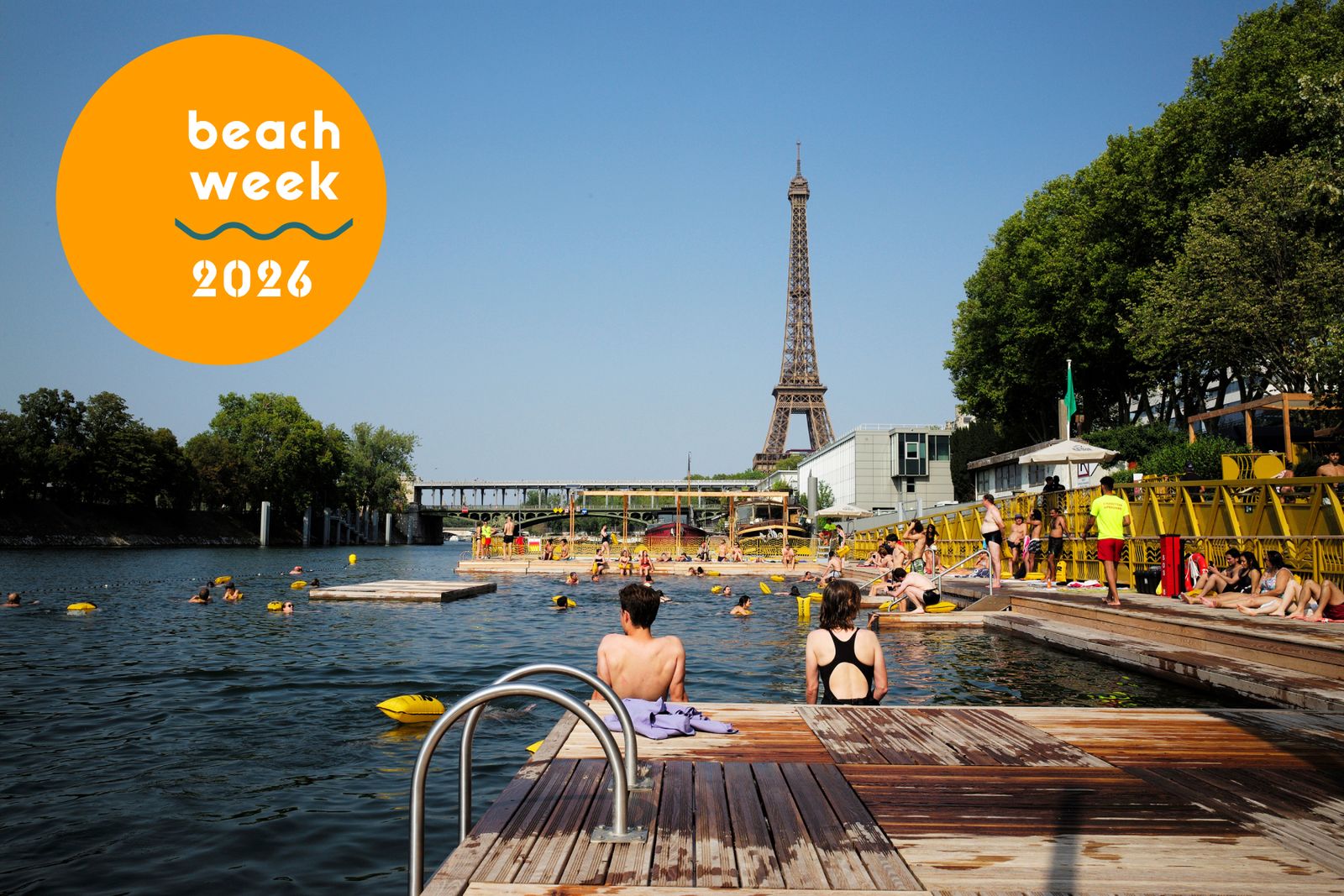
Welcome to Beach Week, our annual celebration of the best place on Earth.
When the temperature rises, it seems half of Portland, Oregon, gets the same idea: Let’s head down to the Willamette. It’s no wonder—it’s the sweetest water for miles, and the banks of this wide, chill river have become the city’s outdoor living room. "Everyone gathers at the downtown beaches with their kids and their dogs, swimming and paddleboarding, jumping off the docks," says Amy Souers Kober, vice president of communications at natural conservation group American Rivers, and regular swimmer in downtown Portland. "The natural open water is just beautiful. It’s a really neat way to experience the place you live." A lot has changed on those banks in the past 20 years—the Willamette has gone from being heavily polluted and illegal to enter, to safely welcoming swimmers. "If you live in downtown Portland, this is part of our quality of life," says Kober. "The Willamette is our natural space. It feels great to be in it."
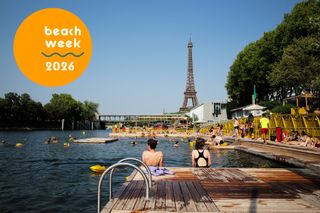
After being unswimmable for decades, major cleanup efforts have transformed the waters of Portland into an American success story alongside cities like Washington, D.C., Boston, San Antonio, and Chicago, which just had its second annual Chicago River Swim. In the global push toward urban open-water swimming, cities like Copenhagen, Oslo, Amsterdam, Munich, and Zurich and Basel have led the way in clearing their waterways of sewage, agricultural runoff, and industrial waste to make swimming part of city culture. All over the world, inner-city waterways are now being reclaimed for swimming and water sports, spurred on by Paris declaring the River Seine open for swimming for the first time in a hundred years, just in time for the 2024 Olympics. It was a moment that made many city dwellers across the world sit up and ask questions—who is our river really for? And why can’t we swim in it?
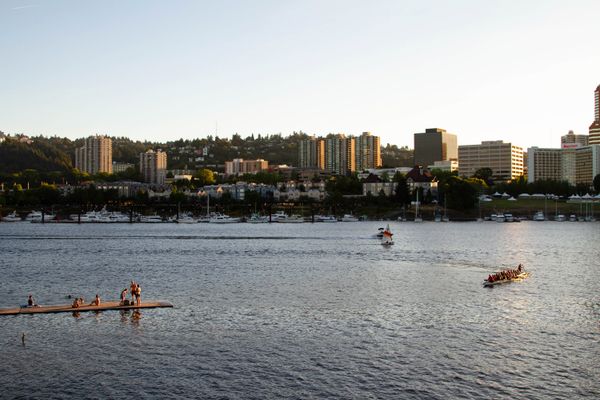
Swimmers lounge on a dock on the Willamette River in Portland, Oregon.
Photo by Ann Suckow via Getty Images
Willie Levenson first asked himself these questions when he moved to Portland in 1996 and found that locals considered the river a write-off. "I was told to never put your toe in the Willamette or you’d grow horns and your skin would flake off," he says. "When I first started talking about swimming in the Willamette, ninety-nine percent of Portland thought I was a lunatic."
Swimming used to be popular in the Willamette before being banned in 1924, as the river became increasingly saddled with sewage overflows and unfiltered factory discharges. Things started looking up in the 1990s when legal nonprofit Northwest Environmental Advocates used the Clean Water Act to compel the city to address the problems. The result was Portland’s 20-year Big Pipe project, completed in 2011 to the cost of $1.4 billion, which ensured the city’s waste no longer enters the waterways untreated. Except on a few stormy days in winter (when the City will issue notifications), the Willamette routinely comes up good and safe for swimming.
Levenson went on to become the founder of the grassroots advocacy group Human Access Project, which has worked tirelessly for 16 years to promote river swimming for Portlanders. "Multiple generations have been taught to feel shameful and hopeless about our urban river spaces, and it takes a lot of work to get people to think about it differently," he says. This is why Human Access Project started out by organizing what they called "recreational protest swims" in the Willamette in the years after the cleanup when entering the river was still illegal—to draw attention to the fact that since the cleanup, the water is safe and the rules needed changing. The transition was gradual; Portland got its first official beach in 2017, and swimming only became fully legal in 2022. But today, anyone can join the River Huggers, the one-time trespassers, as they swim across the Willamette six days a week, right next to the downtown Hawthorne Bridge.
The story of the Willamette is similar to that of many other major cities, where the rivers are often cleaner today than in decades, but people still harbor feelings of urban waters being dangerous and to be avoided. "People protect what they love, so the first step is getting them to see that rivers are assets with value," says Levenson, who describes himself as "a river plunker" rather than a fitness swimmer—"somebody who hangs out on a dock or a beach and sits around until they get hot, then jumps in and cools off." For Levenson, the river is a "liquid public space" for communities to get together. "Cell phones don’t work as well there, and people are generally dressed the same," he says. "It’s just a great way to bring people together."
The City of Portland is a member of the Swimmable Cities initiative, which launched two years ago as an international support organization to inspire and share resources for making urban waterways safe to swim in. After taking off in Europe, the group now has members around the globe, including several recent joiners across North America. Right now the signatories include 237 organizations across 115 cities and towns in 37 countries, including, in the U.S., places from New York City, Baltimore, and Milwaukee to McCall, Idaho.
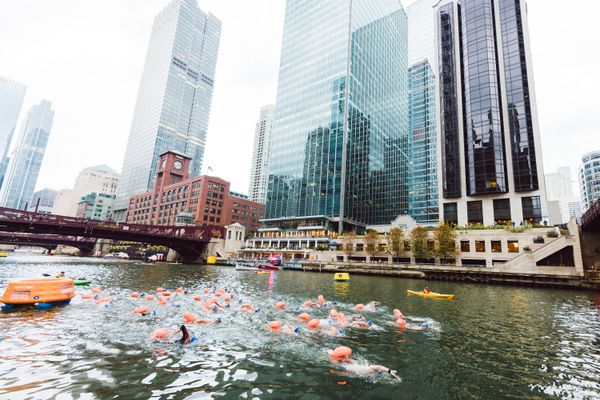
A view of the 2025 Chicago River Swim, which marked the city’s first such event in a century.
Photo by Chris Costoso, courtesy Chicago River Swim
Urban swimmers’ barriers to entering the water usually start with sewage overflows and pollution. "The fundamentals are all very similar," says Swimmable Cities cofounder Matthew Sykes. Long before the initiative launched, cities like Copenhagen and Amsterdam became beacons for urban swimming after spending more than a decade cleaning not only the cities’ waters but the entire systems around them, from preventing sewage spills during rainstorms to compelling individuals to install filters on their houseboat pipes. It’s not cheap—Paris spent nearly €1.4 billion to get the Seine up to scratch, including building a giant stormwater basin. Cleaning the water is just one of the Swimmable Cities initiative’s seven enabling conditions, which also includes cooperation and investment partnerships. And even with everything else in place, campaigners often run into red tape and fearful city officials worried about drownings. "We need to create the social infrastructure of swimming too, with learn-to-swim programs and education about swimming outdoors," says Sykes.
U.S. cities do, however, have some unique challenges. In Annapolis, the state of Maryland spent over $4.8 million to buy back a piece of Chesapeake Bay waterfront that once served the Black community during segregation, in a move that recognized how historic racial barriers to accessing water can still be felt in present-day inequalities. "We also hear a lot more about privatization of waterfronts in the U.S.," says Sykes, explaining that while people may be allowed to walk next to the water, swimming on private land is frequently forbidden due to liability fears.
In New York’s Lower Manhattan, access to the water is so restricted that swimming organizers take people out on boats for Statue of Liberty swims. "Starting from land would be a safer and better experience, but with very few exceptions, that’s not permitted," says Deanne Draeger, founder of UrbanSwim, which organizes open water swims across the five boroughs while campaigning for safe access to local waters. This includes teaching people about water safety, as the Hudson and East Rivers have strong currents: "Downtown Manhattan is a very busy area in terms of water traffic," says Draeger. "And if you don’t understand how the tides and currents work, it can be very dangerous."
New York City’s rivers are much cleaner than they used to be, but there’s still a lot of work to do. Last year, the state’s Department of Environmental Conservation proposed to reclassify the vast majority of the city’s waterways as "swimmable," but there are still too many days when rain triggers sewage overflows (in most cities, a good rule of thumb is to steer clear for 48 hours after a big rain). Still, despite what many New Yorkers think, it’s often safe to swim, at least in the summer—just keep a close eye on the test reports.
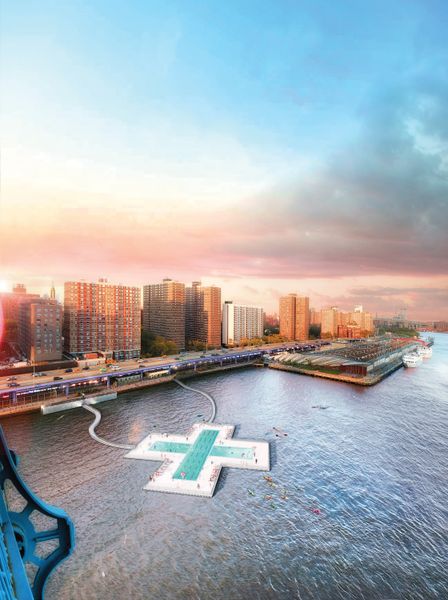
A rendering of the long-awaited +POOL in New York City.
Photo by Luxigon, courtesy of Friends of +POOL
See the full story on Dwell.com: The Urban Swimming Revolution Is Here
Related stories: