Tropical Modernism Beyond Aesthetics: The Politics of Shade and Air
The image is familiar, a façade layered with brise-soleil, light softened into a patterned shadow, interiors kept cool without machines. It appears as intelligence made visible, architecture that understands the sun. This image is rarely examined closely. The same devices that temper heat also organize access, distribute comfort, and depend on particular forms of labor. What looks like a climatic response is also a decision about who gets relief from heat, and how. Tropical modernism, often reduced to a visual language of shade and porosity, emerges instead as a set of situated practices where climate, labor, and power are negotiated differently across contexts.
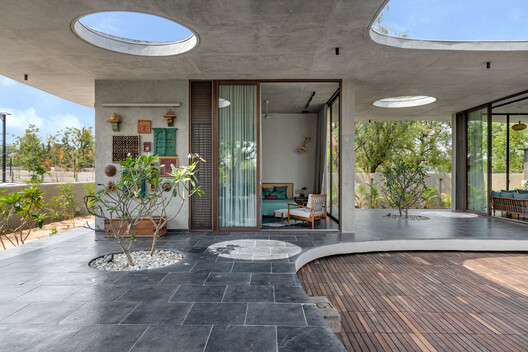
 The Veranda House / Studio Espaazo. Image © Murtaza Gandhi
The image is familiar, a façade layered with brise-soleil, light softened into a patterned shadow, interiors kept cool without machines. It appears as intelligence made visible, architecture that understands the sun. This image is rarely examined closely. The same devices that temper heat also organize access, distribute comfort, and depend on particular forms of labor. What looks like a climatic response is also a decision about who gets relief from heat, and how. Tropical modernism, often reduced to a visual language of shade and porosity, emerges instead as a set of situated practices where climate, labor, and power are negotiated differently across contexts.
At the scale of the element, tropical modernism begins as a technical problem. In hot climates, solar radiation is not incidental but constant, requiring buildings to mediate light, heat, and air before they reach the interior. Architects like Maxwell Fry and Jane Drew approached this with a level of precision that resists any reading of these elements as decorative. Shading devices are calibrated according to solar angles, orientation, and seasonal variation. Brise-soleil are dimensioned to block high-angle sun while admitting diffuse light; overhangs extend just enough to prevent direct gain at peak hours; openings are aligned to encourage cross-ventilation. Mid-century research further tested these strategies, measuring temperature reductions and airflow improvements. In this sense, the language of tropical modernism is not symbolic. It is performative: each projection, void, and screen is part of an environmental system.

.jpg?1601377821#)