We Need to Bring Back "Dump Decor"
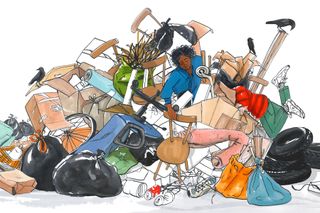
Garbage picking was once a great way to furnish our homes on the cheap. If we resurrected it, would we be better off?
Garbage picking was once a great way to furnish our homes on the cheap. If we resurrected it, would we be better off?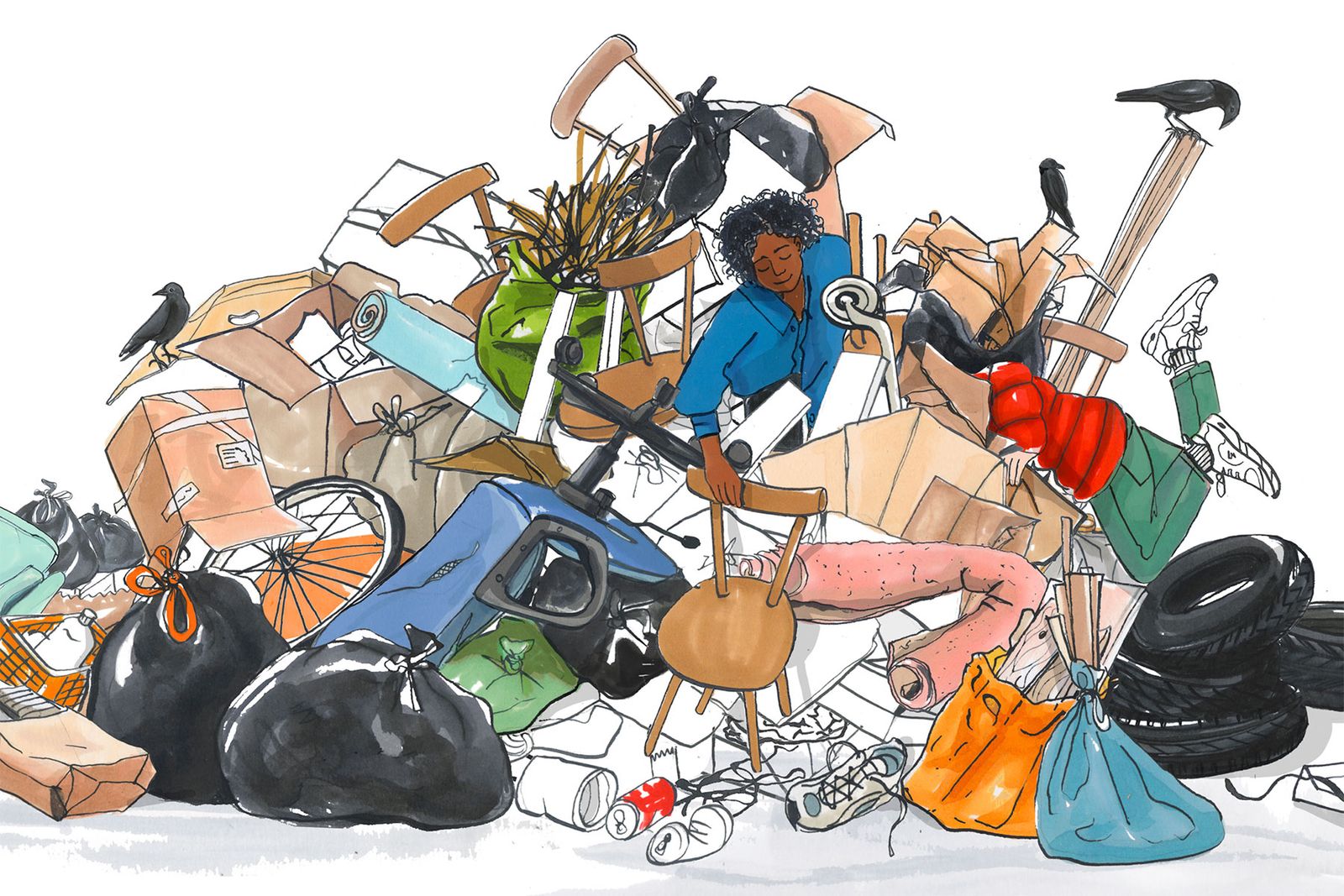
For most of my childhood, my parents cleaned our family summer cabin using a teal Electrolux vacuum that looked like a space-age tank on a leash. The appliance was, for us, fancy, the sort of thing that we might not be able to afford if they hadn’t gotten it for free. Like many other things in the cabin, it came from the local dump.
My parents, grandparents, and great-grandparents used to go to that dump in upstate New York not only to drop off trash but to pick some up. A salvageable side table that someone let go of? Sure. A dining table? Why not? Even a sofa was fair game. Finding furniture at the dump was not necessarily an option of last resort. It was just a sensible, normal thing to do, like picking up something someone had put out on the curb.
But the days of dump decor are dwindling. Our local dump has closed, replaced by a transfer station that takes your waste behind a gate before shipping it off to God knows where. You’re no longer allowed to peruse what others have left behind, and that’s part of a broader pattern.
Dumps themselves are being discarded, and they’re being replaced by landfills. Professor Robin Nagle, who is, among other things, the anthropologist in residence at the New York City Department of Sanitation, explains the difference: "A dump is what the verb says. It’s just a place where things get dumped." Landfills are more deliberate constructions, "very carefully engineered," Nagle says, so that they can one day be capped, contained, and covered with another use. Unlike dumps, with their free-for-all openness, landfills sequester refuse behind sanitary barriers. You can’t just go and poke around in them.
The American civil engineer Jean Vincenz pioneered the modern landfill in the 1930s. His landfill innovations spread across the U.S. after World War II, sometimes becoming part of postwar megaprojects. Fresh Kills Landfill on Staten Island, now covered by a park, is among humanity’s largest creations; one estimate says that it is by volume 25 times the size of the Great Pyramid of Giza. Landfills are not only more sanitary than dumps; they could also, as their name suggests, fill in land along shores or swamps for real estate development. Environmentalism in the 1970s brought more enthusiasm for landfills among lawmakers as a safer way to process waste, and they are now the norm in much of the world.
The shift from dumps to landfills is good. We do not need battery acid leaking into groundwater. But even amid positive change, we can lose a bit of treasure.
Nagle points me to a 1959 Atlantic essay in which novelist Wallace Stegner rhapsodizes about the local dump he used to pick through as a kid. "The dump was our poetry and our history," Stegner wrote. "It gave us the most tantalizing glimpses into our lives as well as into those of the neighbors. It gave us an aesthetic distance from which to know ourselves."
Landfills are closed off for public safety, and whatever goes in there, most people will never see again. But dumps offered a sort of shared space, albeit a flawed one. They were where furniture could be easily recycled among communities without having to make a big deal about it.
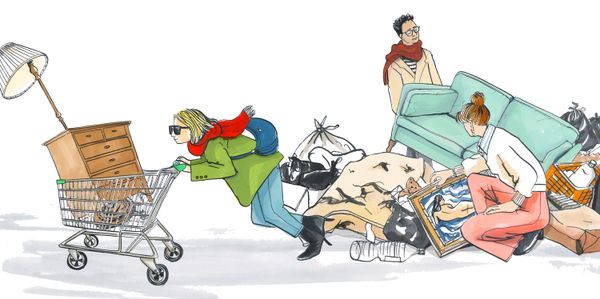
In the decades since dumps have fallen out of fashion, garbage picking of a daintier sort has become a modish, albeit more involved, way of decorating. Setting old furniture out on the curb has become a common way to offer things to passersby, but scoring a treasure that way relies on a lot of luck. With the help of the internet, you can find free things to decorate your home on Craigslist or Facebook Marketplace, and Instagram accounts like @stoopingnyc make curb treasure hunting in the city where I live a bit more efficient. But those platforms are built primarily to buy and sell things, and they impose a shopping mindset on the poetic process of wandering through waste that Stegner admired.
"In a gift economy, wealth is understood as having enough to share, and the practice for dealing with abundance is to give it away," writes the botanist Robin Wall Kimmerer in her 2024 book The Serviceberry: Abundance and Reciprocity in the Natural World. In Kimmerer’s description, gift economies are not built on scarcity and consumer choice but the sense that there is usually more than enough of what we need to go around, so long as we take care of the systems that provide for us. She uses relationships between plants and animals as examples of such setups. "Abundance is fueled by constantly circulating materials, not wasting them," Kimmerer writes. Serviceberry shrubs—from which the book gets its name—feed cedar waxwing birds, which spread seeds; the two populations ensure each other’s flourishing. Massive ecosystems that are much larger than Fresh Kills Landfill or anything else humans have created have existed stably for millions of years relying on this recycling of materials.
It’s ironic that dumps might be an emblem of that kind of ecology. They are where people go to throw away stuff that will sit and fester and pollute the environment. But not all trash is toxic, and reusing old vacuums and chairs is way more sustainable than stuffing them into even the most sophisticated landfill.
We could have public depots where you could drop off furniture you don’t need anymore, and someone else could pick it up. Neighborhoods could have their own local exchanges. Well-made furniture could be recycled within communities for centuries, nurturing design traditions grounded in local history instead of ones tethered to the latest consumer trend. Particle-board slop could become a memory. Even if you don’t have family heirlooms, your home could still be filled with history. And if you have amassed treasures with no kids to pass them on to, your things could easily find new homes. This kind of recycling is not far-fetched; libraries organize a similar kind of community sharing. There are enough freegan and Buy Nothing groups around to show that people are interested in gift economies, and organizing them better would bring them to many more people.
We’re not going to heal the world by doing this. "Even if we all recycle perfectly, it’s a drop in the bucket compared to medical and mining and industrial and agricultural [waste]," Nagle tells me. But just shifting our mindset so that we’re not turning everything into a marketplace and instead creating systems that are more generous would probably help us all.
"Communities of mutual self-reliance and reciprocity are the wave of the future," Kimmerer writes. May those communities be filled with dump-y design.
—