With Its Eerie Corporate Spaces, A24’s "Backrooms" Slashes Amnesiac ’90s Nostalgia
Fluorescent lighting and yellowing wallpaper imbue the film’s massive labyrinthian set with a sinister effect that the production designer wanted to feel "desperate."
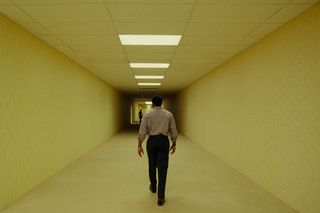
Fluorescent lighting and yellowing wallpaper imbue the film’s massive labyrinthian set with a sinister effect that the production designer wanted to feel "desperate."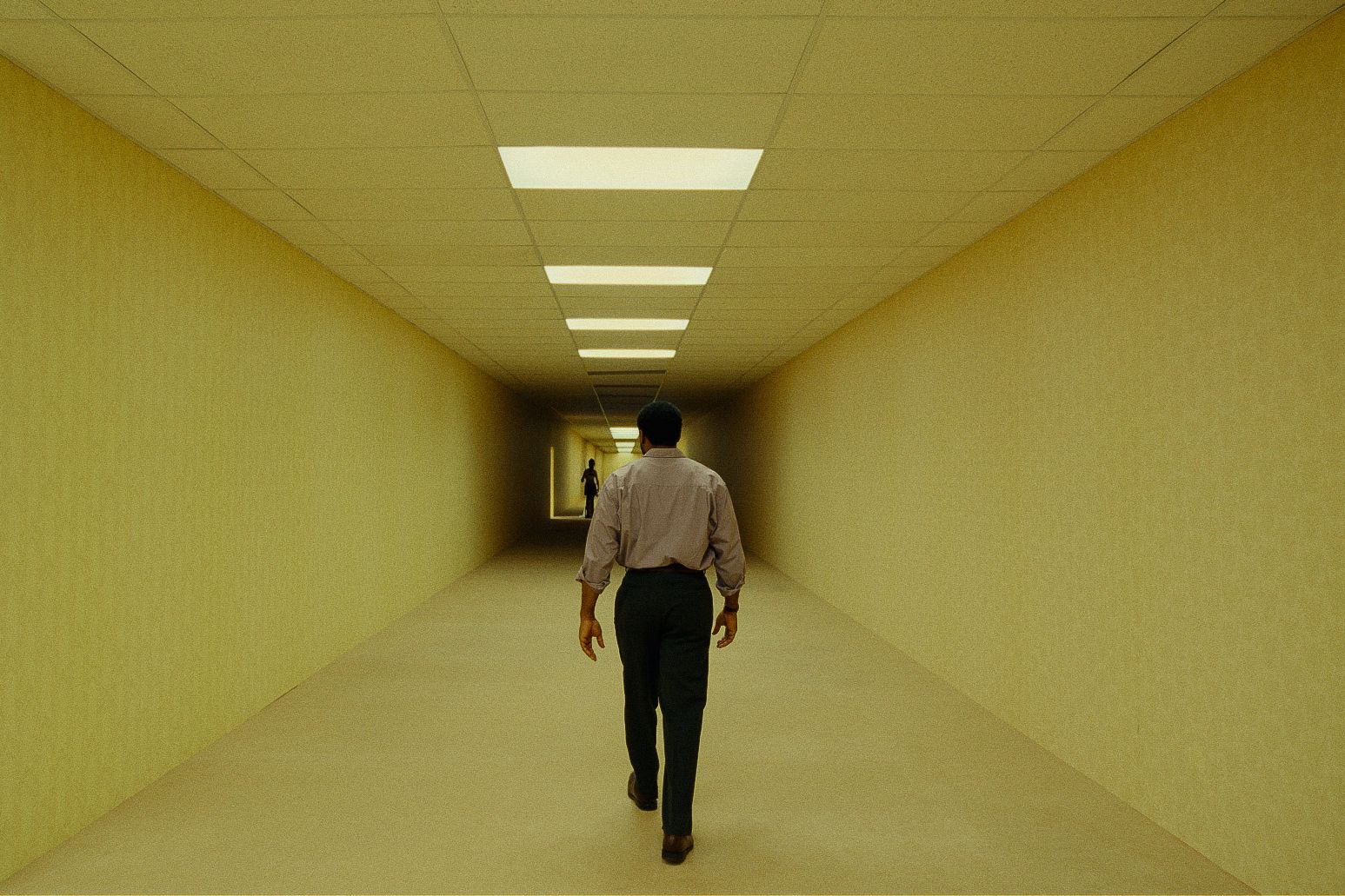
Unlike the reverence for midcentury modernism that has been grounded in the belief that things were made better back then, today’s reminiscing of the 1990s by Gen Z youth is something else entirely. For those of us who lived through the era, watching the resurgence of low-rise jeans and babydoll tees has come with a shudder and a wince—after all, it’s not just a fashion but an atmosphere that we’re reliving. The ’90s in the U.S. were colored by a technology market boom that strengthened the middle class before its inevitable bust. It was a decade that dripped with the rise of corporate expansion and consumerism amidst Ronald Reagan’s pulsing afterglow. The growing commercial enthusiasm was built into our everyday details: Fluorescent-studded popcorn drop ceilings, seas of cubicles, overstuffed (or inflatable) furniture that tried to scream opulence while smothered in pastel florals; web-like shopping malls to trap every consumer imaginable. There was an aura of social collapse under a mountain of stuff we’d built and bought.
It’s the perfect setting, however, for Kane Parsons’s new A24 film, Backrooms. The horror flick is based on Parsons’s viral YouTube series that (borrowing an unauthored singular, awkward image of a strange empty room that made its way across the internet) uses "found footage" to tell a fractured story about an otherworldly dimension called "the backrooms." Through 22 episodes, viewers encounter a maze-like wasteland that resembles an abandoned white collar workplace. Yellow wallpaper lines an endless clustering of rooms connected by doors and hallways; furniture and other artifacts seem to melt into the interior landscape that is lorded over by a malevolent creature.
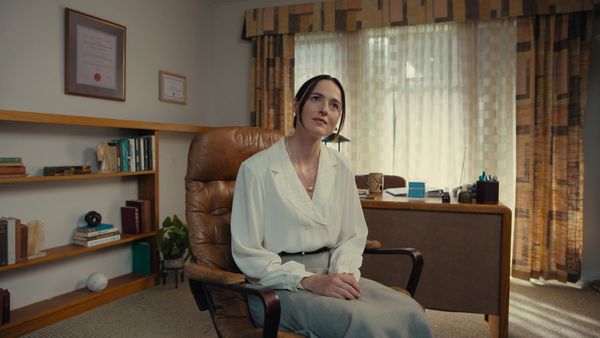
Renate Reinsve plays therapist Dr. Mary Kline, whose office is decorated with plain though period appropriate furnishings.
Photo courtesy A24
Parsons, who was 16 years old when he released his first episode, garnered such a following from his online debut that A24 gave him the opportunity to turn the idea into a long-form story, one that fleshes out the throwback conglomerate aesthetics: We get a good dose of oversize shoulder pads, sure, but we’re also injected with a reminiscent shudder from the 1990s economic precarity and materialism. Rather than relying on a plot that spells out the era’s spirit, the film instead focuses intently on its scenic design to evoke a generational horror. Led by production designer Danny Vermette, Backrooms is as much a scary flick as it is a period piece set in the ambiguous late-’80s-early-’90s, rehashing the era not as a nostalgic time of millennial optimism or Gen X counterculture, but as a harbinger to the agonies of our present.
The movie follows Clark (Chiwetel Ejiofor), an out-of-work architect, and Dr. Mary Kline (Renate Reinsve), the therapist who is guiding him through healing from his recent divorce. Through his recounting in therapy, we learn that Clark gave up architecture to support his now-ex wife’s education by managing a struggling furniture store, Cap’n Clark’s Ottoman Empire, in a dying strip mall. One night while attempting to fix some unruly circuit breakers he discovers that the store’s basement contains an invisible passageway into the backrooms. We watch him transform from a curious architect, mapping out the strange dimension’s floor plans, to an obsessive explorer, drawing his therapist into a gruesome chase in the inescapable, maze-like space. Throughout the movie, the set and props play another character entirely: the backrooms seem to have a life (and memory) of their own.
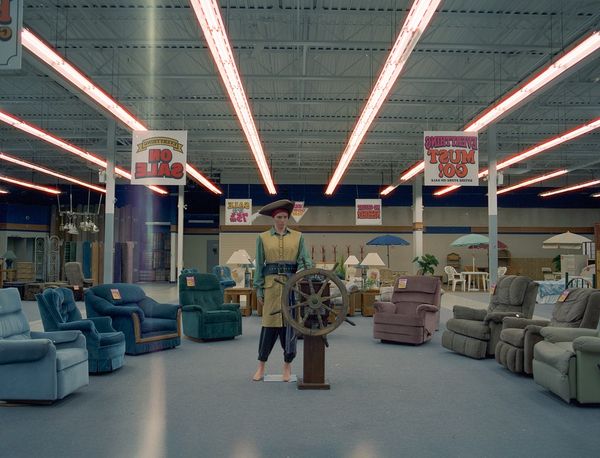
The Cap’n Clark’s Ottoman Empire furniture store is bleak in an entirely different way than the backrooms.
Photo courtesy A24
When Vermette first read the script, he says he knew that the ’90s would play a significant role—not just in the story’s setting, but in its ethos—and wanted to create two distinct sets for the furniture store and the backrooms that would complement each other aesthetically. As Clark attempts to pilot his languishing furniture store, Vermette sought a palette that, he explains, would feel "desperate." "We wanted to highlight that Clark isn’t doing so hot, but at the same time we wanted to make it beautiful; so how do we do that with the signage, with the color palette of the furniture, with the layout?" he says. The resulting interior features a variety of bulging La-Z-Boy recliners, maple bedroom and dining sets, and hand-painted signage reading "EVERYTHING MUST GO." The store feels sparse and foreboding, with awkward columns and too-bright fluorescent lighting. But beneath it, through its yolk-colored basement wall, the backrooms echo Cap’n Clark’s subtle despondency.
Bringing the otherworldly backrooms to life involved building a 30,000-square-foot labyrinthian film set. Initially Parsons provided Vermette with a drawing of the layout that he created using Blender, an open source 3D-modeling software. The file was so large that his computer crashed, Vermette says. They carefully chose which spaces could be physically built, understanding that many of the scenes required creating something fantastical—long hallways in the backrooms become trompe l’oeils that lead to nearly impassable doors, Escher-like stairways mess with the viewer’s spatial reasoning. Some scenes trigger vertigo, while others elicit claustrophobia.
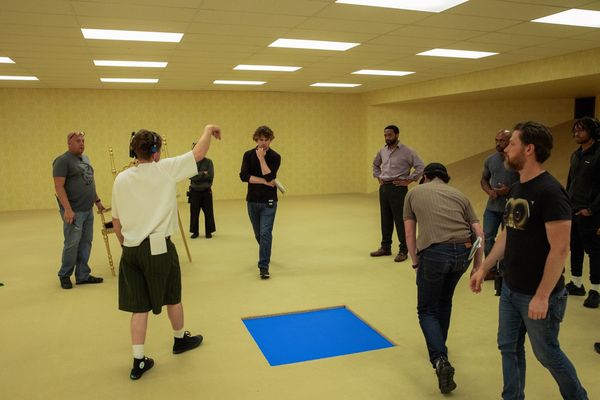
30,000 square feet of studio space was used to build out the backrooms for the film, in conjunction with the 3D-modeling software blender.
Photo courtesy A24
See the full story on Dwell.com: With Its Eerie Corporate Spaces, A24’s "Backrooms" Slashes Amnesiac ’90s Nostalgia
Related stories: