This L.A. Housing Design Contest Is Exactly How This Is Supposed to Work
A recent competition engineered to take advantage of new pro-density legislation has already helped fund the development of 20 new units.
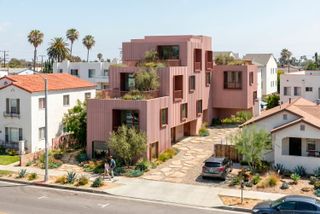
A recent competition engineered to take advantage of new pro-density legislation has already helped fund the development of 20 units.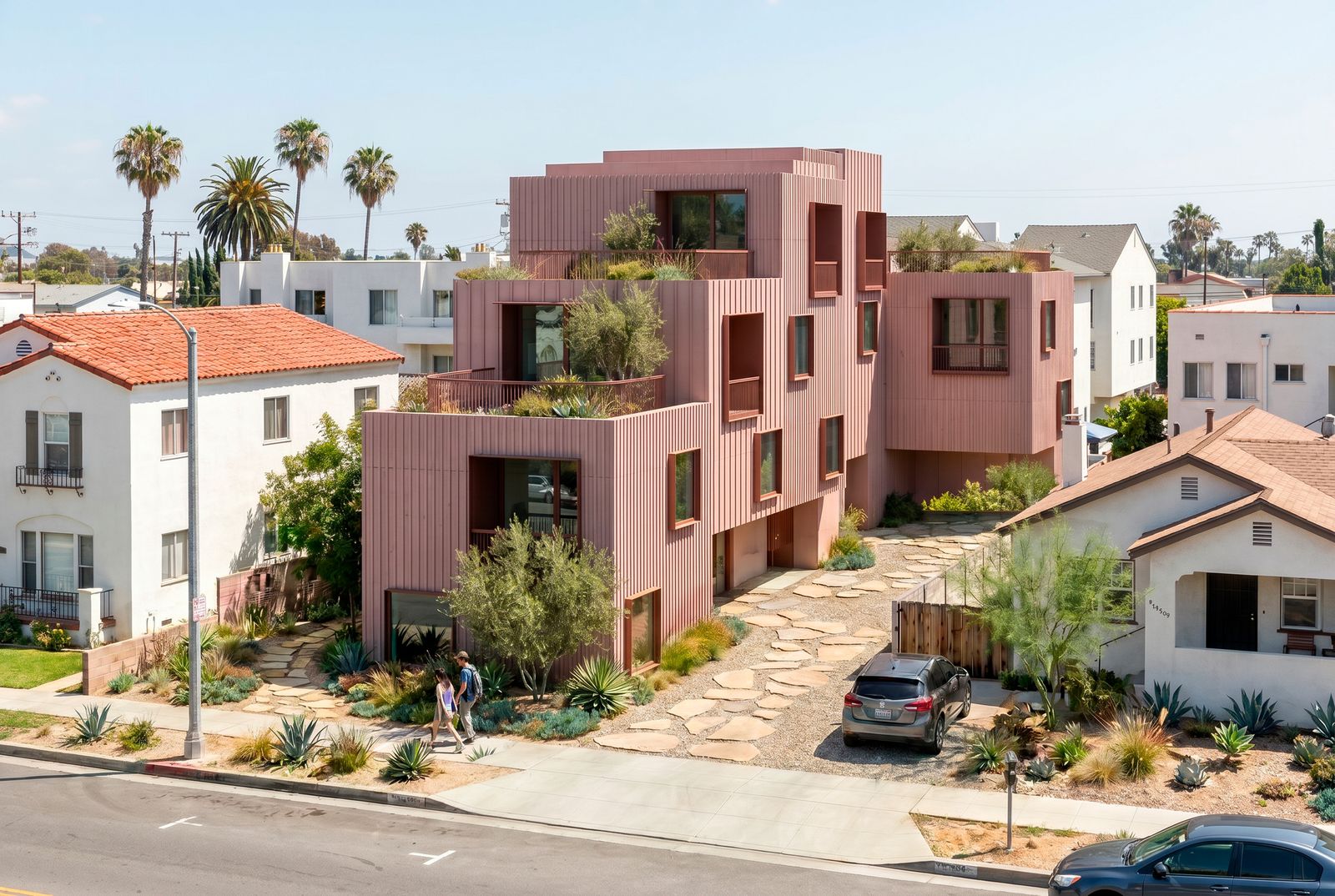
Debates around housing development are often chicken-or-the-egg. To build more housing quickly we must have legislative changes that allow for more housing to be built; but in order to build public consensus around such legislation—to defeat the NIMBY class—we must demonstrate that density is not the enemy, and that new housing can be built without neglecting good design. In recent years, Los Angeles has had a perfect confluence of chickens and eggs: the state and city have begun to loosen restrictions that slow down new developments, while groups like CityLab-UCLA, an interdisciplinary urban development research hub, have been capitalizing on the changes by soliciting proposals from the design and development community to get new homes built across the city’s thousands of vacant lots.
Last year, as Dwell previously reported, CityLab-UCLA launched their Small Lots/Big Impact design competition, which sought plans for a variety of multifamily housing typologies using city-owned land. Winners were selected and announced last spring. But as many design competitions go, their award-winning ideas were just that—ideas. To actually bring new homes to life, CityLab-UCLA partnered with local community development financial institution Genesis LA to introduce a subsequent competition, a request for information from developers and architects looking to build new owner-occupied housing, between three and ten units, on privately-owned land smaller than half an acre.
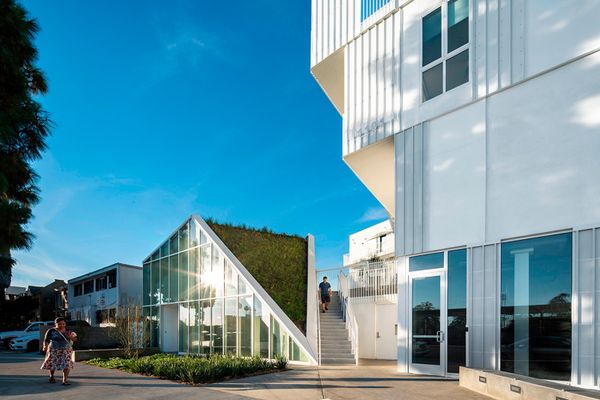
King 1101 Apartments, a previous project by one of the winning firms, Holos Communities, in Los Angeles.
Photo courtesy Holos Communities
This week, they’ve announced three winners of their RFI that, with Genesis funding, will cover 95 percent of the development costs, according to CityLab-UCLA. On the smallest side, Stayner Architects will construct between five and seven units on a single lot in Echo Park; Holos Communities and Assemblage Works, which proposed a modular multifamily development, will target East Hollywood; and the team of co-developers Six Peak Capital and Frolic Community, with architects West of West and Aero Collective, plan to build eight units on a single lot on the city’s west side.
Los Angeles, and California at large, have been leading the nation in overhauling their housing restrictions: Over the last five years, state and local governments have legalized ADUs statewide, streamlined multifamily permitting, and helped developers mitigate costly development fees. Very recently, California made it legal to subdivide individual lots to construct multiple homes on one parcel through SB 1123, which passed last year and went into effect last summer. Now, developers don’t need variances to add up to ten homes on a lot, which saves time (and dollars) on development and construction. The CityLab RFI capitalizes on SB 1123, says Emmanuel Proussaloglou, CityLab co-director. "There wasn’t a particularly economically viable development path on a lot of these lots up until recently, and now there’s a sort of push to see what we can do with it," he says.
Importantly, all of the lots that will be developed are privately owned—a departure from their original design competition that solicited ideas for the nearly 4,000 city-owned vacant lots. They decided to pivot their RFI to use privately-owned land as a way to avoid the lags of getting approvals from city officials. "We made sure that the winners of the design competition would be the most eligible and promising partners for any development deal—private or public," says Dana Cuff, CityLab’s director. In addition to the 4,000 city-owned parcels, there are around 24,000 privately-owned vacant parcels, she continues, many of which are ripe for housing development.
Though renderings are provided for each of the winning designs (two of the projects by Stayner and Six Peak/Frolic were included in the Small Lots ideas competition), they are not finalized, Proussaloglou says. Rather than the usual glossy imagery of many design competitions, he continues, the RFI jury looked for submitting teams that had completed previous work that aligned with their vision.
Winners are responsible for selecting their lots and securing entitlements; only one, Stayner Architects, already owns the lot on which they’ll build. The others are now "targeting" specific areas: The co-development team of Six Peak Capital and Frolic Community is looking at sites in neighborhoods like Venice where land will be more expensive, but Proussaloglou says that they have experience in developing alternative home ownership models to separate expensive land costs from unit costs. Holos Communities and Assemblage Works are targeting East Hollywood, he continues, where they hope to show a proof of concept around modular construction technology’s efficiency. Finding an eligible parcel isn’t easy and securing entitlements can be a long process; CityLab has a set timeline, and in the case that the winning teams cannot secure land there are 11 "bench" winners who can step in.
"We will be able to work alongside the teams to make sure that the laws that are in place are ones that the planning department and all the different review agencies know how to deploy. Since they are kind of new laws, that will be a job for us to work with alongside the development and design team to make sure that it all goes smoothly and according to law," adds Cuff.
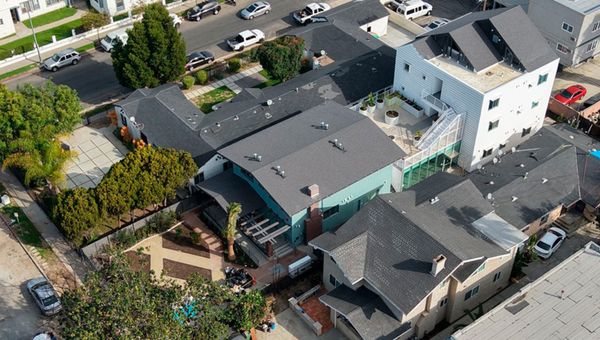
The Steps on St. Andrews, another project by Holos Communities in Los Angeles.
Photo courtesy Holos Communities
They hope that these new homes will be completed by 2029. It seems far off, considering that there will only be around 20 new units added to Los Angeles’s housing landscape, but CityLab organizers believe that their transparent, open-source process will influence how other developers take advantage of the new pro-density laws. "We are going to share as much as we can about the winning submissions—the designs, the pro formas, the summary documents from all 30 submissions," says Proussaloglou. Considering the climate in the Los Angeles real estate market, those developers who own lots and are ready to hit the ground running might have a leg up once the 20 forthcoming units are completed, and landing a chance to whittle down that list of 24,000 empty lots and turn them into a group of new homes as soon as possible.
Top image courtesy of Six Peak Capital
Related Reading:
What the Backlash to Build-to-Rent Housing Says About America’s Single-Family Home Obsession
Can We Blame the Banks for the Dearth of American Starter Homes?