Before & After: How a Couple Brought Their São Paulo Home’s Garden Into the Living Room
Architect Ana Sawaia revives a 1956 home by João Batista Vilanova Artigas by weaving in varying degrees of transparency, bright-yellow accents, and subtle references to his past work.
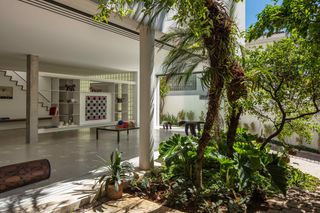
Architect Ana Sawaia revives a 1956 home by João Batista Vilanova Artigas by weaving in varying degrees of transparency, bright-yellow accents, and subtle references to his past work.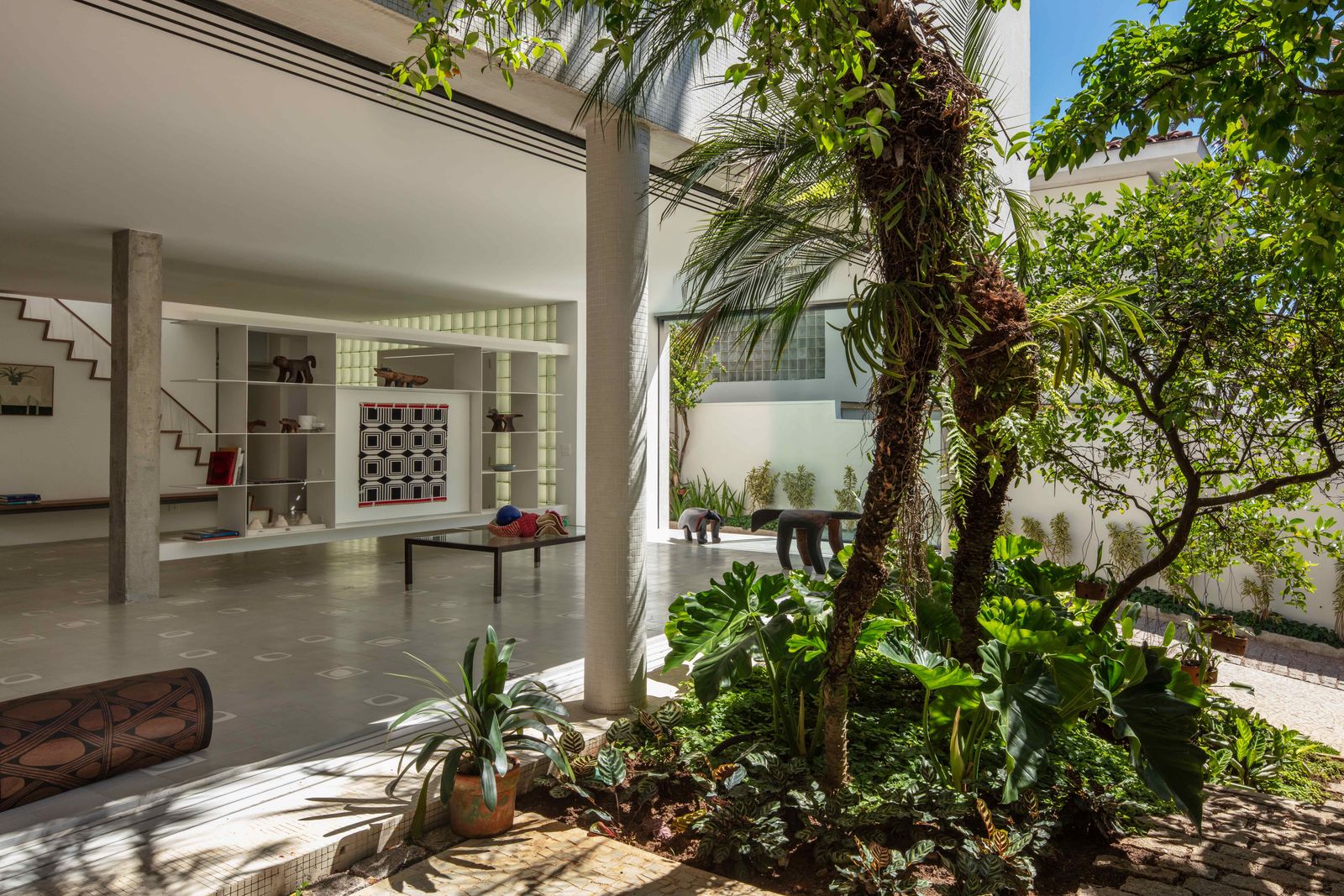
For Brazilian architect Ana Sawaia, the work of modernist architect João Batista Vilanova Artigas needs no introduction. Artigas was a founding figure of the São Paulo–based Paulista School, active from the 1950s to the 1970s, which favored using raw, exposed concrete to construct massive forms. The school’s work has been referred to as brutalist (although Artigas never liked the label)—and it contrasts with the smooth, curving style of the Carioca School in Rio de Janeiro. (For the latter, think Oscar Niemeyer.)
Artigas also cofounded the Faculty of Architecture and Urbanism at the University of São Paulo, where he was a professor. One of his well-known works is the department’s building on the main campus, designed with Carlos Cascaldi and finished in 1968.
Years later, Sawaia encountered Artigas’s work through her own architecture studies, and she’s currently on the board of the Instituto Virgínia e Vilanova Artigas, a professional organization dedicated to his work. In 2020, she remodeled an apartment in the 1946 Louveira Complex, designed by Artigas and Cascaldi. When she was tapped to remodel a second Artigas home, which she calls Casa Muxarabi, in São Paulo, she was thrilled. "I love his work," says Sawaia. "I felt very lucky to do this project."
Before: Exterior
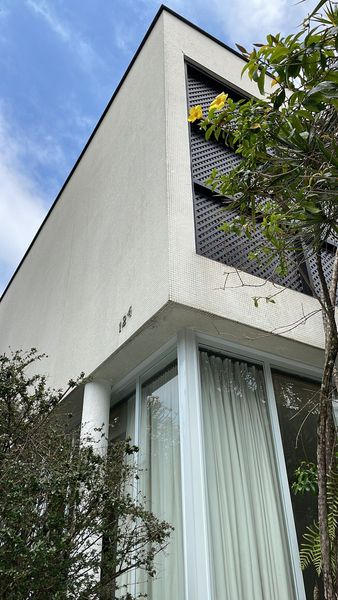
Before: This 1956 house in São Paulo, Brazil, was originally designed by João Batista Vilanova Artigas. When new owners bought it in 2021, it retained many of its original details, such as the exterior tile and the placement of the muxarabi screens.
Courtesy of Ana Luiza Almeida Prado Sawaia
After: Exterior
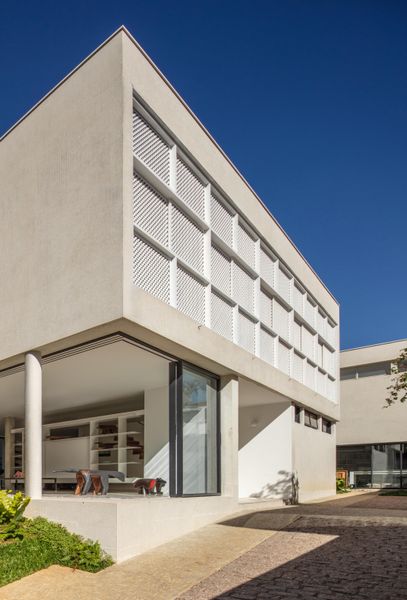
Architect Ana Sawaia restored the screens to their original color, and added stacking glass doors to open the ground level to the garden.
Photo: Nelson Kon
This house was built in 1956, and it’s part of Artigas’s second phase of residential work, says Sawaia. His first phase was more eclectic, with organic touches influenced by Frank Lloyd Wright. The next phase, which referenced Le Corbusier, was "characterized by a clear articulation between structure and spatial organization," says Sawaia. In Artigas’s third phase, which lasted from 1956 to the end of his career in the 1980s, the architect honed ideas that would later become the hallmarks of the Paulista School.
The current owners, a couple who work in the arts, purchased the home in late 2021 after a yearlong search. "They visited several notable houses, but this one immediately stood out," says Sawaia. They liked many of the existing features, like the original exterior tiles and the muxarabi screens, which were once made of white-painted wood, but had since been replaced with black aluminum versions.
They didn’t like the original floor plan, which felt too compartmentalized for the couple and their two daughters, two dogs, and two cats. "They were looking for a more open and connected space for everyday life, and also for receiving friends," says Sawaia. "The challenge was how to adapt the house to contemporary living without losing its special character."
Before: Living Room
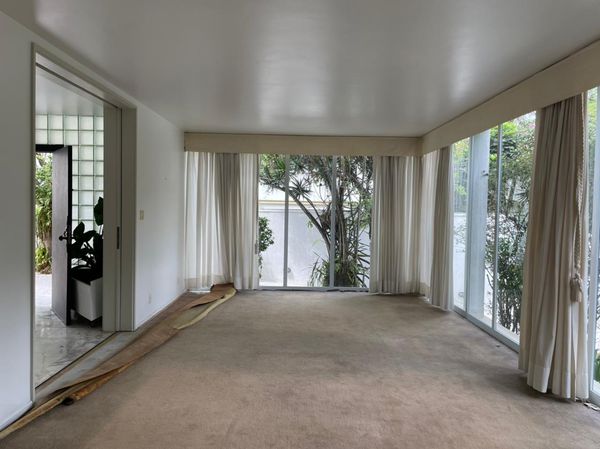
Before: The living room had fixed glass panels, carpet, and heavy drapes.
Courtesy of Ana Luiza Almeida Prado Sawaia
See the full story on Dwell.com: Before & After: How a Couple Brought Their São Paulo Home’s Garden Into the Living Room
Related stories: