From the Archive: The 82-Foot-High "Tree House" That Turned Heads in Small-Town Arkansas
Marlon Blackwell’s client never forgot the hideout his grandfather built him as a child. For his 56-acre property, the architect built a showpiece inspired by it.
Marlon Blackwell’s client never forgot the hideout his grandfather built him as a child. For his 56-acre property, the architect built a showpiece inspired by it.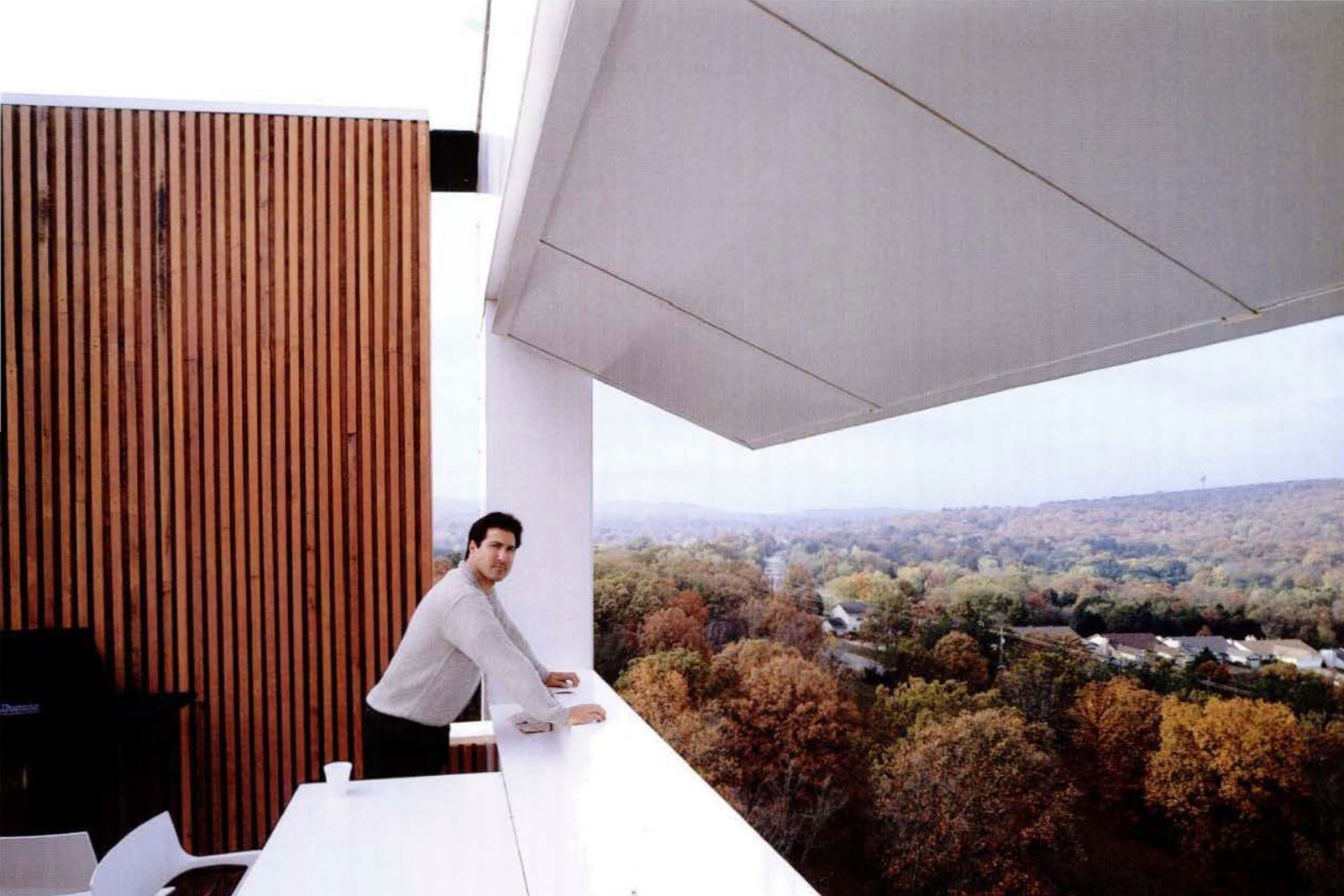
Welcome to From the Archive, a look back at stories from Dwell’s past. This story previously appeared in the August 2001 issue.
When Dr. Edith Farnsworth moved into the glass house Mies van der Rohe had designed for her, she bemoaned her lack of privacy. The recurring discovery of nose prints on the glass was just too much for her to bear. Thoughts of poor Edith crossed my mind when I spent the night in the Tower House in Fayetteville, Arkansas, in a room surrounded by glass on all sides. I was in a space that looms nearly 6o feet above the ground, but as gusting winds whipped around me and the night sky grew darker, discovering mysterious smudges on the glass when I woke seemed entirely plausible.
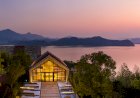
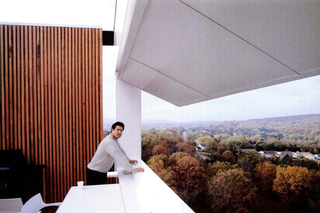
When the sun rose around 6:30 the next morning, everything changed. The panoramic view from the sun-filled room was mesmerizing. Beyond the forest of white oaks that dot the 56-acre property, I could see clear to the plains of Oklahoma. Any initial reservations about the desirability of a structure like this were immediately erased. It was easy to understand the immense pleasure one would take in the perfect simplicity of the space. Once settled in on the Corbu daybed, my feet resting on the George Nelson bench, I could read War and Peace straight through in this room or bring up my laptop and write the sequel.
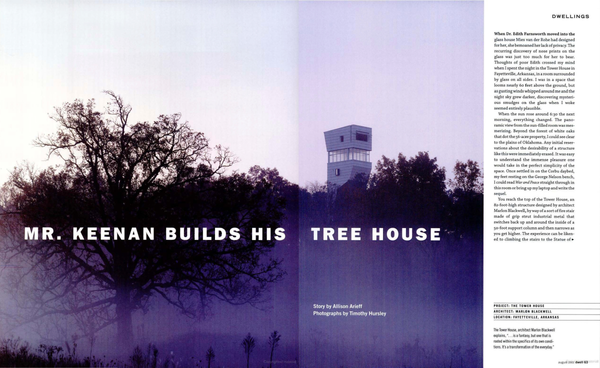
Photo: Timothy Hursley
You reach the top of the Tower House, an 82-foot-high structure designed by architect Marlon Blackwell, by way of a sort of fire stair made of grip strut industrial metal that switches back up and around the inside of a 50-foot support column and then narrows as you get higher. The experience can be likened to climbing the stairs to the Statue of Liberty torch. As you ascend, your focus is on the process of navigating darkness and stairs. Similarly, the somewhat claustrophobic means of entry to the Tower House only makes one’s first experience of its 36o degree view that much more profound. "I always thought of the stairwell as a room where you’d go in and light would filter in," explains Blackwell. "As you move up through it, your view is decelerated until there is no view or light—until you walk into the room."
And like the Statue of Liberty, the Tower is a monument, albeit one on a much more human scale and of a more personal bent. The impetus for its building was owner James Keenan’s desire to pay homage to his grandfather, Jack Stoffer. James’ fondest childhood memory was of his grandfather building him a tree house when he was six years old. Grandpa Stoffer had driven up from Houston to Harrison, Arkansas, to spend a week building the house for his grandson. "I sat on the ground, mesmerized, and watched him build it," James tells me. Two years later, James’ family relocated to Italy. "When our house was sold I had my parents pay me for all the materials my grandfather had bought. They were making me move, they were selling my tree house, and I was going to make them pay for it! But it was less about retribution. In a small way, I felt like a homeowner. And I was losing my home."
His parents did pay him, by the way.
Early indicators of financial acumen were on target. Keenan grew up to be a businessman and philanthropist, and after time spent in Texas and Virginia, he returned to his home state of Arkansas, a place he describes as a "hard one to leave." He purchased 56 acres of land in Fayetteville, surrounded by the Ozark Mountains and blanketed with white oaks, in 1996. Keenan is an unapologetic sentimentalist, a quintessential Southern gentleman who lives with his wife and infant son in a Tudor mansion and serves on at least five boards of directors in his beloved town. But he also happens to collect vintage sports cars. And he opted to commission an 8o-foot tower down the road from his house rather than build a den. He uses the Tower House primarily as a private retreat—a place to read, think, watch a video, get a little uninterrupted work done. He plans to move his office up there soon.
But the true purpose of the Tower? Blackwell laughs. "It’s the Porsche James doesn’t have to keep in the garage."
In 1996, Keenan approached Blackwell about building a tree house that would allow him to commune with the property. The two men had met through Keenan’s wife, Stacy, who worked at the architecture department of the University of Arkansas, where Blackwell is an associate professor. Because of the soft soil and the skinny trees, Blackwell felt that a tree house would not really work. How about, he suggested to Keenan, a house in the trees?
"I’d just returned from Yemen, where people live in these mud-brick towers," Blackwell explains. "I proposed a tower where he’d be above the trees, if not in them. He was intrigued and that’s how we started. The problem was that we had no idea of how to do it."
Blackwell and his team took an inventory of the site in November of 1997, noticing things like the way the light hit the trees and illuminated their texture. "I was interested in the idea of local or immanent form," Blackwell explains. "I’d been working with [architect Peter] Eisenman at the time and we were talking of immanence as opposed to transcendence. My take on it was form that was responding to the questions posed to it from within its own conditions. The idea was to use local craftsmen, local materials, to respond to local conditions."
All of the materials used were made or found locally, down to the pecan shells (obtained from a local nut processing plant) used in lieu of gravel or tan bark in the entryway. ("They make a nice crunching sound," Blackwell explains.) The architect’s notions of "local form" are revealed in the steel tube tower structure clad with disengaged two-by-six-inch vertical white oak fin lattice around the stairwell. The lattice, which rises up 5o feet, establishes a visible marker at the tree canopy (its height corresponds to the mature height of the surrounding trees), and is analogous to the vertical textured bark of the oak and hickory trees native to the site. The structure’s white steel cladding contrasts with the organic condition of the trees. Blackwell had thought about using corrugated metal or Galvalume but was concerned that it would be too associated with the current vogue for the agricultural vernacular. "I thought white would offer a certain ambiguity," the architect explains. "And I was really pleased with how the metal turned out."
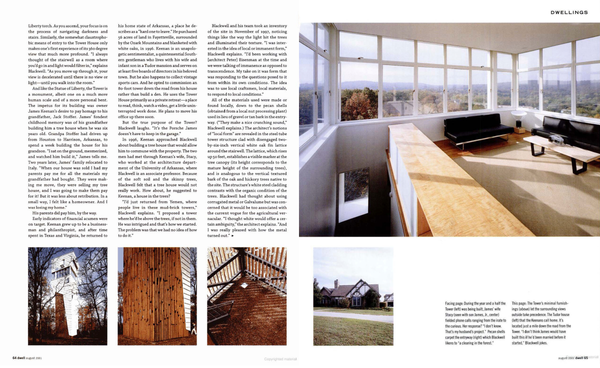
Photo: Timothy Hursley
Atop the tower structure are two rooms. The indoor living and sleeping room sits 57 feet up in the air and has seven-and-a-half-feet-high continuous steel frame windows that provide a 36o degree view of the surrounding landscape. Ten-foot ceilings emphasize the expansive horizon outside. A place to sit, a view to contemplate—the room’s simplicity perfectly illustrates Mies’ assertion that "less is more." A fold-down stair leads to the sky court above. Four different wall openings frame four distinct views. "The outdoor room is really the climax of the project," Blackwell says.
It was the construction of these rooms that created the biggest challenge. The steel stairs went up quickly but the steel-clad rooms were another matter. "Nobody could have known how much labor would be involved," Blackwell explains. "We never used scaffolding, just cranes and lifts. Two of the three carpenters we used were rappellers; they would just hang off and work on the thing. It was amazing but a very difficult process, exponentially difficult. There were a lot of delays but James never really grumbled about it."
"People ask, ‘Is it taller than you thought?’ And it is, because the surveyor was off by about ten feet on the tree height. But we didn’t find out until it was too late," says Keenan. All were surprised, too, by the extent to which the Tower is visible from surrounding roads, including Highway 45. I half expected to catch a glimpse of it as I landed on the rural airstrip at Northwest Arkansas Airport, about 30 miles outside of town.
The Tower’s height prompts the question: How did this thing ever get past the Fayetteville planning commission? Well, Blackwell couldn’t believe his luck. "People were baffled about why it never went to the planning commission for approval. We met with them and said, ‘We’re going to do a residence eventually and this will be the out-building, the retreat.’ And they said, ‘So you’re just doing it backwards? Well, then there are no rules or height limitations so you don’t have to go before the commission. But promise me you won’t make it look like a forest ranger tower, okay?’"
"Ranger tower" is just one of many labels pinned on the Tower. "Deer stand" is another. When it was going up, many thought it was a cell phone tower. There are the inevitable spaceship references, and my personal favorite, "trailer on a stick." "I made the mistake of telling a local reporter that I was influenced by local forms like trailers, chicken houses, and industrial buildings," Blackwell says. "I said it was not intended to look like them but rather was influenced by them. So she writes, ‘The Tower House reminds one of mobile homes and chicken houses.’"
But architect and owner (and owner’s wife) take the ribbing from locals with grace and good humor. Both are quick to offer tours of the Tower House to any of their critics. Keenan often holds his board meetings there because it "guarantees 100 percent attendance." People came to the site every day during construction and scratched their heads. James and Stacy told me about the time they were seated next to a group of six women at lunch and listened in as the group gossiped about the Tower. James sauntered over to their table and asked, "Would you like to see it?" The women, feigning ignorance, refused his offer but most others have eagerly accepted the invitation to visit the enigmatic edifice. "Once they’ve experienced it," explains Blackwell, "they still may not like it but at least they understand why we did it." Numerous others have visited without an invitation. During construction, no small number of amorous teenagers and drunken locals were discovered christening the structure in their own personal fashion.
But the most anticipated visitor was Keenan’s, now 88, who came to Fayetteville last July. Orchestrating his visit was no easy feat. "We had people lined up to carry him up the stairs if necessary. But he climbed up the whole way," says Keenan, beaming. "We had a chair waiting for him on each landing so he could rest. He actually got to experience the Tower in a way most people don’t. He got to take it in at each level, to notice the angles and details that most people miss as they walk quickly past. Until we drove up to the Tower, I think he had no sense of the import his building me that tree house had. I told him how much I appreciated the effort he made to come out. I was acknowledging that he had taken on quite an endeavor. He seemed to be in a kind of nirvana and, despite the strenuous climb, told me that he didn’t feel a bit of pain. I am so glad to have had that moment and to have that memory of him coming to see it."
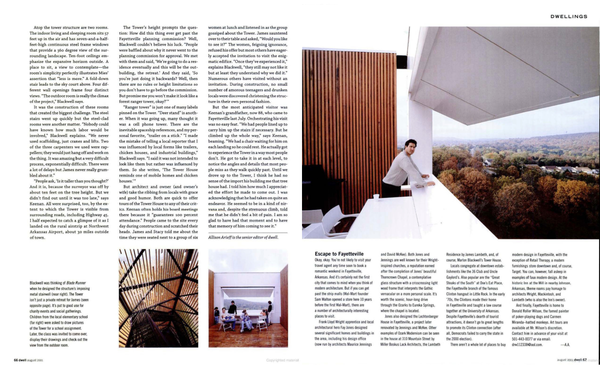
Photo: Timothy Hursley
See the full story on Dwell.com: From the Archive: The 82-Foot-High "Tree House" That Turned Heads in Small-Town Arkansas
Related stories: