Remember When Your Phone Had Its Own "Gossip Bench"?
How household landlines spawned a booming, now obsolete, mid-20th-century furniture category—one that might be coming back into fashion.
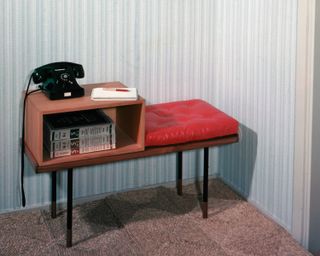
How household landlines spawned a booming, now obsolete, mid-20th-century furniture category—one that might be coming back into fashion.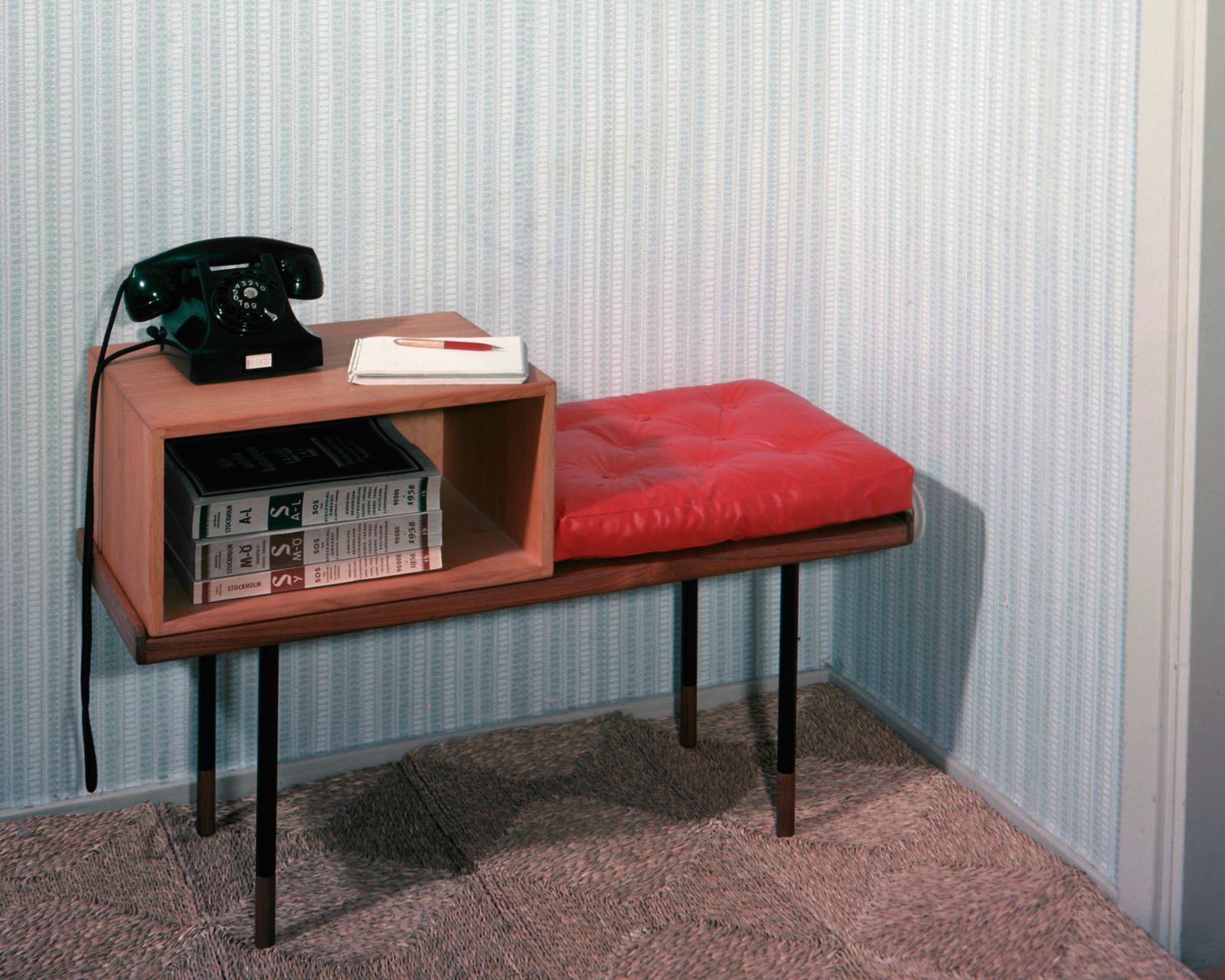
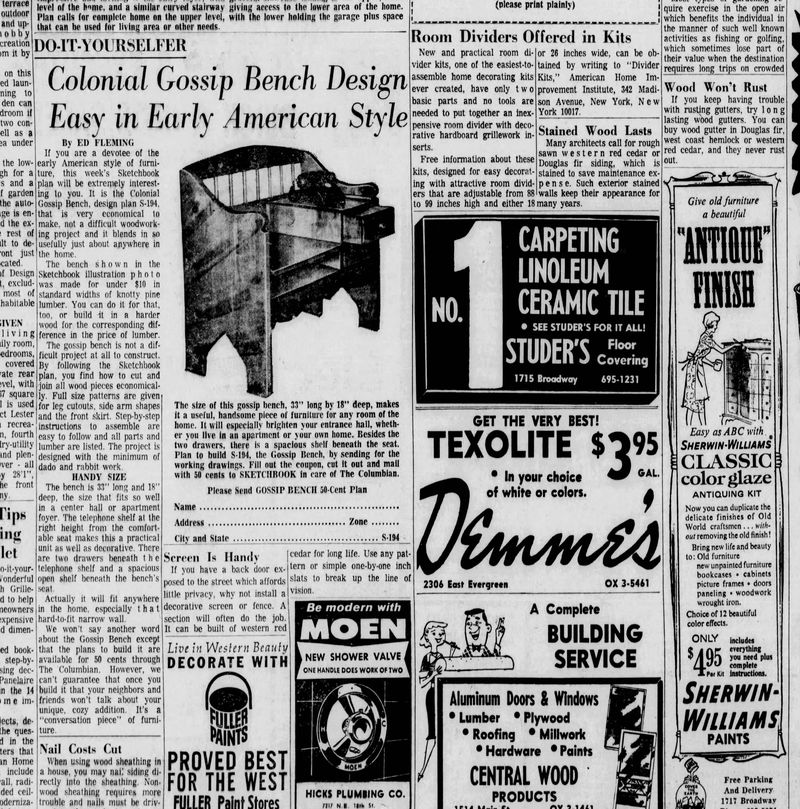
On any given weekday afternoon in the late 1970s, John Stallone’s grandmother could be found in the hallway of her Queens, New York, home, talking on the telephone. "The heavy black receiver would be wedged between her shoulder and ear while she stretched the coiled cord as far as it would go, holding court with friends and relatives from her corner of the house," he recalls. Stallone, who is a historian and curator at the Long Island Telephone Museum, says his grandmother kept a notepad and a thick phone directory on the wire shelf built into the pipe-legged bench where she sat for many of those phone calls. This was the gossip bench (also known as a telephone table), a quintessential product of postwar domestic life that transformed an everyday phone call into a ritual that had a dedicated place within the home.
The connected home
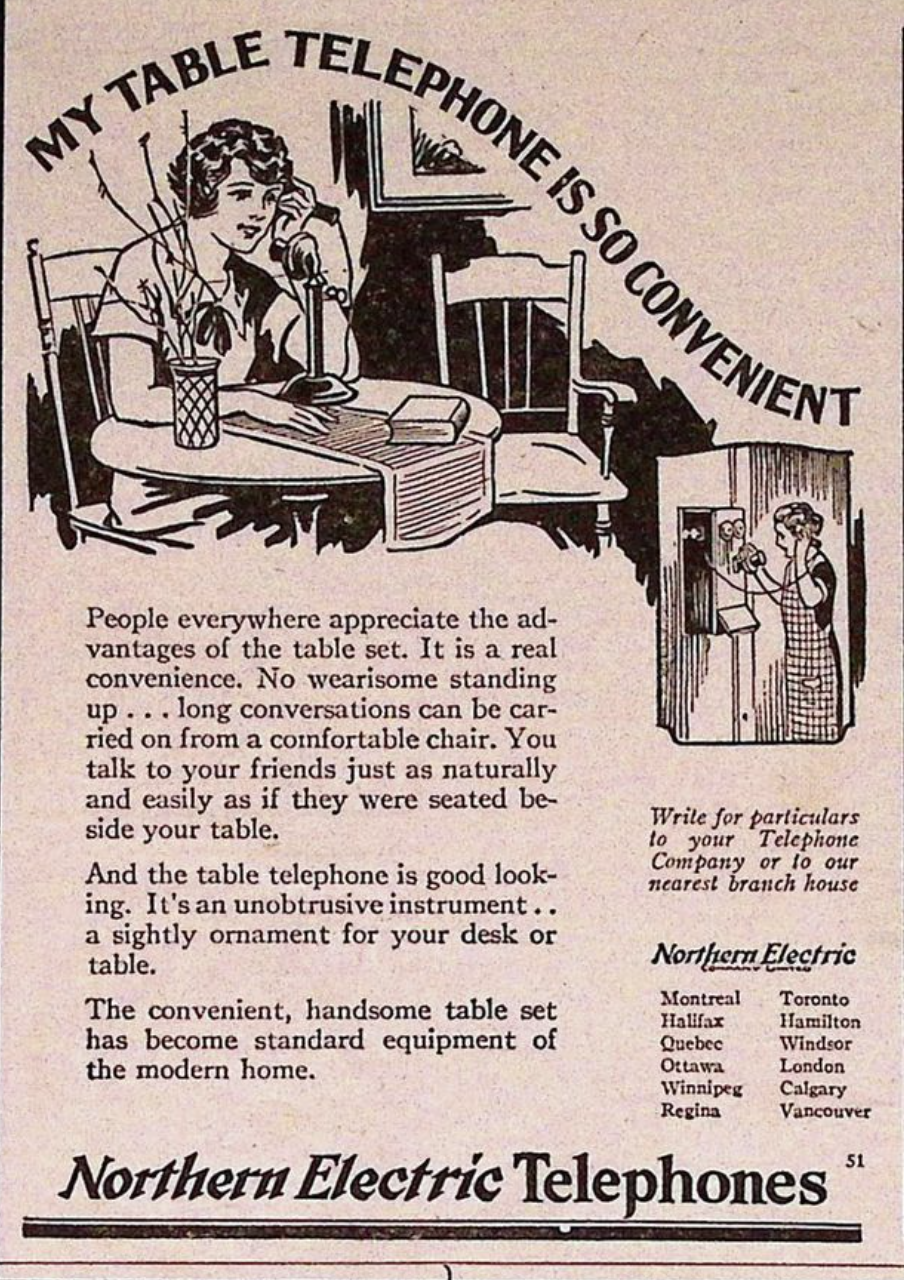
When telephones first entered American households in the late 19th century, they were status symbols as much as communication devices. Basic telephone service cost about $2.75 a month in the early 1880s, equivalent to roughly $90 today, making it a meaningful household expense. (Long-distance calls cost additional—and typically significant—fees billed by duration and distance.) As a result, people often displayed their phones in the entrance halls and parlors of their homes, where the devices signaled both wealth and a family’s embrace of modernity, Stallone says. From the beginning, early owners of the technology made spatial adjustments to accommodate the devices in their homes: According to historian Chris Wisniewski, when telegraph manufacturer Charles Williams Jr. installed the first residential telephone in his Massachusetts home in 1877, he mounted it on a shelf just outside the parlor at the perfect height for use from a nearby chair.
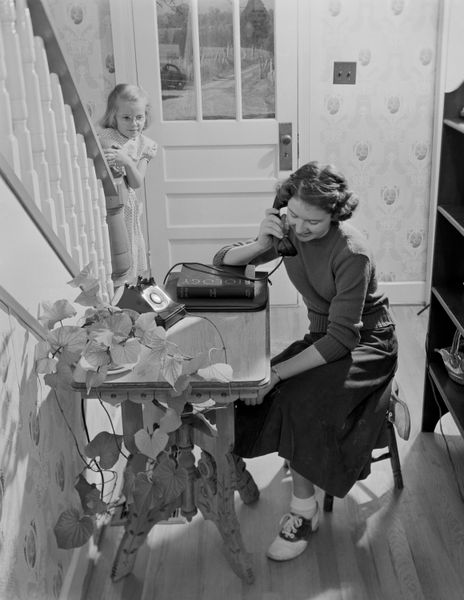
Before the mid-20th-century boom of the gossip bench, people often displayed their household landlines on small tables or built-in nooks near the entryways or parlors of their homes.
Photo by Charles Rotkin/Corbis/Getty Images
Over the following few decades as telephone service expanded, the device became less a novelty than an essential tool of domestic life. Calls to grocers, doctors, and delivery services extended household management beyond the home’s walls, responsibilities that often fell to women. By the 1930s, nearly 41 percent of American households subscribed to telephone service, and advertisements promoted the telephone as both a practical convenience and a "sightly ornament" worthy of display. People added small tables, wall shelves, and built-in hallway nooks to hold directories, message pads, and the increasingly indispensable household landline. But the heavy, corded receiver imposed its own constraints. Anyone who lingered on the line had to stand or crouch in the space nearby or pace within the cord’s limited reach. Furniture makers solved the problem by combining the storage components of the telephone station with a seat, creating a single piece of furniture called the gossip bench. "All good inventions are spawned from necessity," Stallone says.
The conversation piece
The gossip bench gave phone conversations a designated, permanent place in the home. Part telephone table, part chair, and part household command center, it typically paired a seat with built-in shelving or drawers for directories, message pads, and pencils. As telephones evolved into everyday items (eventually becoming available in a variety of colors), manufacturers quickly realized the humble phone bench could be as fashionable as it was functional. Some embraced the sculptural lines of midcentury modernism. Drexel Furniture Company incorporated its signature steam-bent wood detailing, while Lu Van produced a steel-framed version that echoed the clean utility of a school desk. Others leaned into Colonial Revival styling, proving there was a gossip bench for nearly every decorating taste.
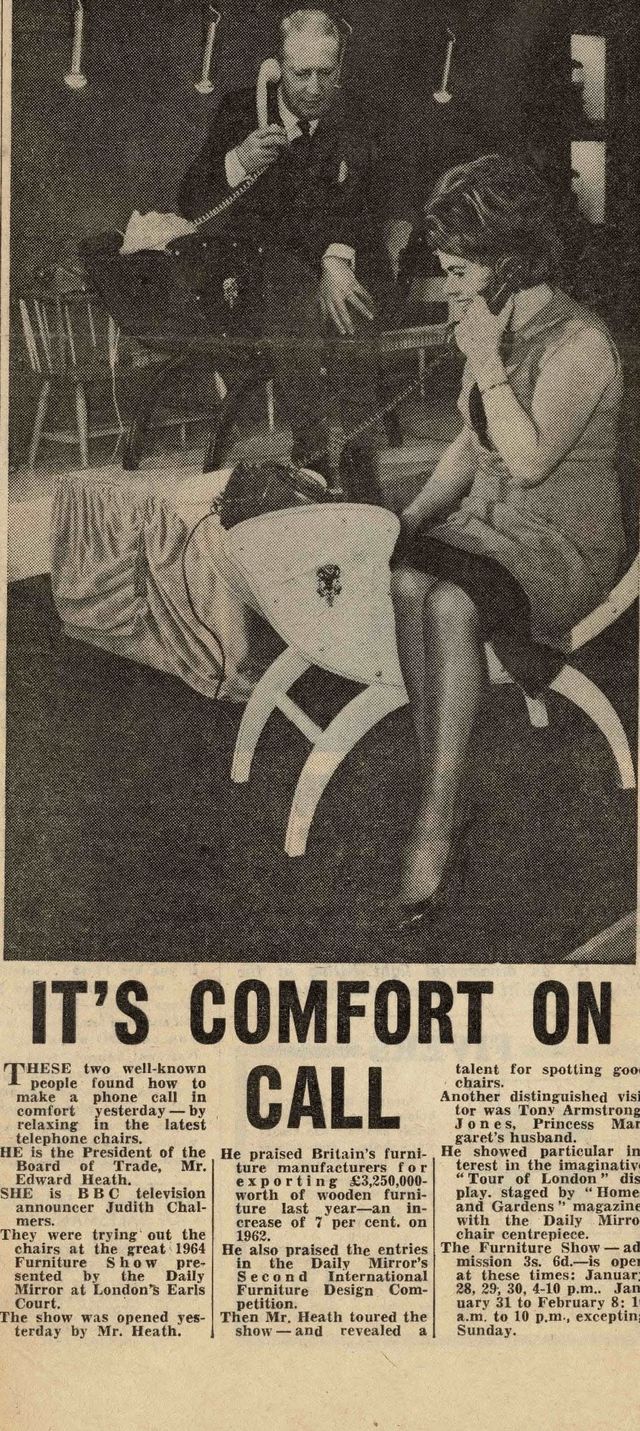
By the early 1950s, the gossip bench had become much more than a practical solution for a corded telephone. Designers including Raymond Loewy, Edward Wormley, and Kai Kristiansen elevated the humble telephone seat into an object of postwar modernism. Advertisements sold an ideal of modern domesticity. "It’s comfort on call," read a 1964 newspaper clip about "the latest telephone chairs" on display at that year’s London Furniture Show. Few manufacturers embraced the form more enthusiastically than the British furniture maker Chippy Heath, which between the late ’50s and early ’80s produced more than 38 models. Among its best-known was the 1960s Contour, with a kidney-shaped form that reflected the biomorphic curves that defined many midcentury-modern designs. "In 1958, the telephone seat was seen by some as a mere gimmick," Garry Heath, the company’s former marketing director and the founder’s son, remarked in archival footage. "That gimmick quickly became a desirable piece of furniture in many of our homes."
Line of duty
The gossip bench reflects the gendered assumptions that shaped domestic life at the time as much as it does the era’s optimism and ingenuity. Amid its rise in the midcentury, furniture manufacturers had identified women as the primary consumers furnishing the home. Designers, who were overwhelmingly men, projected their assumptions back into the domestic sphere. Even the bench’s name reveals those assumptions. "The gossip bench falls into what we call gendered furniture," says Michael Ausbon, curator at the North Carolina Museum of History, placing it alongside hope chests (the cedar trunks traditionally given to young women to prepare for marriage) and Victorian-era fainting couches. "It framed women’s most visible form of communication as idle chatter rather than legitimate exchange."
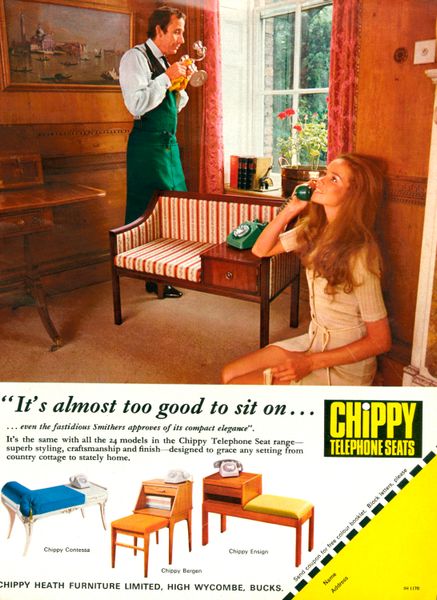
A 1970s magazine ad for Chippy Heath telephone seats (aka gossip benches).
Photo from Alamy
The gendering of the piece was particularly pronounced in the United States. Similar telephone tables appeared in U.K. and European homes, but they were more often treated as practical furniture rather than objects defined by women’s social habits. In the U.S., the "gossip bench" became a cultural shorthand, transforming a functional piece of telephone furniture into a symbol of feminine homekeeping. Emily M. Orr, curator at the Cooper Hewitt, Smithsonian Design Museum, adds that the gossip bench’s nickname overlooked the practical work often carried out there: "Many of the conversations involved coordinating medical appointments, arranging deliveries, managing household finances, or maintaining family relationships, forms of labor rarely acknowledged as such."
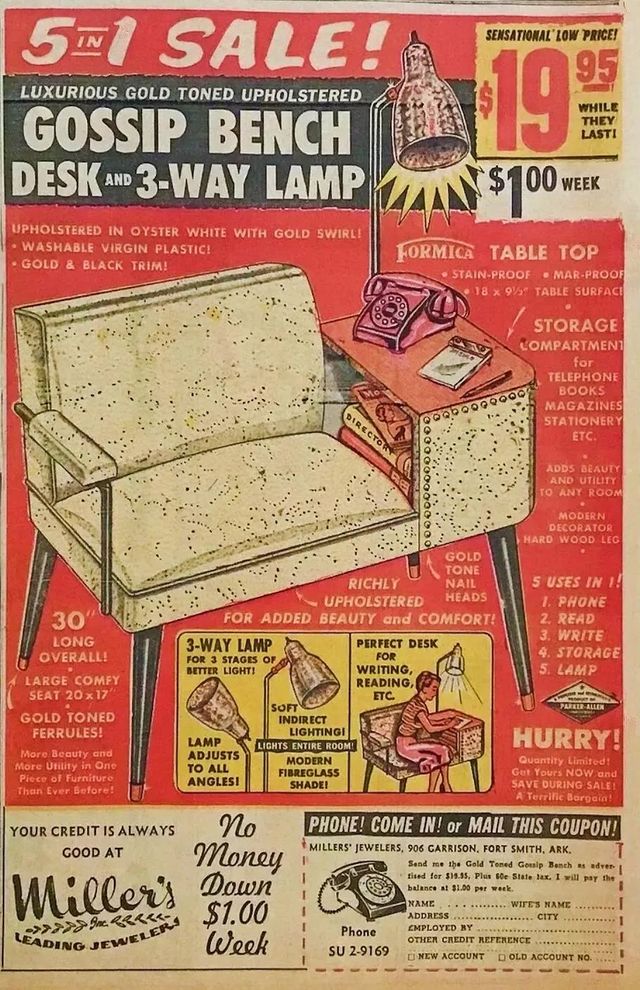
Manufacturers reinforced that narrow image through design and advertising. Benches were often upholstered in floral prints, with modestly scaled seats, and marketed almost exclusively to women. One advertisement even prefilled the order form with the words "wife’s name" and described its upholstery as "washable virgin plastic." Telephone etiquette guides instructed women to avoid profanity and to keep the household phone line available should their husbands receive business calls, reinforcing the idea that domestic communication remained subordinate to men’s professional lives.
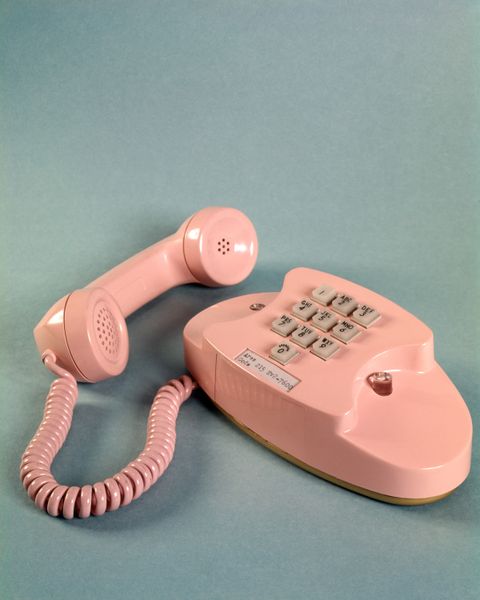
Industrial designer Henry Dreyfuss designed the Princess phone, which was introduced in 1959 and marketed specifically to women and teenage girls as a bedside accessory.
Photo by H. Armstrong Roberts/Getty Images
See the full story on Dwell.com: Remember When Your Phone Had Its Own "Gossip Bench"?
Related stories: