They Put a Mini House Inside This Sixth-Floor Apartment in Japan
A structure resembling the client’s childhood home holds a living area and bedroom, recreating the idea of an engawa around it.
A structure resembling the client’s childhood home holds a living area and bedroom, recreating the idea of an engawa around it.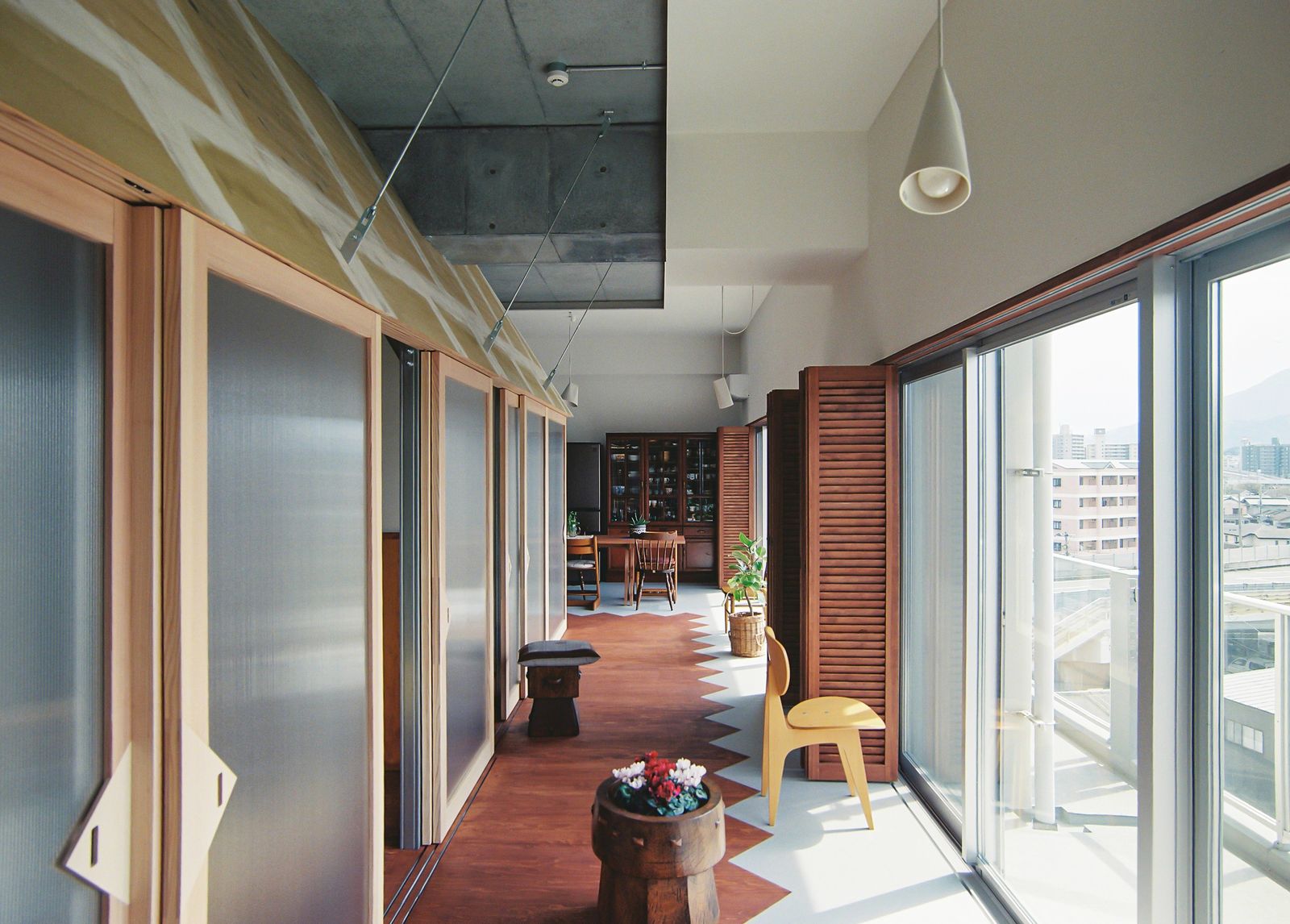
Houses We Love: Every day we feature a remarkable space submitted by our community of architects, designers, builders, and homeowners. Have one to share? Post it here.
Project Details:
Location: Fukuoka prefecture, Japan
Architect: Kuma & Elsa / @kumaelsa
Footprint: 2,706 square feet
Builder: Azuma Kensetu
Structural Engineer: Kenichi Inoue Structural Engineers
Photographer: Shohei Kuma
From the Architect: "The client’s childhood home, a traditional Japanese house, has an engawa—a gallery open to the garden. There, she was immersed in the scent of fresh grass, the fragrances of the seasons, and even the smells drifting from his neighbors’ kitchens. The wish was to recreate that memory, this time in an apartment nearly 50 feet above the ground. We imagined a house open to the sky. The new residence occupies the top two floors of a building owned by the client. She, along with her two sons and their families, will move into three apartments located on the sixth and seventh floors. We were commissioned to design the client’s apartment on the sixth floor and one of his sons’ on the seventh. In this reinforced-concrete frame building, lined with balconies to the north and south, these two levels benefit from a generous ceiling height. They give the impression of new plots of land suspended in the urban sky.
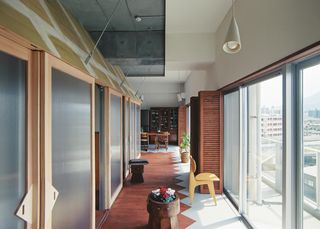
"At the center of each apartment, we inserted a hut-like volume that gathers the quieter rooms: a small living room and the bedrooms. In the space carved out around it emerges an intermediate zone, an engawa that serves both as a place to stay and as a passage. Balcony, engawa, and hut thus form three spatial layers that resonate with the childhood home. To encourage natural ventilation and seasonal thermal comfort, the hut is punctuated with high-level openings. But where do the rooms begin, and where does the passage end? As if to embody this ambiguity of boundaries, the wooden floor extends beyond the hut and interlocks in a sawtooth pattern with the engawa’s tiles. Materials blend together, as do uses of the space.
"Although recently completed, the apartments deliberately retain a sense of incompletion. The white-painted surfaces, which suggest a finished state, are limited to the areas where thermal insulation has been reinforced. Inside the huts, large expanses of exposed gypsum board walls are left open to the inhabitants’ appropriation, so that their future choices may take root. The structure consists of Y-shaped modules made of lightweight steel sections and bracing cables, typically used in shelving systems. These modules are arranged two-by-two in mirrored pairs along a regular grid, with occasional inversions. They are fixed to the floor and ceiling slabs of the building’s structural frame and are structurally stable, requiring no additional bracing to withstand earthquakes. From these new dwellings, one can look down across the street at the engawa of the childhood home."
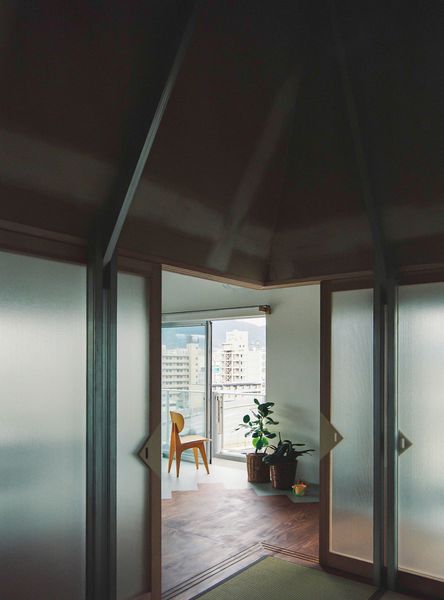
Photo by Shohei Kuma
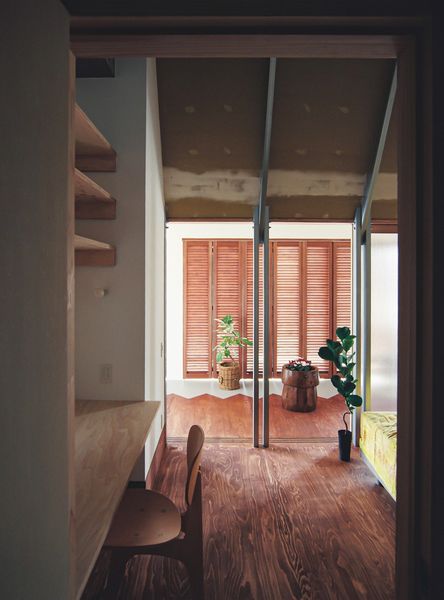
Photo by Shohei Kuma
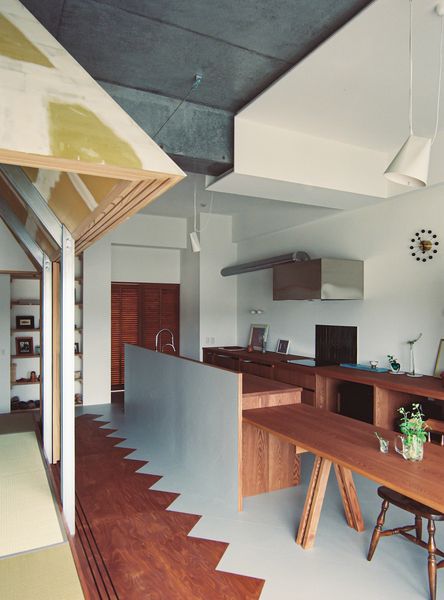
Photo by Shohei Kuma
See the full story on Dwell.com: They Put a Mini House Inside This Sixth-Floor Apartment in Japan