
What Does "Trauma-Informed Design" Actually Mean?
The architectural approach has gained momentum in sectors like supportive housing and healthcare infrastructure. Is it just a buzz phrase?
The architectural approach has gained momentum in sectors like supportive housing and healthcare infrastructure. Is it just a buzz phrase?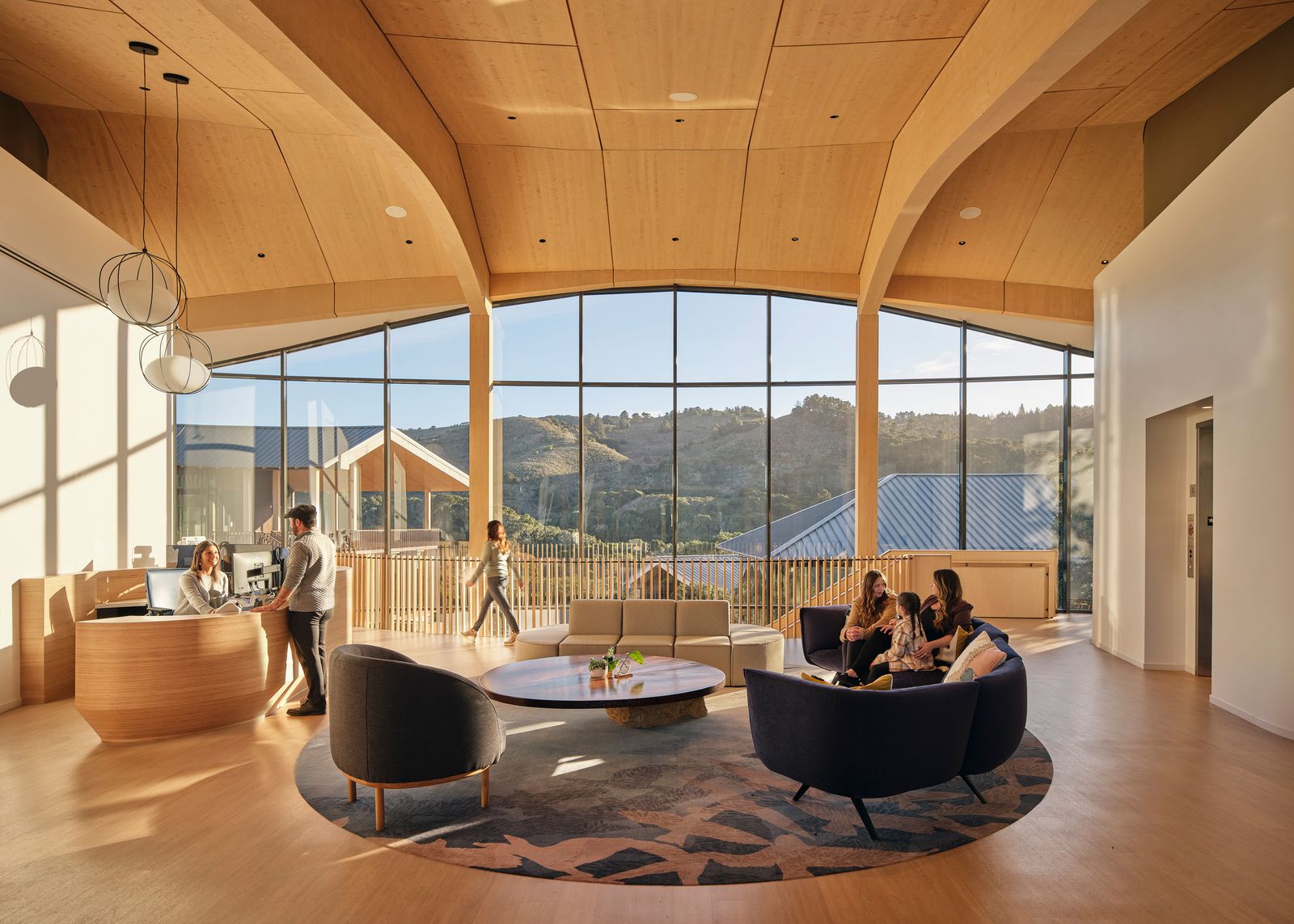
Tucked into a suburban area of Bozeman, Montana, the Barnard Center, a domestic violence shelter operated by the nonprofit Haven, looks a lot like its neighbors. The two buildings on the campus—which house 30 bedrooms, counseling rooms, administrative offices, and communal spaces, like a library, kitchen, and living room—feature pitched roofs and wood siding. Between them, there’s a vegetable garden and green lawns where children can play. And thanks to a perimeter wall, survivors and their families in the shelter can use the outdoor areas safely.
Previously, Haven’s shelter was a five-bedroom, two-story house in which up to 25 survivors at a time slept anywhere there was room, even on couches and the floor. While it filled a great need, "we recognized that it was not a healing environment," says Katie Madison, Haven’s executive director. Now, with an $8 million campus by MASS Design Group that opened in 2023, architecture is "part of the support service," she adds.
Haven’s new shelter is the result of trauma-informed design (TiD), an approach to architecture that integrates research on what helps people feel safe, secure, and emotionally regulated in spaces. "It really just gives us a shared or common evidence-based framework that’s anchored in principles of behavioral, mental, social, and public health that has been used for decades," says Patricia Gruits, co-executive director of MASS, which is known for its socially driven projects like the National Memorial for Peace and Justice in Montgomery, Alabama; the Butaro Hospital in Rwanda; and a maternity waiting village in Malawi.
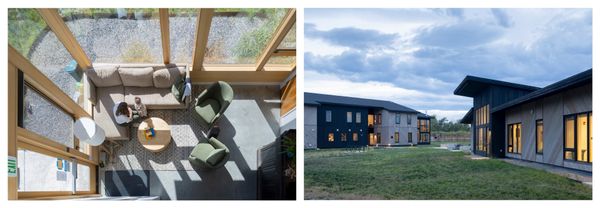
Mass Design Group completed Haven’s Barnard Center, a two-building shelter complex for survivors of domestic violence in Bozeman, Montana, in spring 2023.
Photos by Iwan Baan, courtesy MASS
Trauma-informed design has become an architectural buzz phrase. The approach entered the design field in the 2010s and continued to slowly grow through the middle and end of the decade before becoming more prevalent in the last few years. It’s now applied to everything from shelters, like Haven’s, and supportive housing to hospitals, clinics, schools, and prisons. Professional organizations like the American Institute of Architects and American Society of Interior Designers have hosted lectures and continuing education courses on the topic. There’s even an organization dedicated to advancing the concept: the Trauma-informed Design Society. It offers a $2,000 credentialing course on the TiD framework.
The mainstreaming of trauma-informed design seems to follow the pop culturification of trauma itself, particularly since the Covid pandemic. Trauma plots in film and fiction have a stronghold in the zeitgeist and therapy-speak has permeated our everyday language, especially online, stretching what can be labeled traumatic to include a much broader range of experiences. The Body Keeps the Score by Dutch-American psychiatrist and PTSD researcher Bessel van der Kolk, which was published in 2014, was the #1 New York Times bestseller for over 30 weeks in 2021. Meanwhile, Canadian physician and trauma expert Gabor Maté’s 2022 book, The Myth of Normal: Trauma, Illness, and Healing in a Toxic Culture, debuted as #5 on the bestseller list, where it spent 14 weeks. "Today, an entire industry has spawned around the idea that everything is trauma," Guardian columnist Katherine Rowland wrote last year. The term has also become part of the culture wars. In 2025, the National Science Foundation began reviewing grants with keywords like "trauma," "diversity," and "gender" to ensure they were in compliance with executive orders from the Trump administration.
That’s not to diminish or dismiss the reality that trauma affects many, many people. According to one commonly cited statistic, around 70 percent of people globally have been exposed to traumas during their life, and post-traumatic stress disorder is known to be underdiagnosed. Meanwhile, as doctors and scientists better understand human behavior, the definition of what is considered traumatic is changing. In 2022, the World Health Organization formally recognized complex post-traumatic stress disorder in its International Classification of Diseases. Researchers are now studying issues surrounding epigenetics and race and identity-based trauma, as well as trauma from poverty, the pandemic, and climate change. Architecture reflects the cultural shift, too. The built environment has long played an important role in health care—from quarantining ships during the plague to sanatoria that treated tuberculosis—so it makes sense that changes in how doctors understand the human body and mind would affect how they are designed.
But what are we actually talking about when we talk about trauma-informed design? As the phrase gains momentum in design parlance, some experts argue it’s a long overdue approach to creating better architecture, while others say it’s misused and overused, and perpetuates harmful stigmas about the people using those spaces. "Where trauma-informed design gets misunderstood is that it’s just a set of tools, right? Or it’s just a set of design decisions that can be applied to any project in the same way," Gruits says. "There are principles, but how do those actually show up in the built environment?"
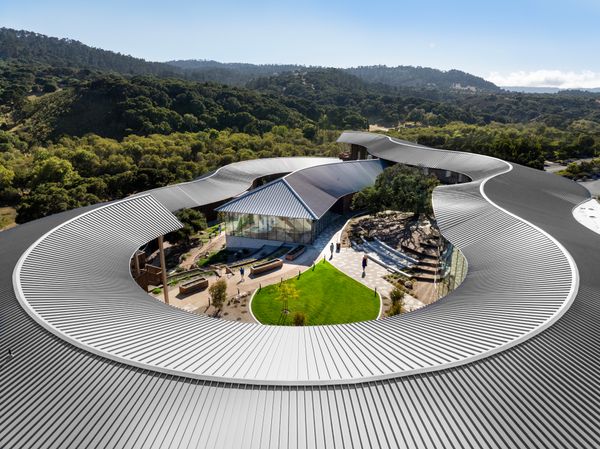
Architecture firm NBBJ designed Montage Health’s Ohana Center for Child and Adolescent Behavioral Health in Monterey, California, with a series of curving volumes.
Photo by Ty Cole, courtesy NBBJ
From medicine to architecture
The phrase "trauma-informed" came from the medical and behavioral health fields; as doctors and social workers began to better understand the effect of trauma on individuals, they adjusted their care practices in order to more effectively treat them and to resist harming them further. In 2014, the Substance Abuse and Mental Health Services Administration (SAMHSA) published a manual on what this looks like. In it, it’s stated that physical environments should come across as "safe, inviting, and not a risk to their physical or psychological safety."
From environmental psychology and neuroscience research, designers have evidence-based knowledge about what features in space can lower stress and increase feelings of safety, comfort, and well-being—or do the opposite. "When we design a space, what you want the space to be able to do is to help you calm your nervous system down and deescalate and go into a regulated state—that is what trauma-informed design, in our opinion, needs to be and should be," says Deanna Van Buren, founder of Designing Justice + Designing Spaces. Her firm designs projects around restorative justice, which has included peacemaking centers for survivors of violence, social service hubs for people who are navigating the court system, and a housing campus for people reentering their communities from incarceration. She says that across her projects, clients and the people those clients serve often talk about qualities like light, color, texture, and comfort. "Those are the things that we know make people feel safe," she says.
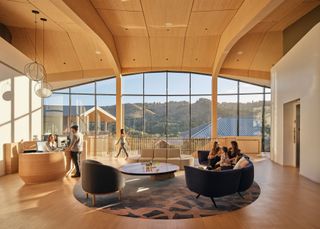
At the Ohana Center for Child and Adolescent Behavioral Health in Monterey, California, architecture is a form of treatment. The campus, designed by NBBJ and completed in late 2023, uses principles of biophilia (or the attraction humans have to nature) which has been proven to reduce stress. Located on a verdant hillside, the curved structures are mostly made of wood and feature floor-to-ceiling windows so that there are plenty of views outside. The facility offers 16 in-patient rooms, clinical space, and recreational areas, and resembles an elite school more so than a psychiatric institution.
Tami Chen, an architect at NBBJ who worked on the project, notes that clients—like Dr. Susan Swick, who commissioned Ohana—are just following the data about what makes patients recover faster. That means more success on the bottom line, too. "People are providing more of that actual data and support to prove out that the design moves do have real impact versus just this theoretical notion of: It’s good for you. Don’t you want it?" Chen says.
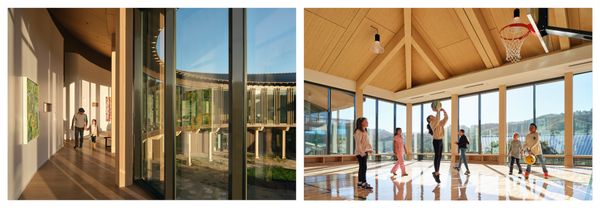
The Ohana Center for Child and Adolescent Behavioral Health comprises an outpatient clinic and a 16-bed residential program, as well as amenities like garden spaces, a gym, and a music room.
Photos by Ty Cole, courtesy NBBJ
See the full story on Dwell.com: What Does "Trauma-Informed Design" Actually Mean?
Related stories: