
Do Plywood Interiors Hold Up?
The material can discolor and is hard to patch. We spoke with architects who used it in projects covered by Dwell to find out how they’re looking now.

The material can discolor and is hard to patch. We spoke with architects who used it in projects covered by Dwell to find out how they’re looking now.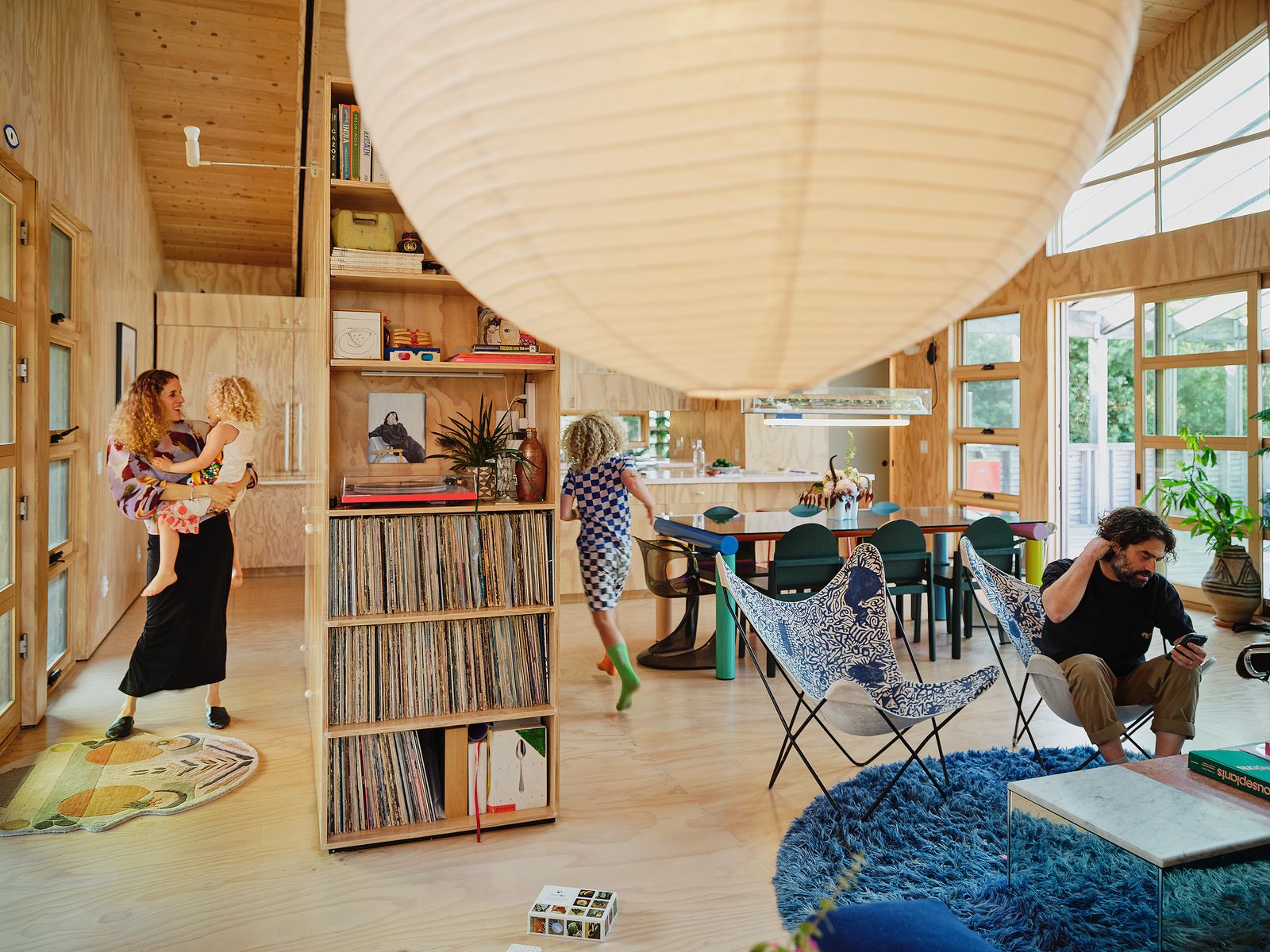
Plywood has been a staple of modernist design since the 1940s, when American architects began transforming it into Dri-Bilt homes. Today, it lines houses around the world from ceiling to floor, as architects take full advantage of its ease of manufacturing, flexible structure, and distinctive grain. And while its aesthetic appeal has lasted almost a century, it’s not the first material that comes to mind when considering durability. But, as we found out, those who’ve worked with the materials themselves beg to differ.
For a ground-up, net-zero house in the L.A. neighborhood of Highland Park, Project Room principal Isaac Resnikoff and his in-laws at Louis Wasserman & Associates made a complete family home from plywood—floors, ceilings, custom furniture, walls, the lot. For those wondering if the material can stand up to the rigors of daily life with young children, good news: "We moved in about August 2019," Resnikoff says, "and over the seven years, it’s held up very well: durable and beautiful." In constructing their two-bedroom, two-bathroom "Unfinished House" in Tiny, Ontario, Workshop Architects relied on raw plywood almost exclusively. "The plywood on walls, ceiling and mezzanine floors was sanded and finished with two coats of Osmo Natural Oil Woodstain in 701 Clear Matte," says principal Helena Grdadolnik. "They typically say to refinish it every three to five years in areas that aren’t high use, but it has been almost five years and it doesn’t look like it needs it." Though, of course, the fact that the vacation house being unoccupied for part of the year doesn’t hurt with the wear and tear.
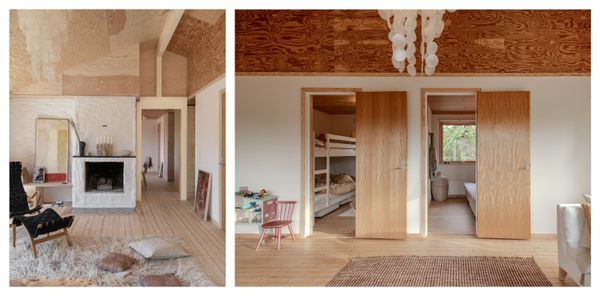
The color of the plywood in Atelier—Heyman Hamilton’s cabin aged between 2023 (left) and 2025 (right).
Left to right: Photo by Andy Liffner; Photo by Andrew van Leeuwen
What worked in the dry climate of northeast Los Angeles and the woodsy bays of Ontario was equally right in southeast Sweden, where Atelier—Heyman Hamilton renovated a 1970s cabin with pine plywood for use as a weekend home. Three years of Nordic weather later, "No repairs have been made, and no sheets have been replaced," reports co-founder James Hamilton. "The key is specifying the right quality of plywood. In Sweden, BB/X pine plywood is a few steps below furniture grade, has no knots or defects on one side, and is cost-effective."
The material lasts. Its original hue may not. "We knew it would darken and age unevenly over time, with areas exposed to direct sunlight changing faster than those in the shade," says Hamilton. "This uneven aging process was a specific quality we were interested in exploring." Resnikoff anticipated a shift, too. "We wanted wood that would not yellow with time, and of course that’s kind of impossible," he says. A lacquer with a bit of white pigment helps mitigate that. "There’s definitely a little bit of yellowing, but it’s not that dramatic! And it’s a satin finish, which feels really nice."
Of course running your hands across the satin plywood has an effect, over time, never mind the more constant wear and tear of family life. Resnikoff has noticed the floors take it the hardest. "It’s a softer floor than you might normally have, so it’s going to get dinged. We have two stools by the kitchen island, and their feet dig the floor a little bit. I think it has almost a hammered patina. When we did it, we thought in ten years we’d probably have to replace it. We don’t feel like that’s inevitable, at this point." Hamilton has also been impressed with the appearance of aging. "Because the cabin is a weekend home, surface wear could even be left intentionally unattended to allow for an uneven, character-rich aging process where areas with rubbed-off finish darken faster."
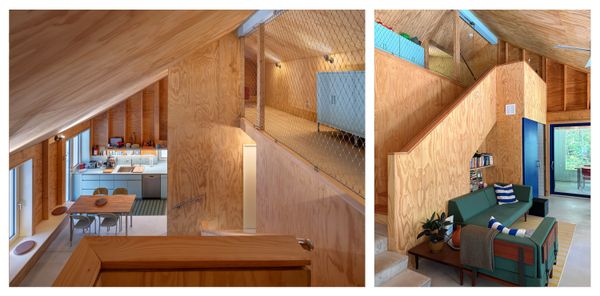
Differences in the "Unfinished House" are minimal between 2024 (left) and a recent photo (right). The wood hasn’t required refinishing in the nearly five years since it was installed.
Left to right: Photo by Scott Norsworthy; Photo courtesy Helena Grdadolnik
There’s patina, however, and then there’s punctures. In the "Unfinished House" Grdadolnik had to relocate the thermostat from the main floor to the warmer mezzanine. "That left a small hole in the wall where the wires attached," she says. That was an easy fix, but it taught her to be careful. "Plywood is less forgiving than drywall, it can’t be patched or replaced without being noticeable," she says. "So plan any lighting, wall switches, and equipment in advance, and think twice before cutting holes in the wall."
That’s assuming you’re seeking a book-matched effect. If so, designers recommend purchasing extra panels and lacquering them alongside the pieces that’ll be used for construction, so that they’ll age together. "We selected a spruce plywood finish with a very strong pattern that came as a bunk from a mill, so the patterns match. If in the future we would need to replace a sheet on a wall or in the ceiling, it would be hard to match and the difference could be noticeable," Grdadolnik says. "You see other interiors using clear birch plywood, which has less personality, but would be easier to replace with a similar look."
Time has given Isaac Resnikoff’s home a slight yellowing, as seen in photos from 2021 (left) and 2024 (right).
Left to right: Photo by José Mandojana; Photo by Emanuel Hahn
See the full story on Dwell.com: Do Plywood Interiors Hold Up?
Related stories: