Dreaming in the Ruins: How a Sleeping Ritual in Logroño Proposes a New Civic Architecture
Cities are increasingly designed to mitigate risk, and by doing so, need to collect data on climate, infrastructure, biodiversity, and social fragmentation so that the language of resilience becomes a fixture of planning. Yet the underlying conditions that produce polarization, civic disengagement, and ecological breakdown often remain unquestioned. The tools that dominate urban practice tend to address only one register of human experience, while the emotional and imaginative dimensions of transformation are not treated as reliable solutions.
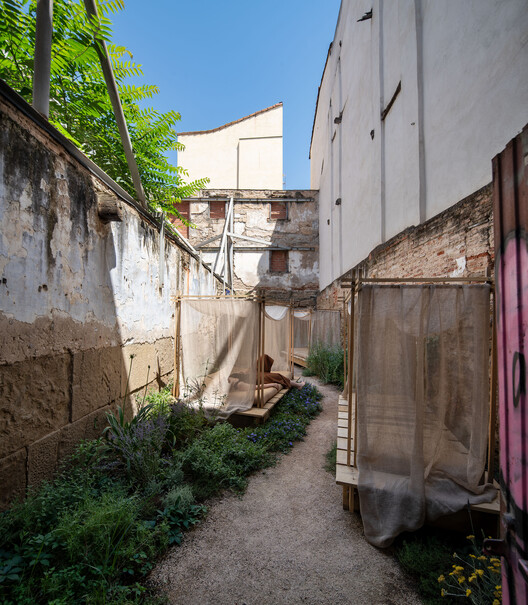
 One Third of Life by Suomi/Koivisto & IC-98, Concéntrico 2026. Image Courtesy of Concéntrico
Cities are increasingly designed to mitigate risk, and by doing so, need to collect data on climate, infrastructure, biodiversity, and social fragmentation so that the language of resilience becomes a fixture of planning. Yet the underlying conditions that produce polarization, civic disengagement, and ecological breakdown often remain unquestioned. The tools that dominate urban practice tend to address only one register of human experience, while the emotional and imaginative dimensions of transformation are not treated as reliable solutions.
Philosopher Felix Guattari proposed that sustained ecological transformation depends on simultaneous attention to three distinct ecologies: the ecology of the mind, the ecology of society, and the ecology of the environment. Mainstream environmental politics tends to concentrate on one or two of the three, flattening a complex condition into a defined problem with a clear answer. Ancient rituals remind us that transformation depends on practices that simultaneously engage the body, the community, and the environment.



_(1).jpg?1590374596#)