How Little Trees Goes Big to Protect Its Trademark Symbol
For such a utilitarian object, the pine-shaped, scented cutout holds a surprisingly singular spot in pop culture. The brand has made sure of it.
For such a utilitarian object, the pine-shaped, scented cutout holds a surprisingly singular spot in pop culture. The brand has made sure of it.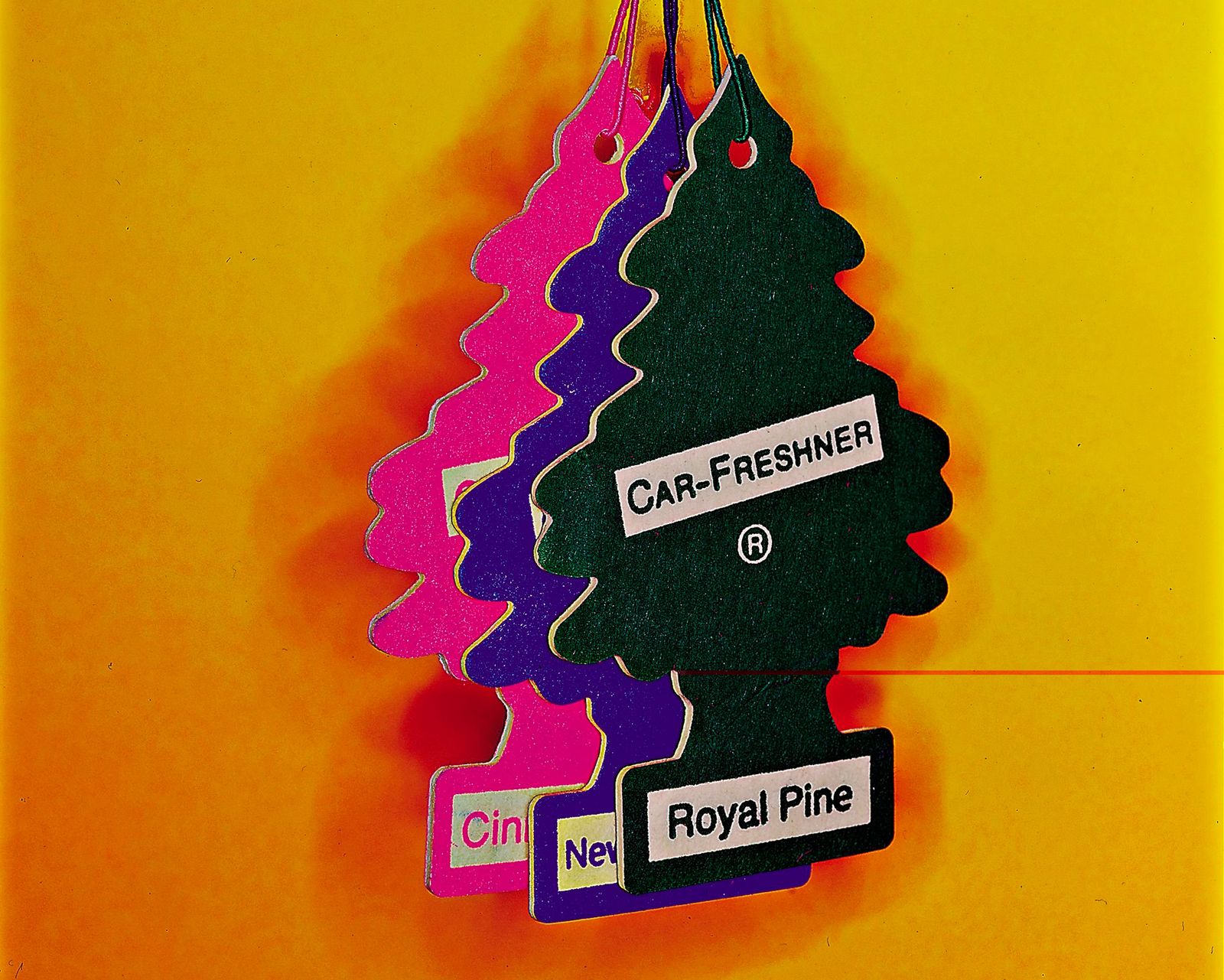
Not everyone appreciates the bracing perfume wafting from a cardboard tree air freshener named Black Ice, Vanillaroma, or New Car Scent—I know I don’t. But while I would strongly prefer to avoid breathing in a heavily scented object hanging from a car’s rear view mirror, I can’t help but love the instantly recognizable look of a Little Trees cutout.
To this day, Little Trees remains the leader of the pack among car freshener brands, and their unique shape has become a cultural phenomenon. It’s a piece of Americana, a collector’s item, and a visual shorthand for smell. But if you’re a brand and think, maybe we could riff on that a little—say, put a tree on a T-shirt or key ring—think again: Little Trees is known for suing those who infringe on its trademark, and the brand usually wins. We’re free to feel our feelings about Little Trees, but the shape, that’s on lock.
Little Trees is the property of Car-Freshner Corporation, a third-generation family firm headquartered in Watertown, New York. The whiff stretches back to 1952 when a milk truck driver complained about the stench of spilled milk to Julius Sämann, a German-Jewish chemist who’d fled Europe during the Nazi occupation. Two years later, Sämann filed a patent for cardboard with "odor-destroying, air-perfuming substances"—the initial version was a pinup lady before he settled on the now-famous pine tree. It was mostly for practical reasons, as a conifer makes it easier to peel back the wrapper slowly, branch by branch, to prolong the smell for up to seven weeks.
Royal Pine was the first fragrance, followed quickly by Spice and Bouquet. As drivers across the country took to this practical solution to an unpleasant tang, the company wasted no time expanding the range. Many have been fruity and spicy, like Cinnamon Apple, Moroccan Mint Tea, and Lavender, while others more ambiguous like Pure Steel, Heat, and Supernova. Today, Little Trees are sold all over the world, in parts of Europe known as Wunder-Baum or Arbre Magique, making the dangling tree an internationally recognized fix for terrible odors everywhere.
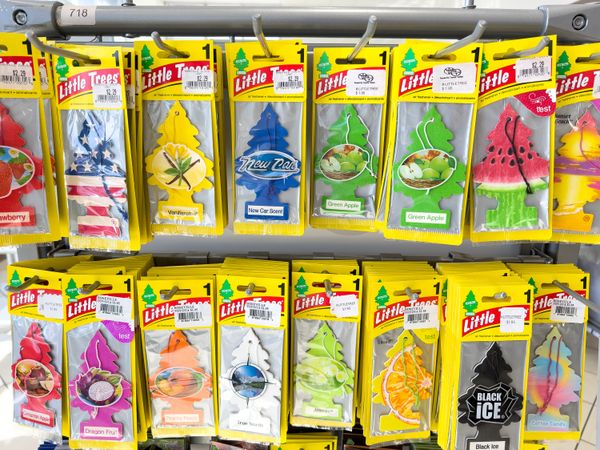
There are more than 30 classic Little Trees scents, each with different imagery on the same trademark shape.
Photo by Jammer Gene via Adobe Stock
But it’s the shape we love. "I have one that smells like surfboard wax. It hasn’t had a smell coming from it in months, but I still like seeing it flopping from the rear view when I have the windows down," says Jason Kress, cofounder and creative director of Washington, D.C., design agency Clever, and self-described "car guy." Kress thinks Little Trees are a mainstay in car culture: "It’s almost like a badge of honor that you wear, down to the type of Little Tree you hang from your mirror." Kress says the "masculine, cologne-smelling" Black Ice is especially popular among Honda drivers, a group he used to belong to before he moved on to VWs and Audis, whose drivers he says are more into Piña Colada, which is "more of a fashion statement."
There are currently 33 classic Little Trees to choose from, with thriving forums of collectors on TikTok and Reddit who hunt for rare special releases and discontinued scents. Kress says he’s seen up to "fifty or so stacked [in cars], as a tongue-in-cheek flex." While he points out there are a lot more elegant (and frankly, better-smelling) car fresheners on the market, Kress thinks Little Trees appeals with its cheerful simplicity and low price: "That amount of joy for a dollar, that’s a pretty good deal! There’s so much variety, so you can make a statement with that dollar."
The ubiquitousness of Little Trees might fool us into thinking we’re at liberty to make our own uses for it. But if you’re a brand tempted to tap in on its symbolism you will soon feel the wrath of Big Tree. When fashion house Balenciaga made a Little Trees–shaped keychain in 2018, it charged $275 for a leather trinket with a nod to retro Americana—and Little Trees sued for trademark infringement. The year after, the company served European budget airline RyanAir for using its image to advertise the airline’s car rental service. Dog toy maker Chewy was informed in 2021 that the pine is not for sharing, and two years ago, Meta was put on notice for failing to take down infringing posts from third parties selling stickers and T-shirts carrying the Little Trees trademark.
Angela Langlotz, a trademark lawyer operating out of Dallas, Texas, remembers the green tree hanging from the dashboard knob of her aunt’s Ford Mustang when she was a child—this is the kind of "intangible goodwill" that Little Trees has built over decades and is keen to control. "I think Little Trees have been appropriately aggressive," says Langlotz, suggesting that they’re just protecting what’s theirs. A trademark is meant to be an exclusive identifier, she explains, so if you let things slide to the point where people no longer associate your brand with your company, you could actually end up losing your trademark rights.
That means when Old Navy puts your trademark on a T-shirt emblazoned with "Keeping it Fresh," it may be best to nip things in the bud—at least that seems to be Little Trees’ attitude. "Then, pretty soon, you get a reputation for being a formidable enforcer of your trademark rights, and people just leave you alone," says Langlotz. This may explain why Little Trees doesn’t just go after large corporations; in 2016, the company sued a nonprofit called Sun Cedar, which helps at-risk individuals get back on their feet, for making a tree-shaped cedar ornament, and two years later, it informed the Bob Ross merchandising company that regardless of how Ross telling viewers to paint "happy little trees" to cover their mistakes, there would be only one diminutive arboreal in town.
Little Trees’ journey from smell peddler to cultural icon has benefited from some memorable pop culture endorsements. "You’ll find one in every car. You’ll see."—that’s the famous line from the 1984 cult sci-fi black comedy Repo Man, which was ultimately a teardown of ’80s consumerism but did a lot to tighten the brand’s associations with American car culture by placing its products in various scenes. "That film is a big part of why some car people are obsessed with Little Trees, sometimes in an ironic hipster way," says Phil Greden, an automotive journalist whose pen name is Murilee Martin. Greden has taken over 10,000 photographs of Little Trees in junked cars over the past 18 years, across the U.S. and overseas. "In junkyards in the U.S., probably ninety-five percent of air fresheners are going to be Little Trees," says Greden, explaining that it’s often the Black Ice and New Car scents. "In the Deep South people like the fruitier ones, like Coconut, Watermelon, and Strawberry.... I think because it’s so humid and they need a more powerful scent to mask the mildew." Greden also finds more clusters in hotter areas—he fondly recalls what he calls the "Charlotte Stack," named for the thick decks of Little Trees air fresheners he saw hanging from the rear view mirrors of many cars in a North Carolina wrecking yard—whereas in dry areas, like his hometown of Denver, Colorado, cars usually have just the one.
The vapors can get overwhelming pretty fast. Little Trees actually provided unscented props to save the noses of the Repo Man film crew, and overly perfumed rideshares are such a common complaint that Lyft has started offering fragrance-free rides as a premium option. When Greden was an official at 24 Hours of Lemons, an endurance race for cars bought for $500 or less, one of the penalties for misbehaving drivers included hanging 50 Little Trees air fresheners inside their cars. "You could smell it as they drove by at a hundred miles an hour," he says. "It was awful." Greden likes to hang his own Little Trees outside for six months to get the odor out, and then enjoy them more as decor.
Despite the brand’s eagerness to defend its trademark, the company behind Little Trees doesn’t seem too concerned about what people say about it. My request for an interview with a representative was politely rebuffed by Nikki in consumer relations, who only remarked that the company "recognize[s] the unique role that LITTLE TREES has played both within the air freshener category and in popular culture over the years." They hardly ever seem to talk to the press—the rare exceptions being when Jody LaLone, the former longtime president of Car-Freshner Corporation, told the New York Times in 2012 that they’d sold billions of units, "Probably right up there with the number of hamburgers McDonald’s sells," and in 2014, when U.K. car dealer Arnold Clark interviewed the brand’s European sales and marketing director who compared the secrecy around Little Trees’s scent recipes to that of Coca-Cola.
Meanwhile, Little Trees occupies our cultural imagination as the car freshener of record, the shape widely celebrated as a classic design. So maybe saying nothing is the smartest move? "Little Trees have been around for so long, I don’t think they need the conversation," says Kress. "They’re doing just fine—their products sell themselves."
Top photo by Bill Hogan/Chicago Tribune/MCT/ZUMA Press Wire/Shutterstock
Related Reading:
What Collectibles Crazes Can Tell Us About an Entire Era
Your House Is Not the Corner Bar...but Does It Need Custom Matchbooks?