John Wilson’s "The History of Concrete" Uses the Built Environment to Critique Failing Systems
In fixating on a ubiquitous construction material, the cult-favorite documentarian’s debut feature film ends up tackling the fragile infrastructure of modern institutions.

In fixating on a ubiquitous construction material, the cult-favorite documentarian’s debut feature film ends up tackling the fragile infrastructure of modern institutions.
What happens when you spit out your gum onto a city sidewalk? If it doesn’t get stepped on and carried away, that wad of sticky, sugary glue becomes a part of your neighborhood. We’ve all seen it: grayish pavement blotches that, over time, have been pounded into a petrified sidewalk polka-dot. As we learn in filmmaker John Wilson’s first feature-length documentary, The History of Concrete, released on September 18 and screening at select U.S. theaters, these blobs don’t need to be permanent—there’s a guy who specializes in their removal. Anthony Mule, the owner of New York–based business GumBusters, tells the camera he uses his specialized equipment to "vaporize" the gum blight in front of people’s houses and storefronts. It’s a neat trick, and an oddly compelling moment in the film; one dude has built a life around repairing one, tiny, inevitable nuisance of living in a concrete-coated urban environment.
The GumBuster is just one way that Wilson, who built his acclaim through his HBO series How to with John Wilson, has approached producing a 101-minute documentary about the trillion-dollar concrete industry. He sets out to understand what concrete—one of the most ubiquitous materials in the modern world—really is and why it’s everywhere. On the way, he runs into much larger questions about our present moment, proving that a sustained look at our built environment can serve as a critique of failing systems and institutions, including those that brought Wilson himself acclaim. After all, sidewalk cracks and freeway reconstruction color our daily lives—they are just as ever-present as someone’s 10-year old gum stuck to a bodega’s entryway.

The History of Concrete is New York City documentarian John Wilson’s feature directorial debut.
Photo courtesy Magnolia Pictures
The documentarian’s curiosity for the omnipresent compound begins with his own housing woes. Years prior, he purchased his Brooklyn building from his former landlord below market value; we learn that he’s been able to offer affordable rent to his friends, but as a landlord he’s stuck with repairs. His basement tenant is dealing with constant stormwater flooding and he tries to fix the cause—cracks in the foundation—with a regular bag of Home Depot concrete. It doesn’t work. He used the wrong product, the wrong techniques. "It’s embarrassing to know so little about something that occupies so much of your visual environment," he explains. He picks up a few books about our paved world, and decides that investigating the material would be his next film project.
Wilson’s research process is not linear; like in his HBO series, Wilson narrates behind the camera while he films long and short cuts, meandering through New York, the U.S., and abroad. He travels to Rome to visit historic sites to learn why their structures have withstood time; he goes to Ohio to see the (poorly maintained) first concrete street in America, then to two industry expos in Las Vegas and New Orleans where he watches a presentation by a company that aims to make concrete on the moon. He learns about the environmental cost of concrete from a handful of companies trying to innovate their way out of embodied carbon, and 3D printing as a future for buildings. Mostly, though, his focus at the conventions are the party environments where company reps and tradespeople celebrate their accomplishments through conga lines and friendly bricklaying competitions. He has questions, of course, but the agreement he signs to be permitted to film the convention requires that he portray the industry in a positive light, leaving only subliminal opportunities to criticize why it is we’d continue using a carbon-intensive product, or whether 3D printing concrete is actually an effective way to build.
The real narrative tension in The History of Concrete comes from Wilson’s seemingly doomed attempt to sell the very film we’re watching. Concrete, after all, isn’t the most compelling of subjects to major Hollywood studio execs who are used to funding Marvel movies and period pieces starring Timothée Chalamet. These execs try to force him to incorporate big-name talent into the documentary that would make it more palatable to wider audiences. One such unnamed production house bizarrely requires in his contract that he feature a prominent musician in order capitalize on the booming popularity of music documentaries.
Wilson goes back to his roots, venturing into DIY music venues hoping to discover an up-and-coming name to include in his documentary—a way to stick-it-to-the-man when "the man" demands a famous name. Spoiler alert: He doesn’t find a big name talking head for his film. Instead, he finds a creative industry that has been ground down to a stump. He befriends a musician named Jack Macco and attends his concerts in half-empty bars where Macco’s band plays a mix of covers and original songs. Visiting one indie venue, Wilson meets a concrete-salesman-slash-actor who agrees to be interviewed a few days later. Rather than talking about selling the product, Wilson learns that the salesman is working on a low-budget short film and accompanies him on a shoot.
The movie looks, frankly, bad, but Wilson feels a kinship with the crew. "You can feel the industry laughing at you for not having a script or a plot or actors in funny costumes," he says in voice-over, remarking upon the recent boom of high-budget movies that try to recreate "old" New York City over shots of Marty Supreme being filmed in downtown Manhattan. (That film’s director/cowriter Josh Safdie and cowriter Ronald Bronstein are among the executive producers on Wilson’s documentary.) "It’s comforting to watch nostalgic visions of a city that no longer exists," Wilson says. "But it seems like we often spend more money recreating the stuff that we miss than actually trying to preserve what’s currently disappearing."
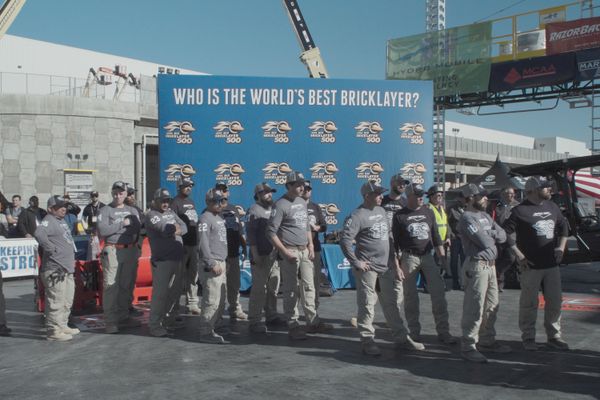
The documentary is about the history of the building material, and also about selling a documentary about the history of said building material.
Photo courtesy Magnolia Pictures
What’s so profound about how Wilson chases down the history of this quotidian construction material is how it reveals our assumptions about what will last forever. We build highways from the miraculous material, but as Sam Schwartz, the former New York City Commissioner of Transportation, tells Wilson while standing underneath the ailing Brooklyn-Queens Expressway, even those have 40-year lifespans. The monumental 432 Park Avenue building in Midtown is failing, the result of choosing an aesthetically pleasing white concrete that’s more prone to cracking than typical gray. The historic Hotel St. George in Brooklyn, now home to dorms, saw its hundred-year-old historic marquee collapse; speaking with construction workers on scene at the hotel, Wilson learns that the aging concrete was certainly to blame. We incorrectly assume our cities, built with the might of cement mixes and rebar, will last eternally; our cultural institutions, which we believe are still built around finding new voices and supporting novel ideas, have similarly decomposed.
It all sounds a bit doom and gloom, though it’s hard to tell from the documentary exactly how Wilson feels about it. His dry delivery doesn’t really reflect disgust, his tone feels more like resignation. But while researching sand (an ingredient in concrete), he attends a Buddhist mandala ceremony to watch monks carefully pour the fine, colored granules in an intricate pattern, only to destroy it once it’s complete. There is significance in watching something end, it seems. Later, we hear those monks chanting while footage plays from the press conference for former Mayor Eric Adams’s City of Yes, a zoning amendment proposal that seeks to build 80,000 new homes in New York and was protested vehemently by those who fought hard against neighborhood development. Samsara, Wilson explains, is the Buddhist theory of the suffering we experience when we deny the inevitability of change.
The History of Concrete isn’t just a "change is inevitable" movie as much as it is, in all of its awkward goofiness, a balm for those who live and work under fragile systems—which is to say, most of us. A significant portion of the film is devoted to failure: The crumbling expressways and buildings speak to fallibility and impermanence. Meanwhile, we see the film industry that has been so optimized for blockbusters that the narrow window for funding churns out unsuccessful filmmakers. Though Wilson wants us to understand collapse, he wants us to see those who are able to carve out a future for themselves under disintegrating conditions: the folks like Macco who keep playing to empty venues, the guy who blasts gum off sidewalks. These people, it seems, are the maintainers—those who try to keep the world afloat, even as gravity takes hold.
All photos courtesy Magnolia Pictures
Related Reading:
These Urban Planning Influencers Want to Help You Understand Cities
"That Is a Number One F U": A Conversation With the Creators of HBO’s "Neighbors" Docuseries