Romance’s New Leading Man Is... a Household Object?
In the increasingly popular "sentient-object romance" subgenre, everything from sponges to stand mixers are fair game for love affairs with (human) protagonists.
In the increasingly popular "sentient-object romance" subgenre, everything from sponges to stand mixers are fair game for love affairs with (human) protagonists.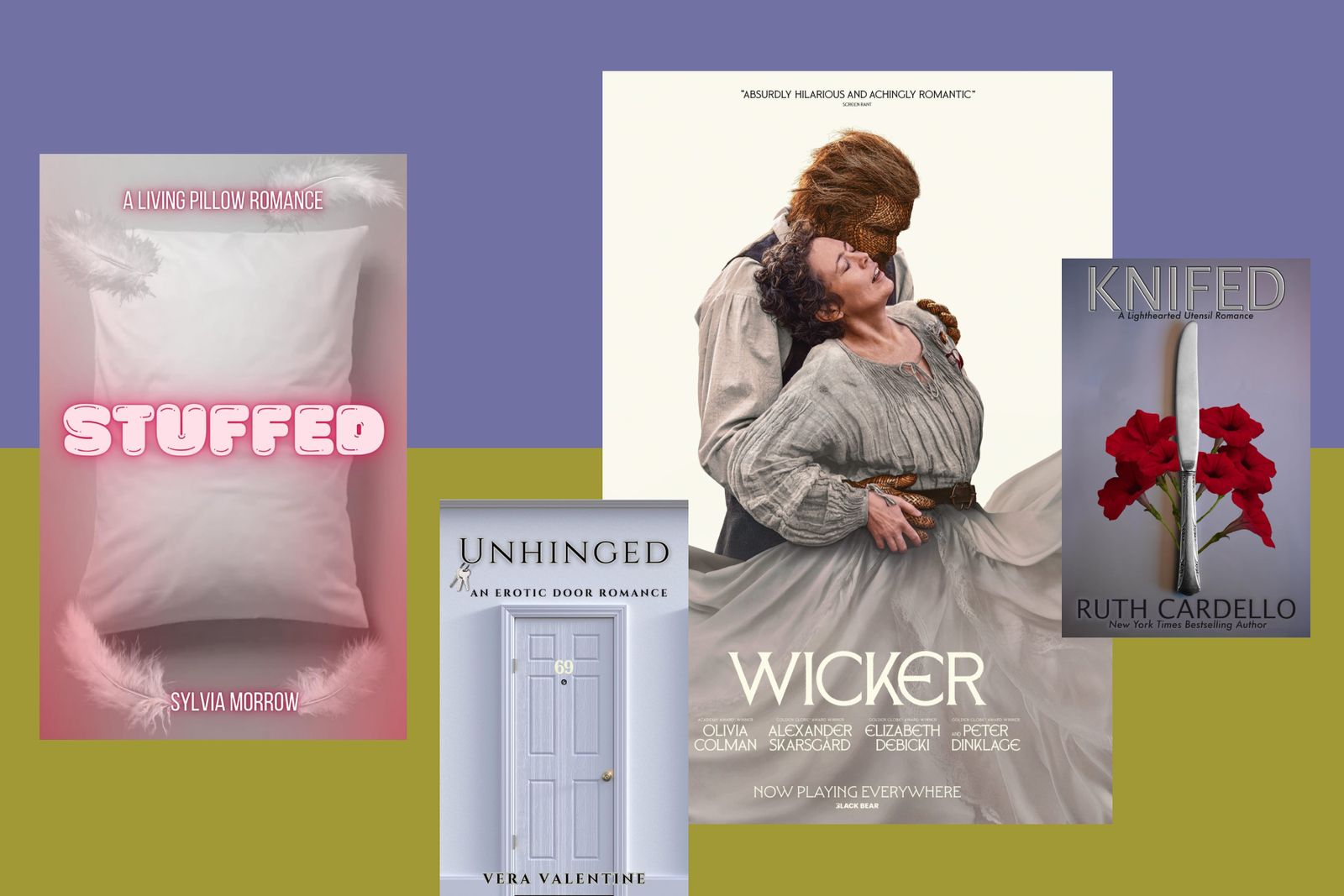
Can a woman fall in love with a fork?
That’s the provocative question at the heart of Ruth Cardello’s 2024 romance novella Forked. The story follows a shy, slightly awkward woman who purchases an antique silverware set from an estate sale and finds that she has an unusual attraction to one particular fork that (stay with me here) has a World War II soldier trapped inside it, the work of a secretive government program. His only way back to human form? Getting a woman to be intimate with him as a piece of cutlery, of course.
Forked is part of Cardello’s "Lighthearted Utensil Romance Series," which includes two other books that pair the female main character (FMC) with spoons and knives. "Well, I guess I’m into fork erotica," reads one Goodreads review. From another slightly less enthusiastic reviewer: "Girl, what?"
Cardello’s books are meant to be unhinged, eyebrow raising, and even comical. They are an extreme take on the paranormal romance genre, a term coined in the 1990s after the success of romance novels like Diana Gabaldon’s Outlander. Gabaldon’s own definition of paranormal romance breaks it down clearly: "Paranormal is any romance in which either the setting or protagonist is ‘different’. He (it’s normally, though not invariably, the hero who gets to be different) might be a vampire, for instance. Or he might be an alien. Or a werewolf. Or a citizen of a future civilization. Or a time traveler. You know, different."
The genre boomed in the 2000s with the release of best-selling series like Charlaine Harris’s Southern Vampire Mysteries (which became the source material for HBO’s True Blood) and Stephenie Meyer’s Twilight. In more recent years, paranormal romance has expanded to include the increasingly popular subgenre called sentient-object romance, in which the love interest is certainly different: Nearly any object is fair game for romance, desire, and satisfaction, from produce to airplanes, inflatable tube men, and clothing.
I discovered sentient-object romance during a bored afternoon of doomscrolling Instagram. Since the algorithm knows all, including my less literary reading habits, it recommended a creator who dealt in unhinged reads. She had just finished Nora Noodle’s 2024 novella Mating with Mallows, an Easter-themed "erotic sentient candy romance." I immediately shared the Reel with a friend, forever dooming my algorithm. Since then, Instagram has fed me Reel after Reel of increasingly creative sentient-object romances, pulling me down a deranged rabbit hole.
While on my (extremely freaky) smut-filled journey, I was struck by how many were about women falling in love with common household objects: rulers, permanent markers, rakes, washing machines, toasters, lint traps, and lamps. FMCs, it seems, abandoned human men for vampires and other monsters, only to leave them behind, too. The sentient-object romance doesn’t switch out the human man for his more dangerous, mythical counterpart, it resists the very idea of female pleasure existing in typical heterosexual sex. The subgenre is fueled largely by self-published writers who have turned Kindle into a madhouse, and it’s consumed by an online community of romance readers who think it’s funny to read about a woman finding fulfillment in a ménage à trois with balloon animals, and even funnier to share their thoughts on the eroticism of that with like-minded weirdos. That influence has found its way into literary fiction, too. Last year, Kate Folk’s debut novel Sky Daddy, about a woman who is sexually obsessed with airplanes, received widespread critical acclaim.
But there is also an element of fulfilling authentic desire that underlines these books, for both home goods and love. "Fantasy is the escapist genre par excellence, and therefore the ideal medium to avoid confronting a threatening world," writes Maria Ramos-Garcia, a professor at South Dakota State University whose research focuses on romance novels, specifically paranormal romance and urban fantasy. Ramos-Garcia notes that the boom in paranormal romance happened in response to the social and political instability of the early aughts, from terrorism to foreign wars and the financial crisis. "Fantasy worlds," Ramos-Garcia writes, "have always been created as a safe space to tackle societal conflicts considered too difficult or realistic in a realistic setting." Or, as one Bookstagrammer captioned a post with sentient-object romance recommendations (that included a meme reading, "Stop being so hard on yourself in the middle of societal collapse"): "The world is on fire, eggs are like $7, and I’m afraid to eat produce or fruit. Let’s get weird!!"
It makes sense then that paranormal would expand to sentient-object romance. As women’s agency and the boundaries of gender are renegotiated, sometimes violently, in the public sphere, the sentient-object romance grants the FMC near-total control of physical space, pleasure, and relationship development. The FMC is (almost always) free to explore sexual fantasies that deviate from the romantic norm within the safe space of her own home. The modern concept of curating a home is often packaged like romance: pick the perfect match, buy it for life, home is where the heart is, build your dream house—do it just right, and domestic bliss is guaranteed. In the world of sentient-object romance, the narrative link between finding the perfect partner and finding the perfect bedding or vintage rug is made clear.
The central trope of these books follows a similar formula: a shy, nerdy, or down-on-her-luck woman finds a sexually eager, ideal mate already living in her home. In Krista LaRae’s 2026 book Creamed by My Monster Stand Mixer, for example, a burned-out baker harboring an unrequited crush finds unexpected sexual fulfillment from the countertop appliance, which happens to be inhabited by a "nonhuman man" who is both attractive and eager to please. The pairing of awkward woman and unimaginably hot, nonhuman partner appeared onscreen recently in A24’s Wicker, starring Olivia Colman as a spinster in a fishing village who commissions a local basketmaker (Peter Dinklage) to weave her a nearly perfect husband (played by Alexander Skarsgård) from, well, wicker. He, of course, is animated into sentience by magical forces, a standard device in sentient-object romance. The movie is based on Ursula Wills’s 2008 short story The Wicker Husband. The Goodreads page for Wills’s 14-page e-book says readers also enjoy titles like Cassandra Elizzabeth’s No Bones About It, a 2026 novel about a recent divorcée who falls in love with "the one thing her ex-husband never let her have": Home Depot’s viral 12-foot skeleton (which kicks off a heated feud with her HOA).
On BookTok and Bookstagram, content creators joke about the depths of their ironic literary depravity, embracing the trend of proudly reading smut. Smut is a time-honored tradition of the romance novel, but its popularity has grown in the last decade, fueled in part by the romantasy boom, which had an estimated $1.4 billion in revenue in 2023. (Romance novels more broadly are, as the Atlantic pointed out, "recession-proof," and the genre’s largely female audience members are voracious readers, driving it to billions in profits.)
I imagine that for many readers like me who find themselves in the dark corners of Bookstagram because they are well past romance stories about fairies and giant blue aliens, the next logical step is following a love affair with a "Scrubbie Dubbie," a familiar cleaning product renamed in April Showers’s 2025 "sentient sponge romance" Scrub Me, Daddy, almost certainly to avoid brand infringement. In one Instagram video, a creator wryly recounts the plot of Vera Valentine’s appropriately named 2023 novella Unhinged, in which a voyeuristic apartment door falls in love with the woman who lives in the unit. She returns the affection and finds that they share some sexual kinks.
Sometimes there’s a surprising emotional depth in the relationships depicted. The 2023 novella Stuffed, for example, part of a series by Sylvia Morrow, follows the anime-obsessed Anne, a young woman who doesn’t like to be touched and may have fictophilia (strong, lasting love or desire for a fictional character). Sure, it’s a funny, absurdist romp, but, like all romance novels, regardless of the subgenre, it’s fundamentally about the expression and fulfillment of fantasies. For characters like Anne, the outside world isn’t exactly kind to her—that acceptance, love, and sexual compatibility all already exist inside her home is the fantasy made real.
That the collection and maintenance of common household objects is gendered is hardly a radical statement. Gender and domesticity are closely linked, and the performance of womanhood involves the careful selection of home goods, a mental inventory of the junk drawer, and knowledge of the current state of the kitchen sponge. The objects that make a home functional are often selected with intimate care; a pillow isn’t just a pillow, it’s exactly the right pillow. And finding the perfect pillow takes time and effort; it also takes consideration of one’s comforts and needs—an expression of desire as physical as it is capitalistic.
In these books, women have both purchasing power and the power of pure agency: Cardello’s FMC chooses an antique silverware set because she desires it and is able to express that desire, which she is later able to do with her own sexual pleasure through her relations with the fork. That the piece of cutlery later turns into a man is secondary; pleasure and power come first.
It makes sense then that a woman could, indeed, fall in love with a fork.
Top collage by Dwell. Source images courtesy Black Bear Pictures and via Amazon.
Related Reading: