The "Little House on the Prairie" Reboot Maintains the Americana Fantasy of the Log Cabin
Netflix’s adaptation of the beloved book series tries to take on tougher truths about the Western frontier, but its titular structure leans into an idealized image of pioneer nostalgia.
Netflix’s adaptation of the beloved book series tries to take on tougher truths about the Western frontier, but its titular structure leans into an idealized image of pioneer nostalgia.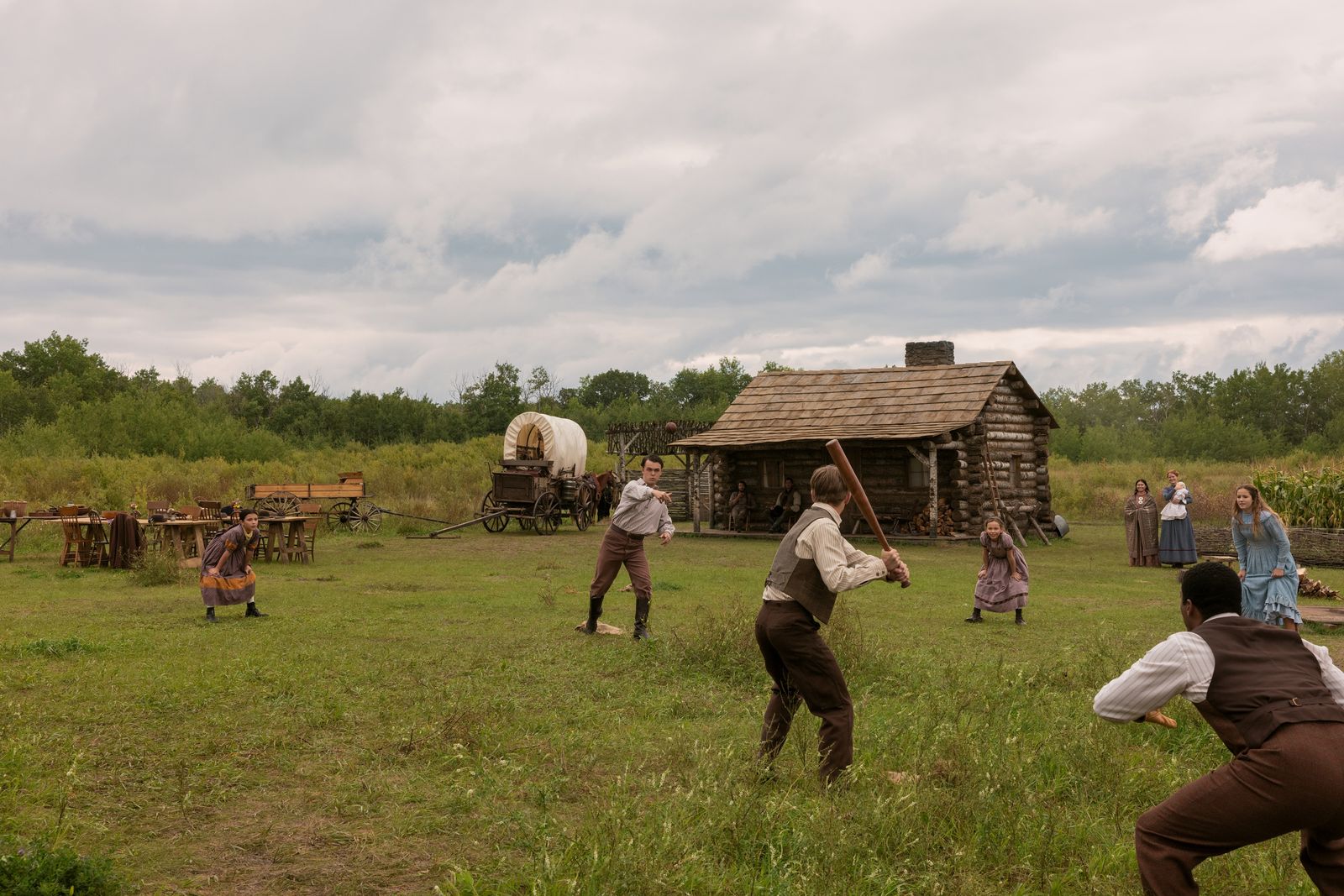
The Ingalls of Netflix’s new adaptation of Little House on the Prairie are depicted as people who want something simple and understandable: a fresh start together in a snug and secure home, which they’re willing to work hard and make enormous sacrifices to build. Consequently, the log cabin where they attempt to make a new life may deserve top billing as much as the actors.
The reboot, debuting hard on the heels of America’s 250th birthday, is the work of a team led by showrunner and executive producer Rebecca Sonnenshine. It’s audacious to even attempt: The nine books by Laura Ingalls Wilder fictionalizing her family’s life on the late 19th-century American frontier are some of the country’s best-loved and most famous novels. The new adaptation is inevitably also being measured against Michael Landon’s 1970s TV version, which remains popular on streaming. And then, of course, there’s the fact that it’s a cultural lightning rod. The books have long been criticized for their depictions of Native Americans, which range from racist to erasure; it’s a reality the Netflix remake attempts to wrestle with—to the chagrin of some. (Conservative media personality Megyn Kelly was fretting that Netflix would "wokeify" the source material long before the show debuted.)
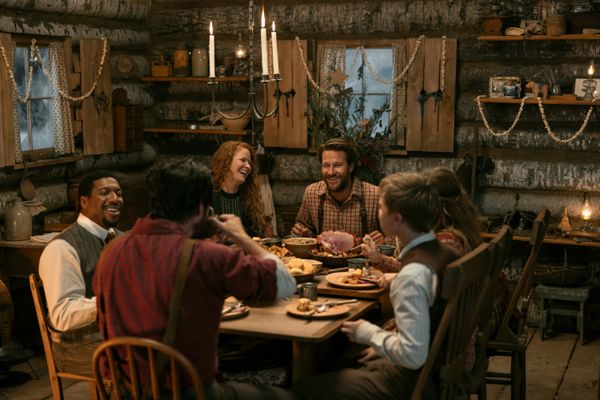
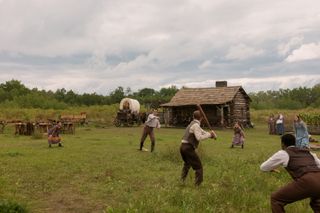
The first season of Netflix’s Little House on the Prairie remake takes inspiration from the third novel in Laura Ingalls Wilder’s semi-autobiographical series. In it, the Ingalls family build their homestead on the frontier near Independence, Kansas, after traveling by wagon from Wisconsin.
Photo courtesy Eric Zachanowich/Netflix
The results are not exactly gritty, but they’re often visually stunning. The show’s creators wisely lean all the way into the sheer beauty of the landscape that’s so integral to the story. There are flower crowns and fresh-picked blackberries and a vast blue sky stretching over a sighing green ocean of prairie so gorgeous it’ll have you yearning to go camping. Though it’s not, in fact, Kansas: the show was actually filmed in Manitoba, Canada.
Much of the first two episodes are dedicated to the Ingalls’s effort to build the titular little house, beset by classic frontier mishaps: a log rolls onto Ma’s foot, for instance. It’s enough to take her out of the construction job, necessitating Pa finding and befriending their gruff alcoholic neighbor, but of course it doesn’t turn septic. The payoff finally comes at the beginning of episode three. And what a payoff: wide plank floors; wooden shutters with elegantly simple cutouts; hand-hewn beds covered in gorgeous quilts that could make a dedicated antiquer weep. Translucent cream-colored curtains move gently in the prairie breeze. The door and mantel are both engraved, the former with the monogram "CI" (for Charles and Caroline Ingalls) and the latter with "The Ingalls Family Home" cradled in a botanical motif. In the crowning touch, Ma pulls out a pink-and-blue porcelain shepherdess and places her gently on the mantle.
The creative team studied the books closely and did a great deal of research to put together the show’s world. In a quest for maximum authenticity, they even went so far as to fashion a proper, homesteader-style log cabin: "We actually built it that way—no nails, all wood pegs," production designer Jonah Markowitz told Tudum, Netflix’s companion site that publishes exclusive content about its original films and series. "My aim was to make it as homey and reflective of the Ingalls family as possible," added set decorator James V. Kent.
There’s no prairie dust, no soot, no greasy cooking residue, no chamber pot logistics. It looks like Ballerina Farm could slide right into the frame cradling a baby and a stoneware bowl of sourdough.
For millennial women who spent hours poring over the American Girl catalog, Netflix’s take on the picturesquely rustic haven will likely recall Kirsten Larson’s cabin as much as the homestead of Wilder’s original descriptions. Its staging follows in the footsteps of Garth Williams’s iconic pencil illustrations for the novels from the mid-1940s, as well as the visual styling of the Landon’s TV show, which, having been made in the ’70s, hewed closely to a color palette of 37 shades of nicotine brown. What the fictional spaces share is a determined homeyness: just rough enough to seem cozy, but not bad enough to make you agree with Ma’s sister, who in this adaptation keeps writing letters begging Ma to come back home to the relative stability of Wisconsin.
The streamer’s 2026 version of the Ingalls’s log cabin is, obviously, a scrubbed-up space, even by the standards of a story that began as a heavily edited version of westward expansion written for children. Despite the fact that the Ingalls’s economic precarity is a driving force in the story—there’s an entire episode in which Mary and Laura attempt to win prizes at the town festival to pay down their family’s debts—as the camera pans around the small but artfully arranged room in that first shot, there are eight candles burning, plus a lit kerosene lamp, even though it’s broad daylight. (Forget any romantic notions about beeswax, by the way: the standard budget option on the 1870s frontier would have been tallow candles made from rendered animal fat, which are apparently smoky and foul-smelling.)
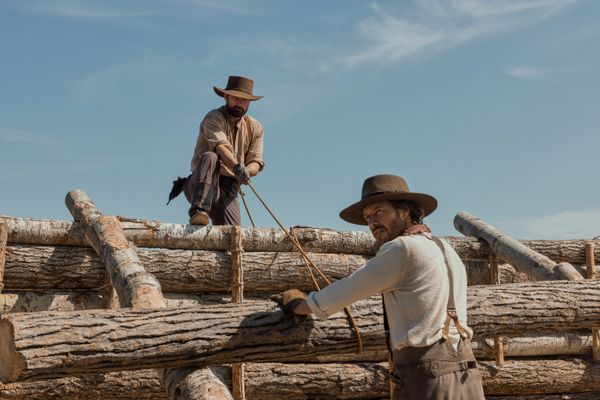
The Netflix series was renewed for a second season before the first season premiered on July 9.
Photo courtesy Eric Zachanowich/Netflix
The modern reconstruction of the Ingalls’s homestead at a dedicated Kansas museum, by comparison, looks significantly more like a cave than the attractive home we see on-screen, which makes bark walls look pretty appealing. In the Netflix reboot, there’s no prairie dust, no soot, no greasy cooking residue, no chamber pot logistics. It looks like Ballerina Farm could slide right into the frame cradling a baby and a stoneware bowl of sourdough.
But this idyllic cabin is completely in keeping with what’s so captivating about Wilder’s original series: it’s not an accident they’re invariably referred to as "the Little House books." A huge amount of the pleasure of the original texts was in following each home take shape as the Ingalls moved across the prairie—the log cabin in Independence, Kansas, the dugout in Minnesota’s Plum Creek, the homestead in De Smet, South Dakota. The series is essentially a parade of houses and homes, a story about creating them right out of a raw American landscape using whatever was available to hand. In Little House on the Prairie (the 1935 book that inspired the plot of the Netflix show’s first season), Wilder herself described the log cabin as "a pleasant house," notwithstanding the fact that it still had a dirt floor at the time. She wrote: "Soft light came through the canvas roof, wind and sunshine came through the window holes."
And so these books held the same appeal as the original Boxcar Children series, Jean Craighead George’s My Side of the Mountain, or Julie Andrews’s Mandy, speaking to kids’ love of high drama and playing house—a game that generally looks less like Mommy, Daddy, and Baby in a house with a two-car garage and more like, we’re orphan sisters lost in the woods, how will we survive?
It’s not a secret that Wilder and her daughter took dramatic liberties when translating their family story into a series of classic children’s novels. But even on their real sojourn in Kansas, the Ingalls were essentially playing house, though a deadly serious version. Caroline Fraser’s magnificent biography of Wilder, Prairie Fires, captures the unmaking that was happening as the Ingalls arrived in Osage territory, hoping to start a homestead claim before the federal government had officially taken the land. She recounts how thousands of settlers converged on the Osage Diminished Reserve while the Osage were away on a seasonal hunt, "setting up saw mills, stealing fence rails, and dismantling or seizing cabins for themselves." They set fire to hay fields and corn stores; they stole lumber and valuables from an Osage village.
Even if the Ingalls didn’t participate in this violence and vandalism, as Fraser makes clear, they were absolutely squatters with no legal right to the land underneath that cabin or even the trees they used to build it, and they were part of a larger push to force the Osage out. The Netflix adaptation tries to work with this reality, introducing the Mitchells, an Osage family with a counterpart for Laura named Good Eagle, and rewriting the Ingalls as people who immediately see the inherent humanity of the Osage.
But the Ingalls are still the protagonists, and the show is still about their attempt to make it in that cozy little log cabin, which remains even now a powerful emblem with enormous cultural currency, maybe even the core American fantasy. Just don’t ask too many questions about how well each of those houses worked out for the Ingalls or look too closely at the candles.
Top photo courtesy Eric Zachanowich/Netflix
Related Reading: