William Morris Sketches That Have Never Been Reproduced Were Plucked For Ruggable’s Latest Drop
Embroidery designs, drawings, and even a tiny detail from a book cover were lifted from the British designer’s archives at The Huntington and put to use for the new floor covering collection.
Embroidery designs, drawings, and even a tiny detail from a book cover were lifted from the British designer’s archives at The Huntington and put to use for the new floor covering collection.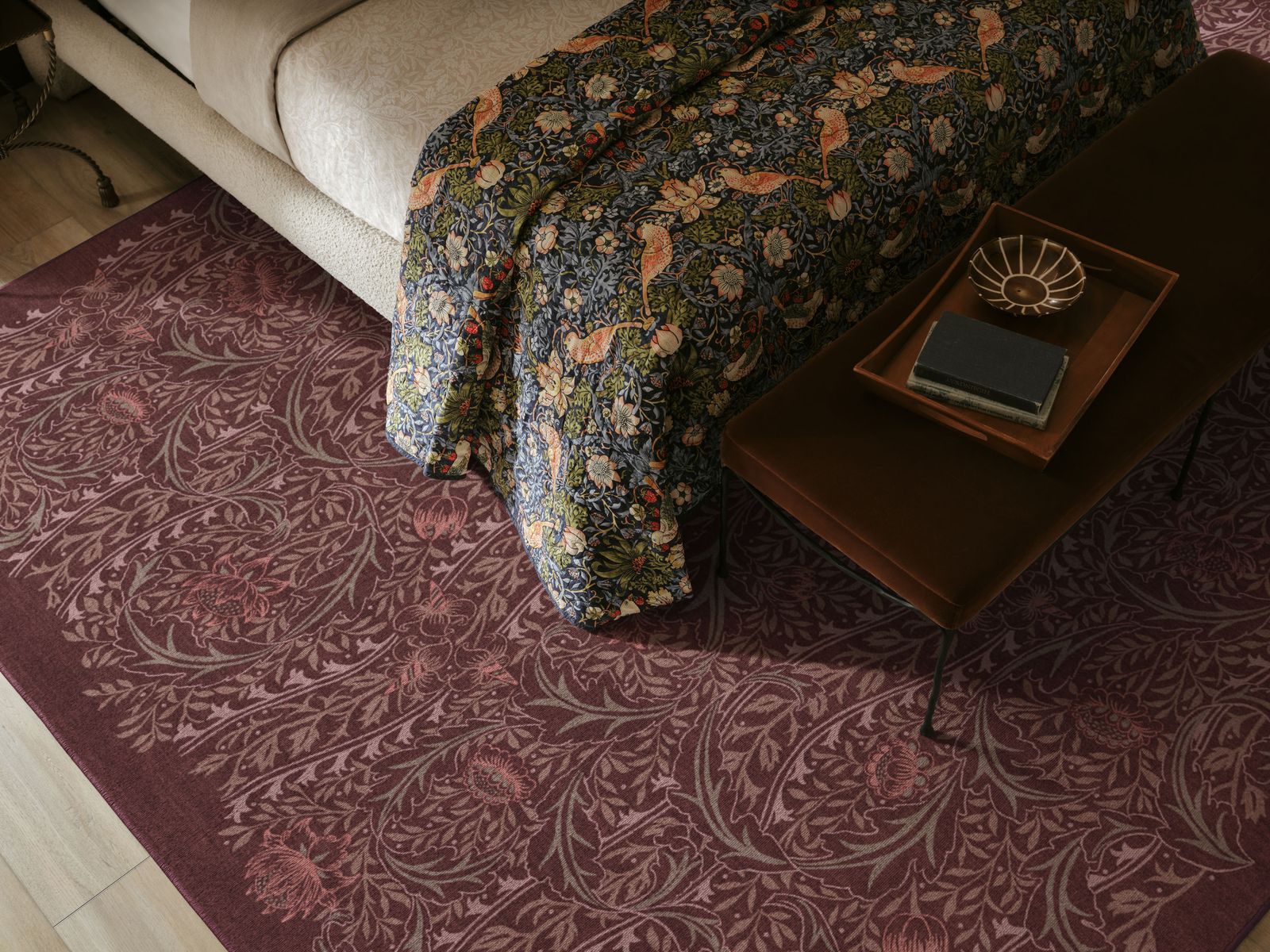
The beloved Arts & Crafts designer (and socialist activist) William Morris prized handcraft, promoted joy and dignity in labor, and borrowed visual inspiration from the natural world. Disillusioned by the Industrial Revolution, he advocated for a return to the medieval guilds, where craftspeople were responsible for every step of design and production. "Have nothing in your houses that you do not know to be useful or believe to be beautiful," he once said. He furnished his own home, The Red House, which is outside of London, with botanical wallpaper, hand-painted murals, Gothic-inspired woodwork, and stained glass.
A prolific designer, Morris sketched many ideas that his brand, Morris & Co, established in 1861, never produced. And now Ruggable—the DTC company known for its machine washable rug system composed of a non-slip rubber pad and a removable patterned top—is adapting some of those archival drawings into a new body of work, its fourth collaboration with the British company. The Morris & Co. x Huntington Collection includes 26 rugs featuring patterns of anemones and bluebells, wild tulips, and Persian-inspired botanical motifs.
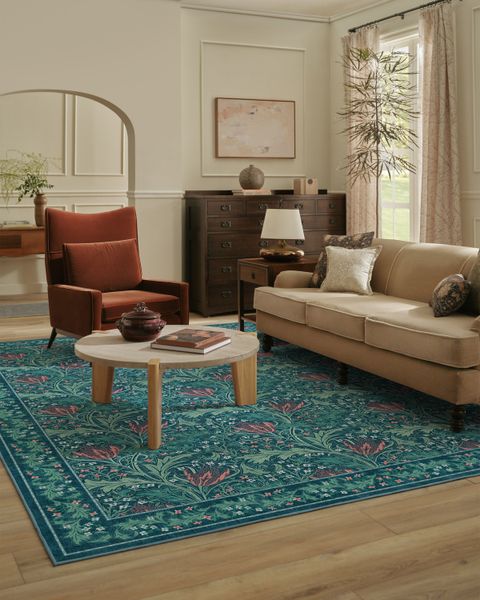
Floral motifs are a constant in the collection.
Courtesy of Ruggable
As it turns out, Morris’s 19th-century designs remain remarkably fresh today. "For me, it comes back to how specific Morris's eye was," says Maria O’Brien, Ruggable’s VP of Global Design. "These patterns were rooted in folklore and storytelling, not decoration for its own sake. That specificity is exactly why they hold up now." To date, Ruggable says it has sold over half a million rugs from its previous collaborations with Morris & Co, making it the company’s most successful collaboration to date. Given the clear appetite, developing a new collection felt like a natural progression for both brands. "People are moving toward pieces that feel considered rather than trend-driven, and Morris’s work was built for that kind of permanence long before it was a marketing idea," she adds.
O’Brien—who grew up in the U.K. and lived in an historic home her parents furnished with Morris designs—viewed her work on this collection as that of a translator. It began with a trip to the archives at The Huntington Library in Pasadena, California, where she found material for ideas that never went into production, including hand sketches, embroidery, artwork for carpets, and "even a small detail lifted from a book cover," she says. Ruggable’s design team collaborated with Morris & Co’s in-house team to complete the patterns and adapt them to rugs. "The goal was never to modernize Morris," O’Brien says. "It was to finish what he started, using the same hand and eye that would have completed the piece originally."
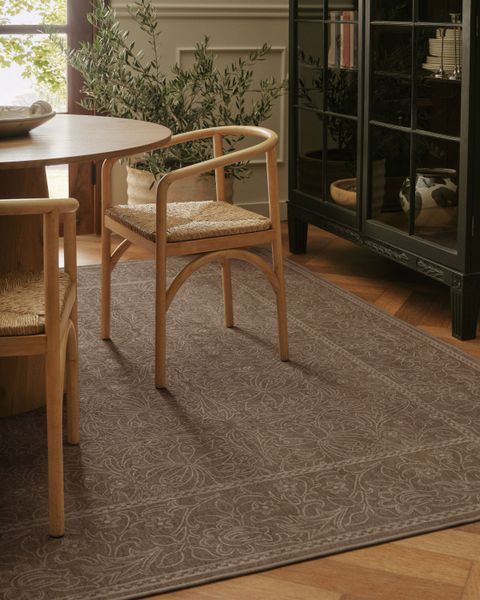
The rugs in the collection are available in a variety of sizes, including Walthamstow which is available as in dimensions that suit use as an area rug, runner, and doormat.
Courtesy of Ruggable
Ruggable’s first collaboration with Morris & Co. involved adapting already existing patterns onto its products. This new collection consists entirely of patterns that have never been produced and are "completed from sketches that sat untouched for 150 years," O’Brien says. "We’ve moved from reinterpreting the archive to actually adding to it."
The designs feature organic, floral motifs—classic Morris—and come in multiple sizes and colorways. For example, the Woodbell and Anemonie rug consists of intricately drawn large-scale flowers and leaves with a symmetrical repeat while the Wild Tulip and Vine is more subtle with a dense concentration of leaves and small blossoms.
After the team selected the archival works to adapt into contemporary products, Morris & Co. designers repainted them by hand in their London studio. "Our designers have effectively picked up the pen laid down by Morris and J. H. Dearle," says Claire Vallis, Design Director, Sanderson Design Group, the parent company of Morris & Co. "It’s a remarkable, unspoken exchange across centuries, pushing the boundaries of exquisite U.K. craft to bring these hidden historical treasures into the modern home, as they were meant to be enjoyed."
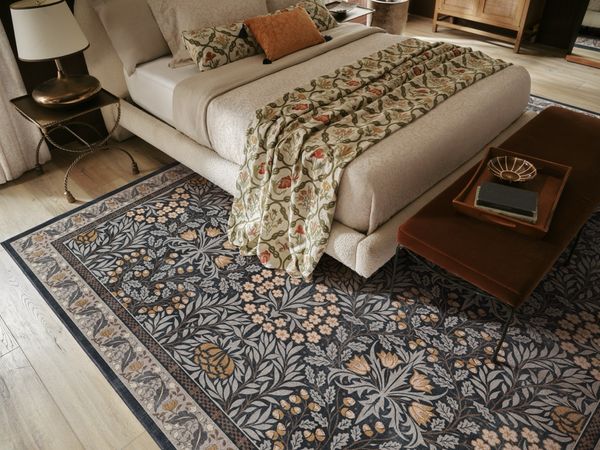
The variety of colors in the collection offer something for a wide variety of color palettes, from vivid hues to true neutrals.
Courtesy of Ruggable
See the full story on Dwell.com: William Morris Sketches That Have Never Been Reproduced Were Plucked For Ruggable’s Latest Drop
Related stories: