Your Favorite Podcast Wants to Make You Feel at Home
As more money flows into the medium, professionally designed sets that mimic domestic backdrops have become the go-to ingredient for keeping things candid.
As more money flows into the medium, professionally designed sets that mimic domestic backdrops have become the go-to ingredient for keeping things candid.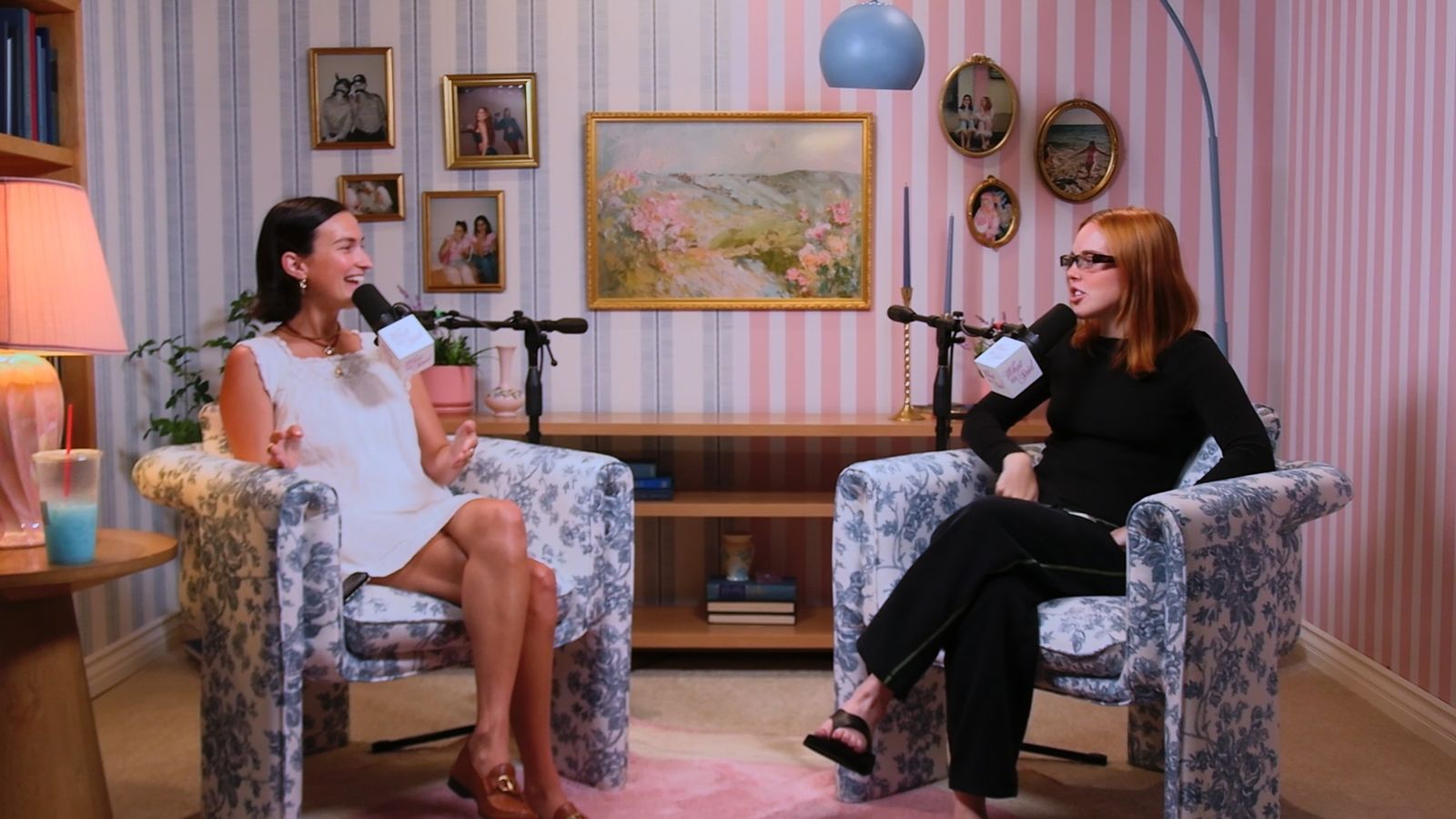
I have to imagine I’m not the only person who has said to a friend, "We should start a podcast." I have a clear memory of having this conversation with a former roommate after one of our frequent evening debriefs, sitting on opposite sides of our gray, L-shaped sofa beneath a gallery wall, our legs tucked under blankets and kicked up on the water-stained West Elm storage coffee table sourced from Facebook Marketplace. If we had started a podcast (we didn’t), that table is probably where we would’ve set up microphones to casually record our ramblings. If there were enough people out there who wanted to listen (we’ll never know!), our setup would’ve likely eventually evolved to include at least one video camera. But we might not have felt the need to change our "studio" setting; today, the lived-in backdrop would’ve fit right in with the look of many of the most popular podcasts out there.
As podcasts have swung from an audio-only medium to a video-centric one, with Youtube becoming the dominant platform for consumption, the lines between video podcasts ("vodcasts") and traditional television talk shows, late night, and cable newscasts have increasingly blurred. Professionally designed recording studios are now the norm; most new talk show podcasts launch with built-out sets, and ones that started before podcasting’s major pivot to video around 2020 have adjusted to meet the moment. At first, that just meant starting a Youtube channel with video recordings of podcast episodes, but since 2023 (upon close study), numerous major podcasters have unveiled full-on recording studio overhauls. And across categories, from pop culture "chat-casts" to expert interview and political commentary shows, those sets overwhelmingly pull from domestic aesthetics, whether they’re filmed in at-home studios or production headquarters. The central notion is that the most interesting, honest, and natural conversations happen between people in the comfort of their homes—and wouldn’t anybody want to be a fly on the wall for those?
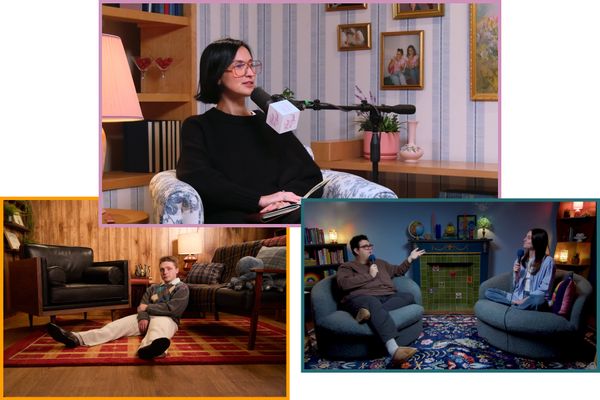
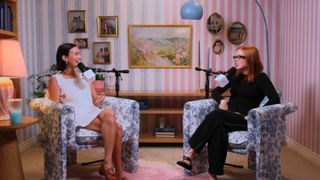
Interwoven Studios and creative director Connor Brock designed the set for Jake Shane’s Therapuss podcast before its first season. They updated it for the show’s second season (shown left) and for the third on Netflix. Interwoven and Brock also designed the studio for What We Said (top). The Dear Media podcast launched in 2018, added video in 2024, and debuted the new set at the end of that year. So True With Caleb Hearon started recording from a new, built-out studio when it was picked up by Wave Sports and Entertainment in late 2025 (right).
Left to right: Courtesy Interwoven Studios; Courtesy Dear Media; So True with Caleb Hearon via Youtube
The nostalgic lounge
When you start looking, there are some clear aesthetic categories that emerge. One of the most recognizable examples of a category I’ll call "the blast-from-the-past living room/lounge" is the wood-paneled backdrop of Therapuss, the talk show–style podcast from influencer/comedian Jake Shane that was among a slew of well-established titles licensed by Netflix in early 2026 (when the streamer ignited a race amongst major streaming services to add video podcasts to their platforms). Before the show’s first season in 2024, Shane and his team approached Los Angeles production services company Interwoven Studios and creative director Connor Brock to design the set, and asked for something along the lines of a "midcentury-modern-inspired therapist’s office," Brock says. They built a distinctly of the internet-era vision of a 1960s den—er, shrink’s office—in the guesthouse behind Shane’s L.A. home. In one episode, Shane and Charli XCX kick up their feet on blue velvet lounges, the framed faux certificates behind them reminding of Shane’s position in "the proverbial therapist’s chair," while the TAYLOR SWIFT ERAS TOUR bumper sticker propped on a bookshelf gestures that he, like the audience, is ultimately just a pop culture stan.
Interwoven cofounder Chance Horky says Shane’s team made "a purposeful investment" in the look of the set as Therapuss took off in its second season, though he declined to discuss numbers. In came a stick-on stone accent wall, patterned rug, and Eamesesque wood-and-leather sofas to add visual texture; out went the Eras Tour sticker and the wood-and-brass bar cart. In the third (exclusive-to-Netflix) season, the framed certificates are the main signifiers that we’re not just in the warm-but-spotless living room of a chronically online person who spends a sufficient chunk of their income on taste-signaling home decor. A-list guests like Hailey Bieber and Kylie Jenner lean into the brown velvet couch and talk to Shane like he’s a friend (indeed, he runs in the same circles as many of his superfamous guests). The environment is shiny enough for fully styled and glammed celebrities to not feel totally out of place in (hello, chrome accents!), but still within-reach for the pop culture devotee watching through the screen to project themselves into.
Some living room-like podcast sets lean into similarly stylized nostalgia for past eras that the hosts and audience actually know firsthand. The set where Arizona-born influencers Jaci Marie Smith and Chelsey Jade Curtis film their lifestyle podcast What We Said—also designed by Brock with Interwoven—could easily be the childhood bedroom of a wealthy New Englander whose empty-nester parents took the space and repurposed it as a reading corner, leaving the baby-pink-and-blue wallpaper and the bulletin board with Polaroids and Post-Its but making space for their World Atlas collection. Brock says the duo’s team gave them a mood board to illustrate the aesthetic they wanted, which he describes as "like, Northeastern rich girl from the Nineties." When the podcasters talk through relationship red flags and "unhinged wellness habits" or stories about wedding drama and accidental texts on chintz-style upholstered chairs, we’re supposed to feel like we’re watching two hometown besties-cum-sorority sisters locking in on a gossip session, and lucky you, you got the invite.
By contrast, comedian Caleb Hearon’s So True got a new set last year that could be a believable pop-up for an Urban Outfitters collab with the children’s book classic, Goodnight Moon. The aesthetics—a green-tiled fireplace with colorful camp pennant flags, and a wall-mounted cord landline—help suggest the tone: We’re in a space that might remind millennials of ones they played and learned in as children, so expect conversations that bounce between silly, intellectual, and earnest.
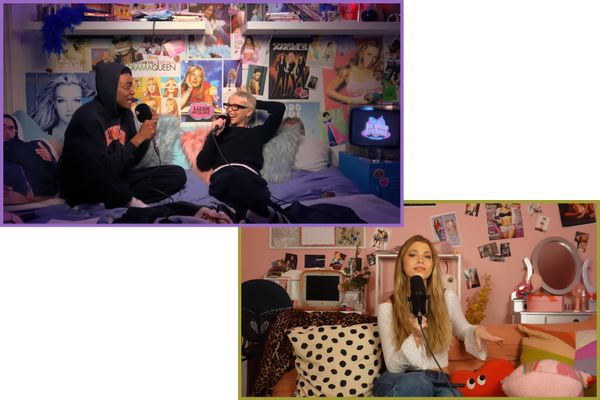
In Your Dreams With Owen Thiele launched in 2024 under Alex Cooper’s Unwell Network with a Y2K-inspired bedroom set where he films the podcast from his home. Influencer Becca Moore also started her For the Girls podcast in 2024 and by the end of that year started recording episodes from a professionally designed at-home studio.
Left to right: In Your Dreams With Owen Thiele via Youtube; For the Girls with Becca Moore via Youtube
The Y2K bedroom
Unsurprising to anyone who’s had even one eye open to what the kids have been into over the past few years, the Y2K bedroom is a more specific subset of the nostalgic podcast set that’s a go-to backdrop for a certain type of zillennial chat-cast. In Owen Thiele’s In Your Dreams, the influencer/comedian curls up on an unmade bed dense with fuzzy pillows and plushies with Gen Z favorites like Emma Chamberlain, who lean against a wall plastered with cutouts from their own magazine spreads alongside Taylor Swift album covers (clearly a quick signifier of 21st-century fan culture) and flyers for canons of early-aughts media like Lizzie McGuire. The hyperstylized slumber party aesthetic begets a manufactured atmosphere of familiarity where Thiele can ask Kendall Jenner, for example, to address internet rumors about her sexuality in a way that Jimmy Fallon could never in a more late-night talk show setting. Remember, this is a sleepover where personal lore is shared—not a traditional media interview.
The set of influencer Becca Moore’s For the Girls (a double entendre for the intended demographic of her podcast, and also her romantic interests) also borrows from the decorative hallmarks of the era. Moore talks directly to the camera about her own dating stories and interviews other queer influencers on a pink Togo-style sofa with a cheetah print blanket and throw pillows. Behind her, there’s a bulletin board with butterfly clips, a Clamshell Macbook, a bedazzled desk chair, and baby-pink walls strewn with cutouts of 2000s pop girl icons like Britney Spears, and queer canon media moments like the iconic Megan Fox lighter shot in Jennifer’s Body.
If the Y2K bedroom podcast studio looks more believably lived-in than "the blast-from-the-past living room/lounge," that’s on purpose. "It’s always towing the line that you see just enough of my mess to feel like we’re hanging out, but also I’m a content creator," explains Christine Tran, an assistant professor at Alberta University of the Arts whose research covers digital culture, domesticity, and the creator economy. "There’s still that professional sheen."
As far as domestic spaces go, the bedroom is the one that most reliably signals intimacy, but Tran argues that it also carries a particularly gendered undertone. "Bedrooms have historically afforded women spaces of safety and networking," she says. "Scholars have looked at the bedroom as a rehearsal room for the type of femininities and social-emotional labor that girls are expected to perform outside the home." Youth culture theorists Angela McRobbie and Jenny Garber introduced the concept of "bedroom culture" in a late ’70s essay highlighting how teen girls of the time participated in subcultures in their private domestic spaces, and researchers have pointed to girls’ bedrooms as "sites of cultural production" since the ’90s and 2000s especially: of zines, of blogs, of fanfic, of mixtapes, of dances, and, eventually, of Youtube and TikTok vlogs and GRWMs. The Y2K bedroom set expresses an unabashed embrace of culture typically deemed feminine (and usually also vapid, for that reason); millennial viewers can recognize it from their own upbringings, and younger generations from depictions on-screen. The background mosaic says something about who the host is, and also who their followers are likely, too. But, Tran says: "It’s important to note that these backgrounds default to suburban, middle-class, white-coded, American-coded settings. And very idealized ones. I think these nostalgic responses, these middle-class fantasies are a way of harmonizing those class differences."
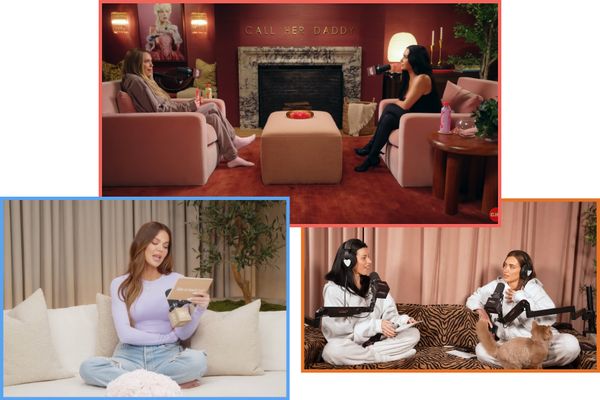
Call Her Daddy host Alex Cooper tapped the designer behind her L.A. mansion renovation to redo her podcast studio twice since 2023 (top). Khloé Kardashian launched her Dear Media podcast Khloé in Wonder Land in 2025; it records from a Calabasas studio (left). The at-home set where influencers (and friends to the Kardashians) Victoria Villarroel and Stas Karanikolaou record their Better Half podcast splits the difference between Cooper’s hyperfeminine backdrop and Kardashian’s luxe but minimal one.
Left to right: Khloé in Wonder Land via Youtube; Call Her Daddy via Youtube; Better Half with Stas & Vic via Youtube
See the full story on Dwell.com: Your Favorite Podcast Wants to Make You Feel at Home

![DoubleMint House / large [medium] design office](https://images.adsttc.com/media/images/66d6/ee58/f999/c656/23a9/c4d7/medium_jpg/doublemint-house-large-medium-design-office_5.jpg?1725361776#)