Imagining Home at the End of the World
Postapocalyptic media has long served as a reflection on what ails us. Right now, TV is particularly full of such series—all with varying visions of how we’ll live after global disaster.
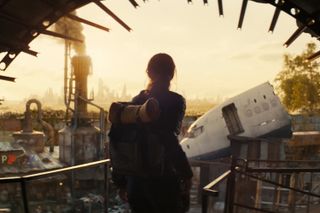
Postapocalyptic media has long served as a reflection on what ails us. Right now, TV is particularly full of such series—all with varying visions of how we’ll live after global disaster.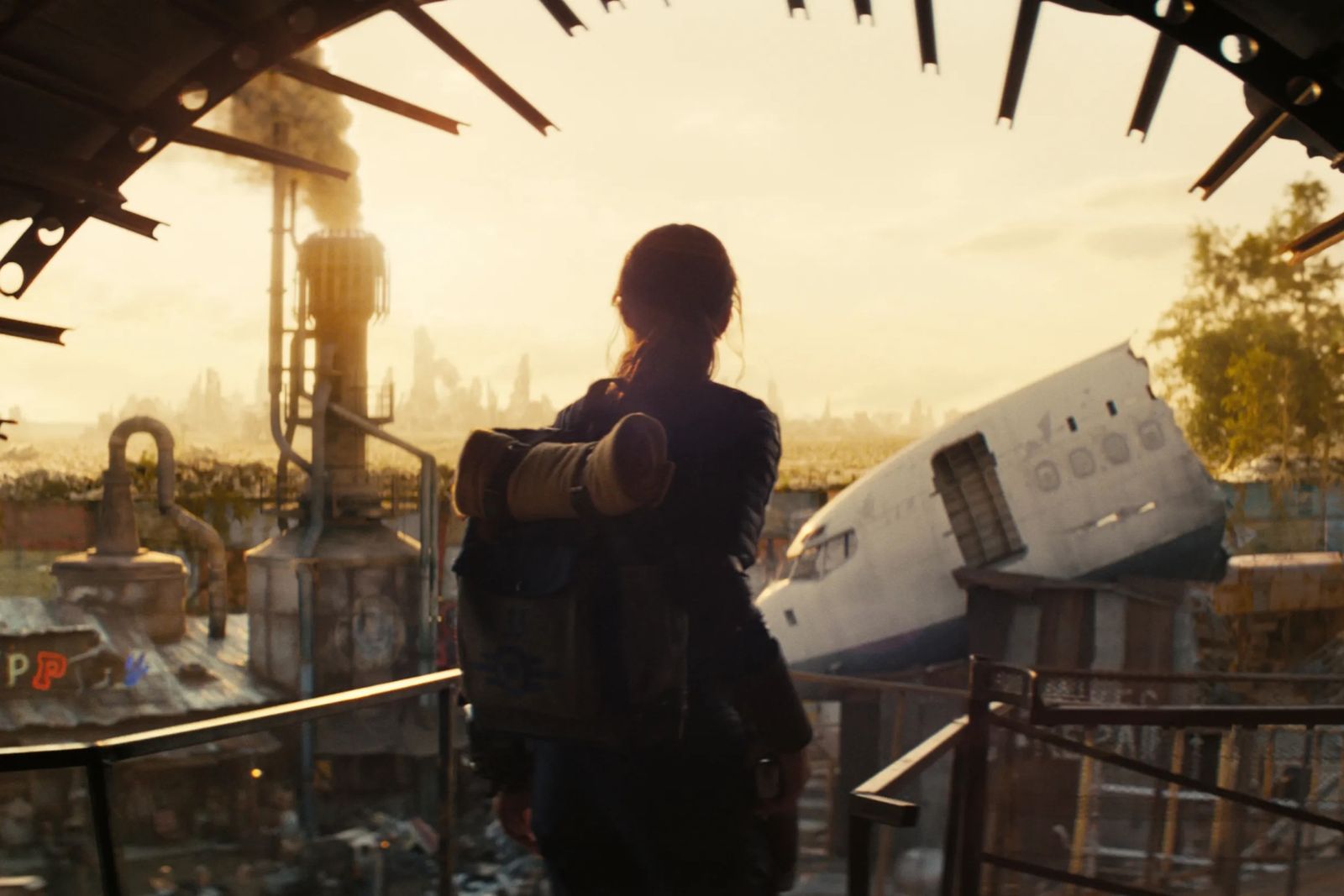
Television right now is filled with examples of what home after the apocalypse might look like: fallout shelters, dilapidated farmhouses, a fortressed city, a beat up car, a spaceship, or a fortified apartment complex. In series produced in the last decade, like AMC’s The Walking Dead, CW’s The 100, Apple TV’s Silo, HBO’s The Last of Us, Peacock’s Twisted Metal, Prime’s Fallout, and Hulu’s Paradise, the sentimental abstraction of home is largely abandoned: there is no live, laugh, love; no home is where the heart is. Instead the postapocalyptic dwelling is bleak, sometimes temporary, and often oppressive.
Whether it’s Silo’s or Fallout’s bunkers or the livable ruins of The Walking Dead, it’s the architecture of the Anthropocene, constructed or adapted in response to a collapse precipitated by humankind’s hubris. Existence isn’t just a question of personal skill or luck, it’s a question of design and engineering.
The apocalypse narrative serves as a proxy for reflection on what ails us culturally, politically, and environmentally. As the wealthy real-life luxurious bunkers and remote refuges, seemingly convinced of their necessity, and the climate crisis intensifies, the postapocalyptic house offered up by television seems to answer what feel like increasingly urgent questions: How does one live after a human-made global disaster? What materials will endure after humanity has destroyed the planet? And can home exist at the end of the world?
The Silo TV series, based on a 2010s trilogy of novels, takes place in a dystopian future where 10,000 people live in giant underground bunker.
Courtesy Apple TV
Humanity has been waiting for end times for millennia.
The Biblical apocalypse in books of Daniel and Revelation laid out visions of the last days, and Protestantism gave those last days more flourish, adding the rapture and tribulation. The Biblical end had little to say about survival simply because it wasn’t an option: the end was quite literal. Secularization revamped the Biblical images of horsemen and monsters into the postapocalypse, less focused on the inevitable wrath of God and more on the existential question of humankind’s survival, especially in an increasingly industrial world.
In an essay from the 2020’s The Cambridge Companion to Apocalyptic Literature, Lorenzo DiTommaso, a professor at Concordia University and prolific scholar on the apocalypse, writes that the postapocalypse "attained its first full expression with the Atomic Age in 1945," arguing that the "driving mechanism" of apocalyptic entertainment was the newfound human ability to "cause death and destruction on a planetary scale." The sense that planetary doom could be imminent permeated, and nations began envisioning how to survive a nuclear attack. Switzerland, for example, was an avid builder of Cold War bunkers.
In 1951, in the wake of the Manhattan Project, the United States’s World War II-era program to develop nuclear weapons, the government founded the Federal Civil Defense Administration (FCDA), dedicated to preparing Americans for survival after a nuclear fallout. The short films the FCDA produced were arguably some of the Atomic Age’s earliest postapocalyptic fiction. In the short film Survival Under Attack, for example, Americans were encouraged to ready their basements as a kind of fallout shelter in case of a nuclear attack. The narrator intones that "preparation can be survival."
As the Cold War intensified, President John F. Kennedy called for "fallout protection for every American as rapidly as possible" in a 1961 address. The shelter construction industry boomed in the 1960s, especially as the federal government invested the modern equivalent of $1.7 billion to build structures that could theoretically protect citizens in the event of a nuclear war. Though it’s impossible to know how many were built, it’s estimated that by 1965, roughly 200,000 had been built across the United States.
How to repurpose the ruin is a persistent question in postapocalypse entertainment, and some on-screen depictions put forth a different vision of homes recreated from wreckage.
Fallout shelters were perceived as a solution, an oasis of safety in human-made destruction, despite legitimate questions about who had access to them and whether or not they were as indestructible as advertised. The structures entered the cultural imagination alongside an eager embrace of the postapocalypse as entertainment in mainstream media. Novels about the apocalypse saw a rapid increase in the 1970s and after, and film and television followed. According to a study cited by DiTommaso, half of "apocalyptic" novels, films, and other mass media that appeared since the late-19th century were produced after 1995. Even as the Cold War waned and anxieties over nuclear proliferation diminished, the interest in postapocalyptic media intensified. Now, the end of the world has many possibilities: environmental collapse, political disorder, pandemics, and irresponsible technological experimentation. Still, the underground bunker has endured, both in fiction and reality, as the most common postapocalyptic dwelling.
Silo (2023-present) and Paradise (2025-present), feature elaborate and entirely self-contained bunkers. But the two dwellings are a stark aesthetic contrast. Paradise’s subterranean society is a luxe escape from the reality of climate catastrophe. Built into the Colorado mountains by a tech billionaire to house hand-selected survivors—other billionaires, tech gurus, politicians, and people of influence—as part of the evocatively named Versailles protocol, its actual form is obscured by a simulacrum of the dead planet: motorized ducks swim in manmade ponds, recorded sounds of insects are piped into the environment, and the sky is a generated image. The elite bunker feels like a slop planet—a digital recreation of Earth where residents leisurely navigate the apocalypse rather than hunker down to scrape out survival. It’s a fitting representation of our current reality in which disaster-preparedness (and recovery) is increasingly becoming a luxury good for the ultrawealthy, and Mark Zuckerberg, Peter Thiel, Sam Altman, and even Kim Kardashian reportedly either have or are planning to have their own high-end doomsday compounds equipped with everything from designer kitchens to swimming pools, wine cellars, and, of course, private security guards. For those with enough capital, planetary demise is little more than a persistent annoyance.
In contrast, the self-sustaining world of Silo houses thousands of survivors of a mysterious world-ending event, and stretches deep underground, its 144 levels connected by a massive staircase. Rendered in aging concrete and cast into perpetually dingy shadows, the silo is remarkable in its construction, but is aesthetically utilitarian and visibly aging. There, luxuries are rare. Production designer Gavin Bocquet told the Guardian that his team was "inspired by brutalist apartment blocks" of the Soviet Union.
Both the Paradise and Silo bunkers are necessarily designed to prevent movement both in and out of their doors. The bunker might be, as President Kennedy suggested, a means to ensure existence, but its consequences, fiction seems to imply, often involves the death of personal expression and freedom. The Belgian television show, Into the Night, which aired on Netflix in 2020, makes that connection between survival and authoritarianism explicit: Its bleak, colorless bunker, cast in partial darkness, and lit by overhead neon lights (often flickering, of course), is run by the military, and those who escape its confines must attempt to eke out an existence under a poisoned sun.
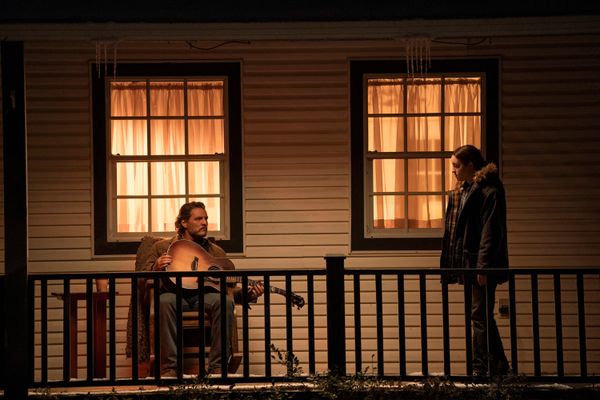
The Last of Us, a postapocalyptic TV series based on a 2013 video game franchise, is set two decades into a pandemic that collapsed society and turned infected humans into zombie-like creatures.
Photo by Liane Hentscher/HBO
Even when the fictional postapocalyptic home isn’t buried underground, it will usually be housed in concrete—modernity’s most durable material. That’s true in Silo, as well as in The Last of Us (2023-present), where government-run cities are carved from concrete and the architecture, like the governance, is severe. Here, home is simultaneously savior and enemy. Walled cities are almost always the site of draconian politics.
In The Last of Us, based on the namesake 2013 video game, the alternative to a life lived in a military-run quarantine zone is the risky endeavor of sheltering in a traditional but crumbling home (often farmhouse style) that is perpetually vulnerable to the threats of a zombie-infested post-outbreak America. Living in the wreckage, the contrast suggests, is hard but there is the potential for immeasurable freedom if one can just survive. The choice is rendered in materials: freedom in the dangerous ruins or tyranny in the concrete.
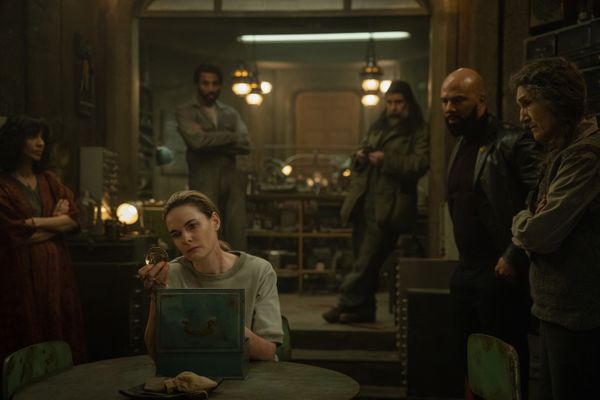
Fallout, another video game-turned-TV show, leans into the contrast between a dwelling preserved from destruction and the exterior ruins. The so-called lucky live in retrofuturistic subterranean shelters while the population aboveground wars over scraps. The concrete-and-steel structure of the bunker is a stark contrast to the midcentury-modern interiors filled with the warm natural woods, Sputnik chandeliers, and colorful furnishings and wallpaper that fixes the end of the world in the Atomic Age. On the surface, hideously mutated survivors have learned to live in what’s left of Los Angeles, salvaging modernity’s scraps to create livable spaces.
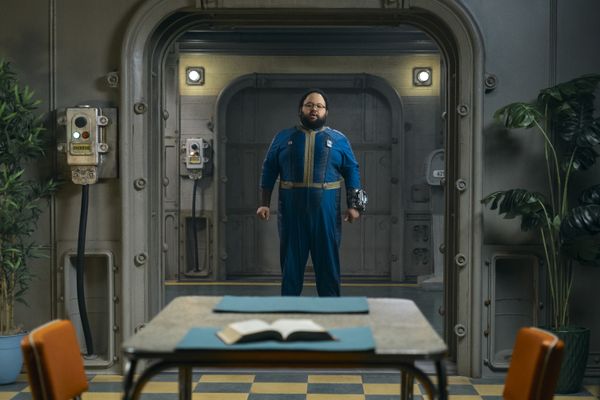
Like the video game franchise it’s based on, the Fallout TV series takes inspiration from postwar culture of the 1950s United States in the retrofuturistic look of its underground bunker.
Photo by Lorenzo Sisti/Amazon Studios
See the full story on Dwell.com: Imagining Home at the End of the World
Related stories: