
There’s Something Ugly About Going to the Gym
If we’re so obsessed with our bodies, why don’t we care about the aesthetics of working out?
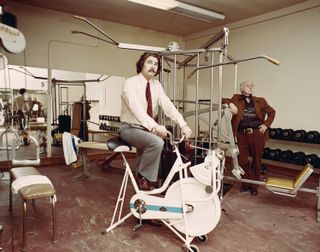
If we’re so obsessed with our bodies, why don’t we care about the aesthetics of working out?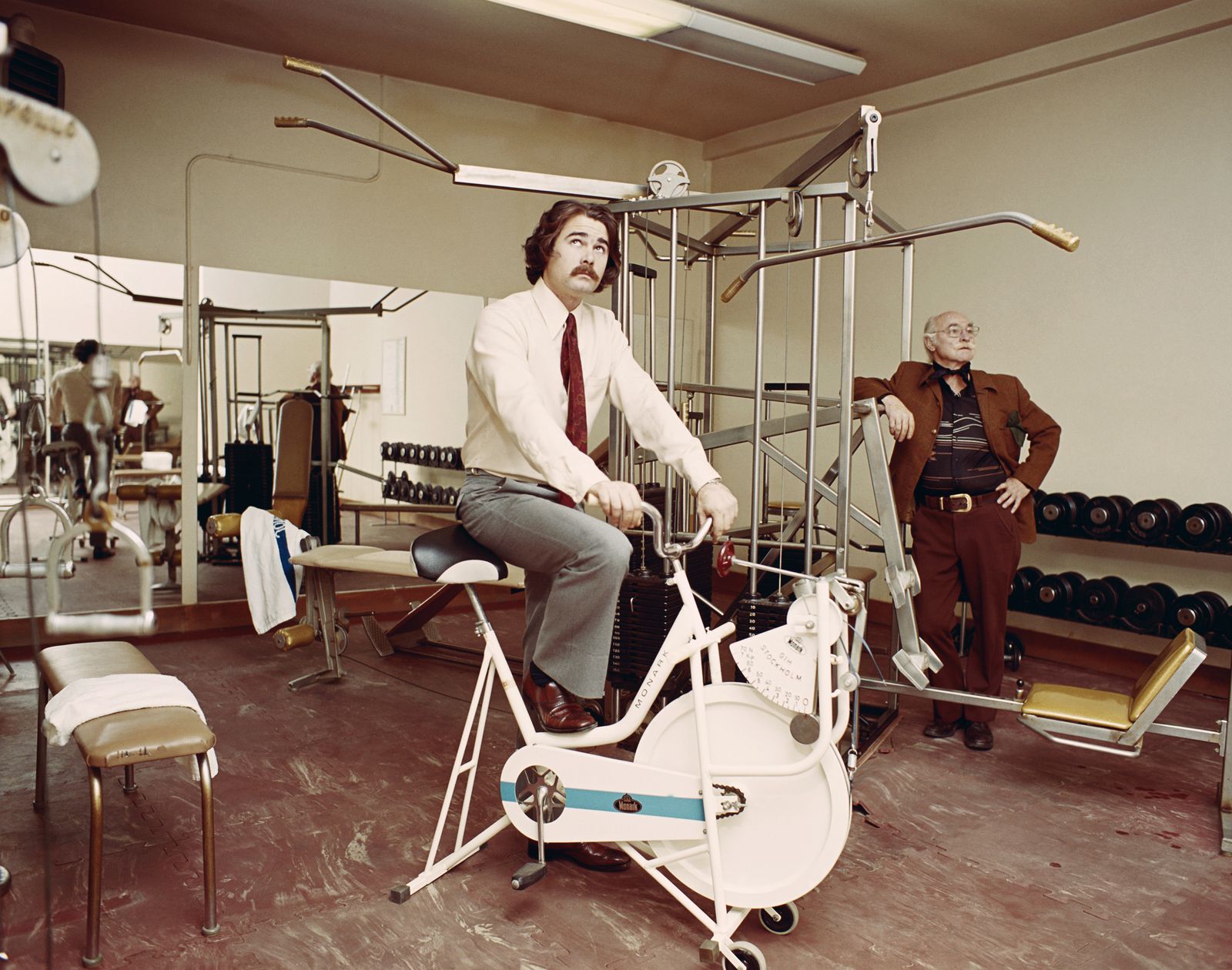
Welcome to Field Guide, a column by Sami Reiss of Snake covering all-time design and where you can find it.
Most places we work out in are hideous. If you ask me, the cavernous commercial and chain gyms that a plurality of us work out in, with claustrophobic layouts, ugly equipment, bad lighting, and scant space, and that define our fitness moment are intolerable. If you agree, you’ve likely developed avoidant behavior: an unspoken effort, beyond the workout itself, to ignore the bad music, suffer through gauntlet aisles, and deal with grotesque machines and inelegant poly-coated weights. Even if you like going to the gym, you might not like going to the gym.
And yet more Americans are working out than ever before. Over 80 million held gym memberships in 2025—up from 57.3 million in 2016—reflecting the deepening obsessions with fitness in our culture. While a decade ago being healthy may have meant laying off the fries and going for a jog, getting in shape now implies much more effort. The new conception of health pushes us to efficiently reach our absolute best, using a rise-and-grind mindset to live at the gym, take GLP-1s, protein max, and whatever else helps us reach these health goals or otherwise frame them as a virtuous, prosperous act. But how did we get here? If we’re obsessed with our bodies, why don’t we care about the aesthetics of where we work out?
Much of it goes back years. After the release of the 1977 documentary Pumping Iron, which led to more interest in bodybuilding and made Arnold Schwarzenegger a pop-culture icon, gyms went mainstream. The gyms that preceded the film, so-called "black iron" facilities, which were limited to very heavy weights for developing big body parts, were largely pushed aside by multipurpose gyms, designed for bodybuilding lite. Drawing inspiration from the legendary Gold’s Gym from the film, these gyms featured special machines for smaller muscles, and every iteration of free weight, and were more genteel and less grimy. When jogging and light cardio grew in popularity in the ’80s, the gyms became even more respectable, adding specialized cardio equipment—StairMasters, treadmills, elliptical machines—that was easier on the body and appealed to just that need. Some of the older strength training machines were elegant, even beautiful, but these new gyms were no longer minimal or focused. (Le Corbusier would not have approved.) Gyms that started as weight rooms were now massive cardio hangars. At some, you couldn’t even lift weights.
In the following years, gyms would specialize and evolve. But in the past decade, things swung back the other way. A surge of interest in pre–Pumping Iron ways of lifting, spurred on by social media and CrossFit, has made lifting in an all-purpose gym a pain in the ass. These gyms are big but not so big that there are never lines at the squat rack, and the glut of machines, for some lifters, is not sufficiently specific. (One example is a reverse hyper machine, a contraption originally used by power lifters to target the hamstrings, glutes, and lower back muscles without straining the spine. It’s an excellent fix for nagging back pain and would help many gym goers, but it’s rarely on a commercial gym floor.)
As we’ve evolved our lifting knowledge to recognize the efficacy of different forms of training, from black iron work to strength machines to, yes, cardio, it has become clear that some commercial gyms are better than others. To someone on an Arnold-era bodybuilding program, a multifunctional gym is a great buffet, but for a heavy lifter, it just gets the job done, while being ugly, overstuffed, and mostly inadequate. To be sure, for someone who’s not there all the time, the commercial gym compromise is still reasonable: A modest membership fee and convenience grants access to many machines and all sorts of weights. But if you’re like me, you still have to ignore everything else in the room, which gets harder the more you’re there.
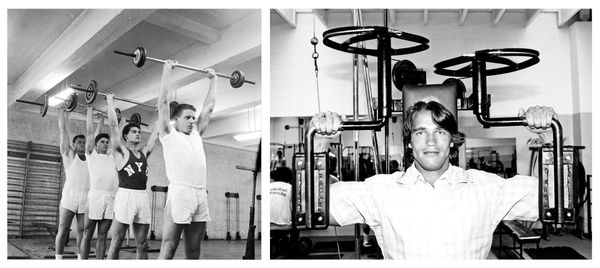
Before Arnold Schwarzenegger starred in Pumping Iron, gyms were largely "black iron" facilities.
Photos (from left): Jacobsen /Three Lions/Getty Images; Elisa Leonelli/Shutterstock
Since the pandemic, attendance among gym members has actually gone down. The ugliness of a commercial gym is enough to keep me away, and it could be for you, too. But it also so happens that most of the alternatives, to my eye, are much more pleasant aesthetically. One is to get exercise equipment you actually like, or can hide, and work out at home.
If you have the space, it’s terrific, though in cities where space is a premium, doing so can be tough. I tracked down, for my home gym—actually a nook abutting my kitchen—an old Schwinn stationary bike I’d been obsessed with for years. Named the Airdyne, and introduced in the late ’70s, it’s a fascinating piece and a technological and design achievement. Fan blades on the wheel increase the resistance of pedals and arm levers the faster you move, offering a full-body workout, the first bike with this technology. It’s also a genuine design piece. Older models are lithe, made of steel, and have decals with pops of color and almost Deco angles. It’s in dialogue, to me, with early Dyson appliances from around then. It’s a great workout, but it’s also the opposite of avoidant: a bike that looks so good it invites you to ride.
The ugliness of a commercial gym is enough to keep me away, and it could be for you, too.
Those with more space can go beyond a nook to a home gym proper. At least one recent survey shows one in five people has a home gym; sales of home-specific equipment more than doubled in 2020 and the market is still growing. Most of this gear isn’t designed for aesthetics, though there might be a beautiful piece among the options. For the most part, the home gyms highlighted by Garage Gym Reviews, a YouTube and Instagram account highlighting people’s builds, are based on individual needs. Indeed, if choosing between a $500 minimal weight bench/pull up bar setup and a $50,000 storage container build, the top-of-the-line gym usually looks worse. It tends to feel more cramped than a commercial gym and outfitted with complicated, multifunctional machines. Nothing is simple: squat racks hide away and columns have umpteen attachments and rings. I wouldn’t say no to having one—Corbu rules aside, such gyms are convenient—but I’d keep it hidden.
Working out in a dedicated facility, like a yoga or Pilates studio, has been an option for the last few decades, and in the past couple of years, bookings for such classes have only grown. Then there are run clubs, which saw a 59 percent uptick in participation in 2024, according to fitness app data. Doing either of these feels completely different from checking in at a gym. In a Pilates class you’ll strengthen your core and build muscular endurance but usually without fluorescent lights and in a calm, minimal room. Running outside is running outside; there’s a similar appeal to the black iron gyms in the singularity of focus. A chain gym will renovate with rows of new equipment to attract new members, but they can still turn a profit if no one comes. But at a black iron gym you’re only there for one thing. It’s not for everyone, though it does serve its members.
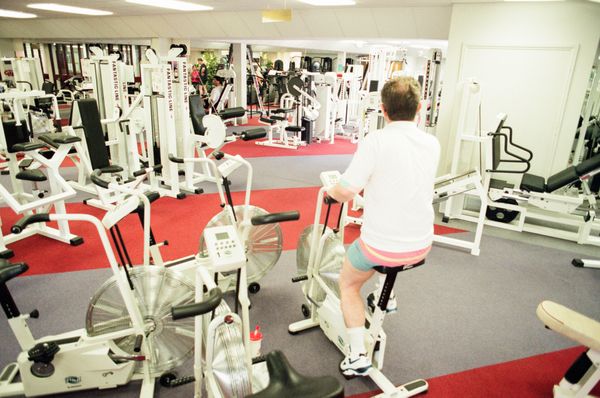
In the decades that followed, fitness became defined by commercial gyms overstuffed with gear.
Photo by Michelle Maddison/Mirrorpix/Getty Images
If you have lots of cash, there is gym equipment that focuses more on design—albeit a specific, moneyed and minimal aesthetic. One good example is Pent. A luxury outfitter from Poland, it specializes in Hermès-styled pieces, offers a leather weight bench for $4,625, and is building out a gym at the Ritz-Carlton Naples. According to its website, Pent. makes "the most exquisite fitness equipment you’ve ever seen," and if you’ve seen it, you likely saw it on Instagram. The equipment is standard—treadmills, medicine balls, lightish weights—in wood, leather, and stainless steel, an aesthetic that hints at classic luxury sporting goods or, more simply, Louis Vuitton steamer trunks. The weights don’t get very heavy, though they’re heavy enough for Norwegian soccer superstar Erling Haaland’s private gym.
The good news is those who care both about breaking a sweat and design don’t have to spend their nest egg, suffer bleak chain gyms, or spend every other minute on Facebook Marketplace. There are, here and there, normal pieces of workout equipment that just happen to look good. Minimal gear like gymnastics rings are aesthetic neutral and offer excellent, if challenging, workouts. (The sculptor Adaline Kent kept rings in her studio.) And newer, more high-tech exercise bikes can be just as satisfying—and punishing—as an Airdyne. One option I really like is the Zwift. It "games" bike riding: There’s no instructor; you can race online against your friends. It also looks good. The Ride model, which I own, has a rear wheel and an angled front column that gives off a challenging ’70s Italian look. If I’m being generous, it feels like a napkin sketch by Giorgetto Giugiaro, the future-scraping Car Designer of the Century, who designed, among other masterpieces, BMW’s M1. It’s all very futuristic and clean.
Can it be that way for gyms? It is sometimes. Here and there a new-school gym—and an odd old one—will get it right and offer a superior workout experience. Gyms like 613LIFT, in Ottawa, Ontario, which is about a decade old, and Dublin’s Hercules Club, founded 1935, are good examples of this singularity of purpose. 613LIFT, for example, where I’ve lifted, is a snug space with an impressive amount of gear that has a unified aesthetic and purpose. The machines look good; many are red; and there’s just enough space for lifters to move between them. And there’s still plenty of room in the gym to chat with other lifters between sets. Such gyms service lots of customers without being too visually busy. The clutter here is part of the function: keeping active members satisfied.
These places seem to be the exception. Despite the comprehensive fitness moment we’re in, the legacy of unhelpful chain gyms still defines the landscape. It’s surprising that for all the attention paid to aesthetics in the health space, the gyms out there are so ugly. But if a gym’s jumbled aesthetic ever gets in the way of your workout, you can always look for a diamond in the rough or just hop on a bike.
Top photo: Archive Photos/Stringer Via Getty Images
—